8 min read
An integrator SLA matters more when downtime is costly
Learn when an integrator SLA matters more than a warranty, covering response, recovery, local parts, replacement devices, and liability.
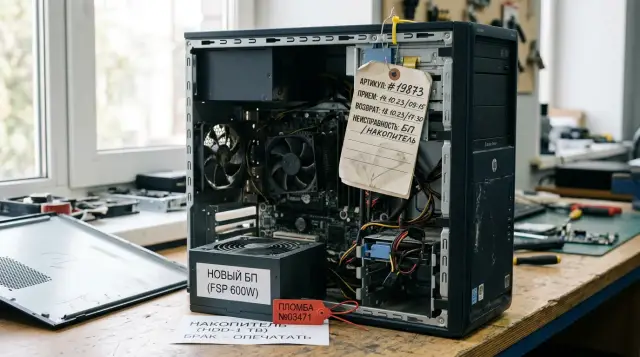
A manufacturer warranty protects the buyer from the cost of defective equipment. It almost never protects the business from the cost of a workstation that has stopped working. If a checkout cannot take payments, a doctor cannot view scans, a dispatcher has lost access to a system, or an engineer cannot open a project, a free part replacement several days later is still a good warranty and a bad continuity plan.
When downtime is expensive, buy a promise to restore work, not a promise to repair the device eventually. An integrator usually puts that promise in an SLA, but the document's name guarantees nothing. A workable SLA specifies when the clock starts, the restoration target, where parts are stored, how a replacement is issued, the limits of responsibility, and the financial consequence of a breach. Anything less can become a report showing how quickly the provider answered an email.
Warranties and SLAs cover different losses
A warranty answers who pays to correct a manufacturing defect. An SLA answers a different question: who will return a working service to the user, and by when. Both obligations can apply at the same time, but they cover different outcomes.
Under a warranty, the manufacturer or an authorized service provider usually diagnoses the device, confirms that the case qualifies, and repairs it or replaces a component. Timing depends on the warranty terms, service availability, logistics, and the diagnostic result. The provider can meet every warranty obligation while the employee remains without a computer throughout the process.
An SLA should cover a working workstation of a defined class, rather than the serial number of one system unit. The provider can then use the fastest approved method: replace a power supply, move a drive under an agreed procedure, issue a prepared replacement, or deploy the user's profile on a spare machine. Warranty repair of the original device can continue after the employee is back at work.
Buyers often blur four separate outcomes: accepting the request, starting diagnosis, temporary restoration, and final repair. If a procurement document calls all four «support», the provider and customer may sign the same text while expecting opposite results. Temporary restoration has its own value for critical roles. It stops business losses before the warranty process ends.
The warranty is still necessary. Without it, the customer pays for defective components and argues about the service life of every part. Yet high downtime costs make a warranty the base layer of protection, with a service contract above it.
The cost of an hour sets the service level
Choose a service level after calculating the losses. Otherwise, procurement argues about a discount on the SLA and misses the price of the outage itself. Calculate the consequences for the specific role, not the price of the computer.
Start with one type of workstation and one plausible incident. For a cashier, the cost includes lost margin while the checkout is closed, a queue, manual reconciliation, and overtime after recovery. For a designer or engineer, add idle colleagues, delayed approval, and a possible shift in the production schedule. For a doctor, the clinical process sets the consequences, so a monetary figure cannot replace safety requirements and a maximum interruption time.
A practical formula looks like this:
Потери за инцидент = часы простоя × потери процесса в час
                    + труд на обходной процесс
                    + труд на восстановление данных и очереди
                    + договорные последствия задержки
Do not present a department's assumed profit as an exact hourly cost. A range is more honest than one polished number. Calculate conservative, expected, and severe cases, then compare the annual difference between service levels with the expected losses. Even without failure statistics, the decision threshold becomes visible: if a faster SLA costs an extra 3 million tenge per year and one avoided six-hour outage saves 4 million, the debate about probability now has concrete bounds.
Separate the fleet by impact on the process. A regular office employee may be adequately covered by a warranty and an internal spare on the same floor. A workstation used by an operator, cashier, doctor, dispatcher, or engineer needs a restoration target that the process can tolerate. Do not buy the same expensive SLA for every keyboard merely to simplify the specification.
Do not substitute average monthly availability for acceptable downtime. A 99.9 percent figure may look persuasive, but it says nothing about how interruptions are distributed: several short outages and one long failure can produce the same arithmetic and very different consequences for a shift. For workstations, specify the maximum duration of one incident, the acceptable number of recurrences, and a separate rule for a mass failure. Monthly availability can remain a reporting metric, but it should not be the contract's only target.
Check the budget across the full service life. The SLA price includes on-call coverage, inventory, logistics, replacement preparation, and supplier risk, so comparing it only with the cost of one spare part makes no sense. Compare three options: your own spares and internal team, an on-site warranty without a restoration target, and an integrator with a measurable SLA. Add training, storage, image updates, and incident management. An internal arrangement may win at headquarters while branches still need an integrator's service. The contract can reflect that difference.
Include the available workarounds in the calculation. If an employee can safely move to the next computer in ten minutes, round-the-clock dispatch adds little. If the profile, license, peripherals, and network access are bound to one station, a spare box alone will not restore work. The cost of downtime shows both the speed you need and the part of recovery worth buying from a provider.
Response is not restoration
A response target measures how quickly the provider acknowledges a request or starts work. It does not promise that the user can perform the task again. «Response within 15 minutes» may end with a message saying «incident accepted», followed by a full day of diagnosis.
The contract needs separate targets for four events: registration, qualification, arrival when required, and restoration. For costly downtime, the most useful measure is often called the service restoration time. Its clock stops when the workstation reaches the agreed state, not when someone closes a ticket: the user signs in, opens the required application, sees the data, and verifies mandatory peripherals.
Define the calendar for each clock. Four hours under an 8 by 5 schedule and four elapsed hours produce very different results after a Friday evening failure. State the time zone, public holiday rules, handling outside a shift, and site categories. «During the customer's business hours» is not enough if the branch, service desk, and head office use different schedules.
Specify pauses. The provider may stop the clock while waiting for physical access, an account, or a customer decision, but each pause needs a reason, a start time, and a notification. Do not allow the SLA to stop for information that the engineer could have collected during initial registration. Otherwise, the first question about a serial number can turn a four-hour commitment into an open-ended one.
Priorities hide another trap. If only the service desk assigns severity, a broad outage can receive medium priority because electrical power technically remains available. The matrix should consider impact and urgency: how many users have stopped, which process is unavailable, whether a tested workaround exists, and when irreversible harm begins. The customer's right to raise priority also needs a procedure, or it will become an argument during the incident.
Separate temporary restoration from final resolution. A replacement can return the user to work within an hour while the manufacturer investigates a failed board for a week. The restoration clock stops at that point, but the incident does not necessarily close: returning the original device, moving data back, and replenishing the spare each need a separate target. Without one, the provider can satisfy the fast metric while leaving the customer with permanently depleted reserve stock.
Acceptance criteria must test the role itself. «The equipment turns on» may be adequate for a system unit repair, but not for a workstation. Name who confirms the result, how much time that person has, and what happens if the user is unavailable. During a night shift, the duty manager might confirm recovery with a short script. Do not treat a user's silence as automatic acceptance when the service desk has neither performed the tests nor attached the results.
ISO/IEC 20000-1 requires services to be managed against agreed requirements throughout their life cycle, instead of limiting management to equipment repair. The practical lesson for a buyer is to measure the service outcome from the user's perspective and connect the provider's internal actions to that result. A provider's certificate may indicate a mature management system, but it cannot add a missing restoration target to your contract.
Spare parts must exist before the failure
A fast-repair promise is credible only when the parts have been positioned in advance and the logistics are clear. «Parts are available» says nothing about quantity, storage location, compatibility, or authority to use them without another approval.
Ask for the list of components the provider holds locally for your fleet: power supplies, drives, memory, system boards, displays, and specialized adapters. Each line needs a minimum quantity, replenishment time, and compatible models. Inventory changes, so the contract should require a regular report or a right to spot-check it, not a photograph of the warehouse before the tender.
Confirm who owns the reserve and who has a claim on it. A part in shared inventory may appear in service plans for several customers at once. That is invisible during a single failure, but a defective batch or power incident creates a queue immediately. Dedicated stock costs more, but the provider cannot send it to someone else's ticket. Shared stock can also work if the contract defines planned capacity, allocation priority, and an emergency replenishment target.
Some parts become obsolete before the fleet reaches the end of its planned service life. After a model update, the manufacturer may continue warranty support while a rare board takes longer to arrive from another region than the allowed interruption. The integrator can address this with local inventory, approved donor devices, or a full replacement. The customer should authorize acceptable options in advance, or the engineer will wait for a signature while the SLA clock is already running.
Having the part does not mean it is ready to install. A drive raises questions about encryption, the system image, destruction or return of the failed medium, and access to backup data. A system board replacement may require license reactivation or security setup. Replacing a component in an all-in-one can take longer than swapping the entire device. These dependencies belong in the recovery plan, not in comments on the first incident.
Check the geography. «A warehouse in Kazakhstan» does not set a delivery time for a particular branch. The SLA needs a site table with service class, dispatch time, delivery method, and weather or transport exceptions. If a remote site cannot honestly be restored within four hours, keep a replacement kit there and train a responsible employee to reconnect the cables safely by following instructions.
A replacement restores work faster than a repair
A replacement device helps only when it has been prepared for the user's role. A sealed computer in storage rarely restores a workstation within the stated target: it still needs an image, updates, an account, security policies, applications, licenses, data, and tested peripherals.
Describe an equivalence class instead of demanding the same model down to the last part number. An office workstation needs compatibility with the image and peripherals. A designer or engineer needs the right processor and graphics performance, memory capacity, monitor resolution, and application license. An operator may need specific ports, a reader, or a serial interface. A replacement that boots but cannot perform the production task does not count as restoration.
Separate cold and hot spares. A cold spare is stored as equipment and needs deployment. A hot replacement receives regular updates, powers on, passes policy checks, and is ready to accept a profile. The second option costs more to maintain, but its return-to-work time can be tested in a drill.
Set rules for data. The provider must not copy a user's profile to an engineer's personal drive or leave data on the replacement after it is returned. The contract should state the approved transfer method, the data owner's involvement, an operation log, and device wiping. If data cannot leave the site, that changes the repair route: the failed drive stays with the customer, and the warranty claim must proceed without it or under a separate procedure.
Finally, assign an owner and a test cycle for the reserve. Who replaces batteries, updates the image, renews licenses, and returns the replacement after repair? Without an answer, spare fleets gradually become museums of devices with flat batteries. A monthly automated check is not always necessary, but powering on quarterly and testing a standard role usually costs less than one failed recovery.
Liability starts with precise boundaries
Financial liability works only when a breach can be proved unambiguously. A penalty «for failure to meet the SLA» is weak when the schedule does not define the clock, trigger event, permitted pauses, and restoration criterion.
Article 293 of the Civil Code of the Republic of Kazakhstan defines a penalty as an amount established by law or contract for a failure or improper performance, including delay. A creditor does not need to prove actual loss when claiming the penalty. That makes a pre-agreed charge easier to apply than arguing over the entire cost of downtime, but a lawyer should review the wording and liability limits for the specific procurement.
Do not confuse a service credit with damages. A credit usually reduces a future support payment. It creates an incentive for the provider, but it does not cover the stopped process. Damages require evidence and causation, and the contract often caps them. Article 351 of the Code connects damages and penalties and permits different contractual models for recovery, so the existence of a penalty does not automatically preserve a right to recover every other amount.
A sensible model ties the consequence to the severity and duration of the breach. A response that is five minutes late and a failure to restore service for a full day should not cost the same. An unlimited penalty, however, scares providers into pricing the risk or contesting every priority. A reasonable liability cap should come with a right to terminate after repeated failures and an obligation to provide a corrective plan.
Exceptions also need narrow definitions. Force majeure, a site made inaccessible by the customer, and unsupported third-party work can be described in verifiable terms. «Other circumstances outside the provider's control» allows almost any supply delay to become an exception. The customer is buying local stock precisely to transfer supply-chain risk, so ordinary part unavailability should not automatically release the integrator.
Define one evidence base: the service system log, access-control records, device telemetry, the replacement handover form, and user confirmation. If the provider's clock differs from the customer's, specify the authoritative time source. A dispute that cannot be settled from the log within one business day will return after every serious incident.
The contract schedule must be executable
A good SLA reads like instructions for the person on duty, not a sales promise. Teams can test it against a fictional incident without spoken explanations. Remove marketing language from the schedule and keep measurable commitments.
A minimum record for one workstation class might look like this:
service_class: critical_workplace
coverage: 24x7
start_event: ticket_registered_by_service_desk
response_target: 15m
restore_target: 4h
restored_when:
  - user_authenticates
  - required_application_opens
  - assigned_peripherals_pass_test
clock_pauses:
  - site_access_denied_and_logged
  - customer_approval_required_and_logged
replacement:
  location: customer_site
  readiness_test: quarterly
parts_report: monthly
breach_evidence: service_log_plus_customer_confirmation
This fragment does not replace legal drafting. It shows which fields must survive negotiation. For each workstation class, add the mandatory applications and peripherals, sites, coverage window, contact path, security rules, and consequences.
Create a responsibility matrix separately. The manufacturer confirms warranty eligibility and provides parts under its own terms. The integrator accepts the request, diagnoses the fault, holds the agreed reserve, restores the workstation, and manages the warranty route. Internal IT provides access, manages accounts, and confirms the business application. The process owner assigns priority and accepts a workaround. When one line has two owners, it often has none during an incident.
Require one end-to-end incident number even when the integrator opens a separate manufacturer ticket. The user should not coordinate two service desks or repeat the diagnosis. The party that signed the service contract with the customer remains responsible for the SLA; its relationship with the manufacturer stays inside its supply chain unless the contract explicitly says otherwise.
State how the fleet changes. New models, office moves, and retirement alter the required parts and replacement inventory. Without a monthly register, the provider may reasonably say a new device was never included in its resource plan. The register should contain model, serial number, site, service class, inclusion date, and removal date.
Tie payment to acceptance of the report, but do not turn the customer into a hunter of every breach. The service system should calculate clocks under the approved rules and flag missed targets automatically. The customer reviews exceptions and a sample of incidents before both parties approve the report. If a service credit applies only after a separate claim within two days, bureaucracy will erase most breaches. Automatic calculation makes the cost of failure predictable for both sides.
Add an exit process. When the integrator changes, the customer needs a current equipment register, fault history, customer-owned parts, images, instructions, and open warranty cases. Set the transfer format and deadline, plus an obligation to keep providing service during the transition window. Otherwise, the savings from a new tender begin with a period when nobody knows where the replacement is or who is waiting for a part.
Test the SLA before a real incident
A signed restoration target remains a hypothesis until both parties run a controlled incident. A drill quickly exposes a dead phone number, a locked warehouse, an expired image, a missing cable, or an employee who lacks authority to accept a replacement.
Run a test on one workstation in each critical class. Register the request through the normal channel without warning the duty team of the exact time. Do not damage a working device; simulate unavailability in an agreed, safe way. An observer records the event times, service-desk questions, issue of the replacement, user sign-in, application launch, and peripheral checks.
The test needs a log-based review, not a general verdict that «it went well». Compare the actual sequence with the contract. If the engineer restores the station on time but breaks the drive-handling rule, the security part of the test has failed. If the replacement is ready but network access takes six hours, fix the customer's internal process instead of penalizing the provider.
Record the initial state before the drill. The image version, application list, connected peripherals, account state, and network segment should be known, or the dispute will shift to whether the workstation ever worked. At the end, retain the event log and actual evidence for every critical acceptance criterion. This package becomes a model for a real incident and shows the service desk the quality of records the customer expects.
Test more than the happy path. On one occasion, make the site inaccessible; on another, refuse to release the storage medium; then simulate a mass failure of several identical workstations. The last case shows the depth of the reserve: one replacement computer produces an impressive result for a single failure but cannot save a branch after a power surge.
Set the frequency according to the pace of change. A stable office fleet may need one full annual drill and a quarterly replacement check. Repeat the affected test after changing the image, endpoint protection policy, business application, or network architecture. The report should end with an owner and deadline for every gap, or the next drill will find the same locked cabinet.
Buy the warranty as a base and the SLA for continuity
A warranty alone is sufficient where downtime is inexpensive, an internal reserve exists, and IT can quickly restore the profile, applications, and access. In that case, an expanded service layer may cost more than the loss it prevents. The money is better spent on several compatible spare devices and a tested issue procedure.
An integrator SLA is necessary where the permitted interruption is shorter than the normal warranty route, sites are distributed, configurations differ, or the internal team cannot provide on-call coverage and hold parts. Buy it for selected roles, not for the entire inventory. The most expensive package cannot make up for a vague restoration criterion.
A mixed model also works: the manufacturer bears warranty costs, the integrator provides the first line, local parts, and replacements, while the customer manages profiles and business applications. It often gives better cost control, but it needs an honest responsibility matrix. Every gap between «the hardware works» and «the employee works» must belong to a named party.
GSE manufactures workstations in Kazakhstan and combines equipment delivery with systems integration, 24/7 technical support, and a nationwide service network, so buyers can discuss the warranty route and workstation restoration within one chain of responsibility. The customer still has to specify targets, inventory, replacement rules, boundaries, and consequences for its fleet: a provider's capabilities do not replace a contract schedule.
During negotiation, ask the provider one awkward question: «What exactly happens between a 02:00 call and the user's confirmed return to work at 06:00?» If the answer cannot be mapped to people, inventory, actions, and timestamps, you are buying hope. The warranty will pay for a future repair, but today's downtime remains yours.
Frequently asked questions
Can an extended manufacturer warranty replace an SLA?
It can if the customer has its own reserve and a team that restores profiles, applications, and access faster than warranty repair. An extended warranty reduces spending on parts, but it does not by itself promise to return the business process by a set time.
What is a reasonable workstation restoration target?
There is no single reasonable target for every role. It must be shorter than the point at which downtime causes unacceptable harm, and it must reflect actual geography, working hours, and replacement readiness.
How does response time differ from resolution time?
A response confirms that the provider accepted the incident and started work. Resolution or restoration time ends only when the workstation reaches the operational state defined in the contract.
Should the integrator keep parts at the customer's site?
For remote or critical sites, local inventory often costs less than urgent delivery. The storage location depends on the required target, but the contract must name the warehouse, minimum stock, and replenishment process.
When is a replacement computer equivalent?
It is equivalent when it performs the required work with the necessary performance, applications, access, and peripherals. A matching brand or case proves nothing, while a different model may meet the requirement completely.
Can an integrator be penalized for every missed SLA?
The contract can provide a penalty or service credit if it defines the breach and calculation precisely. A lawyer should check how the consequences interact with damages, liability caps, and applicable law.
Who is responsible if the manufacturer delays a warranty part?
The integrator contract decides. If the integrator promised restoration and local stock, an ordinary delay by its supplier should not automatically transfer the risk to the customer.
Do regular office computers need an SLA?
Not always. If an employee can move quickly to a compatible spare and the interruption barely affects the process, a warranty plus an internal procedure is often better value than paid 24/7 service.
How can we test an SLA before signing or launch?
Run a safe controlled incident through the normal support channel. Measure registration, site access, replacement issue, user sign-in, application launch, and peripheral operation.
What belongs in a monthly SLA report?
Include every incident, its priority, clock timestamps, pauses, restoration method, and breaches. Add parts inventory status, replacement readiness, and open actions from reviews.
