8 min read
Registry extract for computer procurement in 2026
What a KTP Registry extract confirms in a 2026 computer procurement: document status, product codes, manufacturer identity, and supply volume.
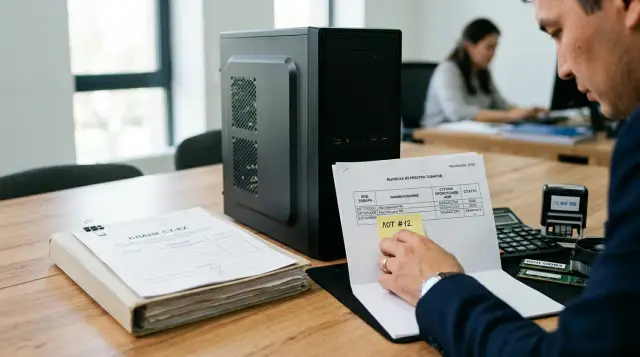
Since 1 January 2026, the Kazakh origin of a computer in regulated procurement is confirmed not by an ST-KZ certificate, but by information about the manufacturer and the specific product in the Registry of Kazakhstan Commodity Producers. The working document for a bid and the commission's review is an extract from this Registry. An old ST-KZ no longer proves origin, even if it names the same factory and a similar system unit.
An extract does not give a bid automatic admission, however. The commission must establish that it applies to the bidder or to a manufacturer permitted under the procedure, covers the exact product being procured, contains matching classification codes, and remains supported by a current Registry entry. A certificate of conformity, technical specification, dealer authorization, and Registry extract answer different questions. Mixing them up is risky: the commission may admit an imported configuration under a document for another product, or reject a proper bid for a requirement that is absent from the documentation.
ST-KZ ceased to have effect, it was not merely renamed
Law of the Republic of Kazakhstan No. 188-VIII dated 19 May 2025 changed the procedure for determining the country of origin of goods. Its transitional provision established that ST-KZ certificates ceased to have effect on 1 January 2026. This is a firm date, not the beginning of a gradual replacement of forms.
The consequence for procurement is simple. If a bid is submitted in 2026 and an admission condition requires confirmation of Kazakhstan commodity producer status or Kazakh origin through the new mechanism, the commission checks an extract from the KTP Registry. An ST-KZ from a supplier's archive does not become valid because it was issued for several years, attached to an earlier contract, or accepted by the portal in the past.
A convenient but mistaken argument often appears here: "The document was valid when issued, so it confirms the historical fact of production." It may be useful material for the company's history, but it is not the proper admission document after the date set by law. A procurement commission evaluates a bid against the current requirements of the procedure. It does not compile a biography of the factory.
The industrial certificate went through the same transition. The Ministry of Industry and Construction expressly explained that the extract replaced both ST-KZ and the industrial certificate from the beginning of 2026. Substituting one old document for another old document does not cure a bid.
An extract is required only when the procurement regime requires it
The existence of the KTP Registry does not mean that every purchase of every computer is now closed to imported goods or ordinary suppliers. The commission must first identify the legal basis for the particular procurement: the procurement method, the applicable list of exemptions from the national regime, restrictions on eligible participants, and the wording of the standard documentation.
Rules and lists changed during 2026. For that reason, the statement "all computers may be procured only from KTPs" is too broad and often wrong. The commission must check the ENS TRU code of the particular lot and the version of the regulation applicable to the notice, rather than the category name in the plan or last year's minutes from a neighboring organization.
The extract becomes an admission document when procurement is conducted among manufacturers of the purchased product, when the product is subject to a relevant exemption from the national regime, or when the applicable documentation directly connects an offer of self-produced goods with the Registry. In its 2026 notices, the public procurement portal identifies the extract issued under Order No. 327 of the Minister of Industry and Construction dated 27 August 2025 as the confirming document.
If the restriction does not apply, the commission may not invent it after bids have been opened. It checks country of origin and supplier status only to the extent prescribed by law and the documentation. A desire to buy locally made equipment must be structured correctly before proposals are accepted, otherwise a sound intention turns into an unequal condition.
The extract confirms a manufacturer-product link
Order No. 327 defines the Registry as a state information system containing information about Kazakhstan commodity producers and the goods they manufacture. An extract confirms that a producer is present in the Registry. Its evidentiary force rests on the "entity-product" link, not on a general company status.
The extract form contains a registration number, inclusion date, name of the legal entity or individual entrepreneur, BIN or IIN, and registration information. The product row identifies the Kazakhstan-origin product, OKED, the EAEU TN VED code, KP VED code, ENS TRU code, production capacity, and localization level. Special classifiers apply to certain categories.
It is not enough for the commission to see a familiar factory name in the header. It must find the row that covers the subject of the lot. An extract for "computing machines" should not be extended without review to a monitor, uninterruptible power supply, printer, or furniture set, even if the seller calls all of it a computer bundle.
The Registry also does not prove that the proposed configuration meets the customer's technical specification. It answers the question about the manufacturer and the origin of the registered product. The commission establishes compliance with processor, memory, storage, port, operating system, warranty, and delivery requirements using other information in the bid.
The name and BIN must lead to one manufacturer
The first match worth checking is the manufacturer's identity. The full name and BIN in the extract must match the bidder's details when the procedure allows only the commodity producer itself. A similar trade name, a common founder, or a letter from a corporate group does not create that match.
In practice, the error looks harmless. A trading LLP submits the bid and signs the technical specification, while the extract belongs to an affiliated factory with a different BIN. If the conditions require the manufacturer to participate, a letter stating that the companies are in the same group does not transfer KTP status between legal entities.
The position of a dealer depends on the procedure. An electronic store and some documentation may recognize official representatives of a manufacturer, but the right to supply goods and commodity producer status are not the same thing. The commission must see the proof of the relationship prescribed by the rules and confirm that the particular procurement method permits a representative to participate. The factory's extract alone does not turn the dealer into a manufacturer.
The signatory and their authority are worth checking separately. An extract does not replace a power of attorney, a decision appointing the chief executive, or other bid documents. This seems like a formality until one company attaches another company's product document without a lawful connection to it.
The product code matters more than the model's marketing name
Classification is the main error zone for computers. A lot may use the general word "computer," while the actual subject is a system unit, all-in-one, workstation, laptop, server, or a set of several independent goods. These positions may have different ENS TRU, KP VED, and EAEU TN VED codes.
The commission should start with the ENS TRU code in the notice and compare it with the product row in the extract. It should then compare the name and the other codes. A matching "8471" root is not enough if the extract and the bid describe different types of computing equipment or if the document gives a ten-digit code that does not relate to the proposed item.
The model and configuration also matter, even though the extract form does not become a catalog of every combination of processor and storage device. The manufacturer must offer a product within the registered product row and must actually perform the required operations. A supplier cannot take a finished imported laptop, apply a local label, and rely on the same enterprise's extract for desktop computers.
For a composite lot, review each independent product position. An extract for a system unit does not confirm the Kazakh origin of an imported monitor. If the documentation procures a single computer set and the applicable restriction covers several of its parts, the commission must follow the structure of the lot and the requirements of the documentation. It may not silently transfer the origin of the main unit to the whole bundle.
This distinction should be recorded in the minutes in one line: "The lot's ENS TRU code and the code and product name in the extract match," or "do not match," followed by the actual values. The phrase "the document complies" explains nothing to a reviewing authority and provides weak support for the commission's decision.
Production capacity is not warehouse stock
The extract states annual production capacity in units. This measures the manufacturer's ability to produce the declared product, not a promise that every unit is already in stock. The commission should compare it with the supply volume when the applicable rule or documentation requires that comparison.
It is a mistake to treat any capacity below the lot quantity as an automatic rejection without considering the performance period and the exact wording of the rule. It is equally mistaken to ignore an obvious gap when the procurement rules directly require sufficient capacity or volume. The decision must rest on the cited basis, unit of measure, and product row, not on the commission members' impression.
For example, a lot requires 600 system units and the extract shows 200 units per year. A supplier's letter promising to engage a contractor does not increase the manufacturer's registered capacity and may conflict with the condition that goods be self-produced. If the extract shows 2,000 units per year, that resolves only the capacity question. Delivery time, component availability, and configuration compliance still require separate checks.
Do not add together capacities from different rows without an explanation. Capacity for all-in-ones is not added to capacity for system units, and the figures of several legal entities are not combined because they offer one trade name.
Local assembly must match the registered operations
The KTP Registry moved confirmation away from paper and toward a review of actual production. Under Order No. 327, an applicant reports the production address, equipment, premises, product codes, capacity, actual output, share of in-country value, and technological operations performed. The applicant attaches video of the process and agrees to access to the production site and monitoring.
The sector commission compares the operations against the minimum threshold set by Order No. 392 of the Minister of Industry and Construction dated 25 September 2025. For computing equipment, the box and label are not what matters. The actual production process matters: incoming inspection of components, installation of functional units, configuration, software installation, and testing in the combination required by the current table for the relevant code. Order No. 392 has already been amended during 2026, so a commission should not copy an old list of operations from an ST-KZ certificate.
The procurement commission does not repeat a factory inspection for every bid. The authorized body and the sector commission perform that assessment when the producer is included in the Registry. The procurement commission must, however, refrain from expanding the result of that assessment: an extract for one code and product type does not prove local production of every device sold under the same brand.
This is where the popular advice to "just check that the company is in the Registry" fails. It is popular because it takes a minute. It is wrong because the Registry is maintained by producer and product, while the localization level is tied to production operations. The product row must be checked, not just the enterprise card.
Registry status must be checked on the review date
An extract is a snapshot of information, while the Registry is a changing system. After a manufacturer is included, the rules provide for monitoring through digital verification at least once each quarter. The manufacturer must update changed information, and repeated failure to correct discrepancies can lead to exclusion.
A file downloaded by the supplier several months earlier therefore cannot be evaluated separately from the current entry. The commission should check the registration number and the presence of the manufacturer with the required product directly in the Registry, then preserve the result in the review materials by a method permitted within the organization. This is not an additional qualification requirement. It is a check of the authenticity and currency of the submitted evidence.
The extract generation date and the Registry inclusion date answer different questions. The first shows when the document was obtained. The second shows when Registry status began. Neither guarantees that the entry was not changed after the download.
If the portal receives the information through an integration, the commission uses the system data and records its state. If the integration is temporarily unavailable, it must not guess the status from an old ST-KZ. The commission must follow the failure procedure established by the portal and procurement rules while maintaining equal conditions for all participants.
A missing extract and an error in one require different decisions
A required extract that was not submitted at all is not the same as a discrepancy in a document that was submitted. In the first case, the commission establishes the absence of the prescribed confirmation. In the second, it must identify the field, code, or product row that does not match the bid. Using the same rejection language for both situations conceals the review process and prevents the bidder from understanding the decision.
The commission must not repair a bid with its own assumptions. Commission members may know that an enterprise genuinely assembles computers, may have seen its factory, or may have contracted with it before. That knowledge does not replace a document and system information recognized as evidence by the applicable procedure. Otherwise, a participant with a familiar name gets to supplement its bid with a reputation that the others do not have.
A different situation arises when the rules and portal architecture expressly provide for Registry information to be obtained through an integration. The system entry can then form part of the bid without a separately uploaded file if that is how the requirement is designed. The commission cannot require a paper image of the extract from one participant while accepting only automatically obtained data from another without a common legal basis. It must first determine how the document or information is supposed to enter this procedure.
A mismatch in one code cannot automatically be dismissed as a technical typo. Codes distinguish a system unit from a laptop, a server from a workstation, and a finished item from a separate component. If the bidder gives one code in the technical specification and the extract contains another, the commission may not choose the more favorable classification on the bidder’s behalf. It applies clarification rules only when clarification is permitted, does not change the subject of the offer, and is available to all participants on equal terms.
A clarification request must not become a second bid submission after the deadline. Clarifying a value already presented and bringing in missing evidence of status are often different procedural actions. The boundary depends on the procurement method and the current rules, so the commission should cite the provision permitting a request and determine in advance whether the response may change the substance of the offer. Selective requests sent to a preferred supplier will almost certainly produce a dispute.
If the producer corrects its product card in the Registry while bids are under review, the commission records which information applied when it checked and when the change appeared. A new row may matter for later procedures, but it should not silently rewrite a bid that has already been submitted. When data exchange is delayed by a technical issue, the system message, check time, and repeated result should be preserved so that a portal failure can be distinguished from an absent status.
A supplier should resolve these points before submission: download a fresh extract, compare the BIN, full product name, and codes with the notice, check capacity in the correct row, and make sure the file remains readable after upload. This is practical prevention, not ceremonial caution. The comparison catches the most expensive errors before the deadline, while the document can still be obtained again and the offer’s classification can still be corrected lawfully.
A manufacturer’s statement that it has applied for Registry inclusion is not the same as inclusion. A status of "under review," a letter confirming completion of digital verification, or a site assessment record shows a stage in the process, but does not replace the final entry and extract. The commission cannot admit a bid conditionally in the hope that the producer will obtain status by the delivery date when status is required for participation itself.
If an extract contains several similar rows, the supplier must connect its offer to the correct row without changing that row’s content. The commission compares the full set of codes and capacity for that row, rather than taking the highest figure from an adjacent item. An updated computer configuration may remain in the same product category, but that conclusion must follow from Registry information and the documentation, not from the supplier’s marketing description.
File authenticity and the scope of the file are checked separately. A correct registration number, electronic signature, or other prescribed attribute confirms that the system generated the document. It does not prove that the document covers the proposed laptop if the product row identifies a server. The commission first establishes authenticity, then content, and only then applicability to the lot.
A screenshot of search results should not be used instead of an extract when the rules require the prescribed document form. The screen may omit the BIN, full code, capacity, or inclusion date. A screenshot is useful as a record of an additional currency check, but the extract or information received by the portal in the prescribed format remains the primary evidence. The materials should show the source, date, and product row reviewed.
In the reasons for its decision, the commission should state the fact, rule, and consequence. For example: "The extract is mandatory under the documentation clause; the submitted extract contains no product with the ENS TRU code stated in the lot; the document does not confirm the origin of the offered product." This is stronger than the general conclusion "the extract is invalid," especially when the file itself is authentic and the actual problem is a product mismatch.
Certificates of conformity remain a separate check
The end of ST-KZ did not repeal technical regulation. Personal computers and their components may be subject to mandatory conformity assessment under EAEU technical regulations, including those on the safety of low-voltage equipment and electromagnetic compatibility. The particular set of documents depends on the product and its code.
A KTP Registry extract does not replace a certificate or declaration of conformity when one is mandatory. Conversely, a certificate of conformity proves compliance with technical requirements, but does not assign Kazakh origin to a product. The shared word "certificate" in procurement conversations has caused many incorrect rejections.
The commission should not demand conformity documents earlier or in greater scope than the procurement rules permit. Some information may be checked upon delivery if that is how the documentation and contract are structured. The commission must separate bid admission criteria from contract performance conditions.
Warranty, software authorization, licenses, marking, serial numbers, and acceptance documents are also checked separately. The Registry answers for the origin of the registered product. It does not promise the customer a required operating system version or confirm that the supplier will provide service in a particular district.
The review record should show how the decision was reached
A good commission leaves a trace that another specialist can verify and use to repeat the conclusion without an oral explanation. A short comparison card is enough for one lot. It can be inserted into an internal worksheet, with material discrepancies then moved to the minutes:
Лот: [номер и наименование]
Основание требования выписки: [акт, пункт документации]
Участник: [наименование, БИН]
Производитель: [наименование, БИН]
Выписка: [регистрационный номер, дата формирования]
Статус записи при проверке: [активна / сведений нет]
Товар в выписке: [наименование]
ЕНС ТРУ: [лот] = [выписка]
КП ВЭД: [заявка] = [выписка]
ТН ВЭД ЕАЭС: [заявка] = [выписка]
Количество лота: [единиц]
Мощность по строке выписки: [единиц в год]
Результат: [соответствует / не соответствует]
Мотив: [конкретное совпадение или расхождение]
It is sensible to keep the review sequence consistent:
- Identify the rule that makes an extract necessary for the lot.
- Compare the bidder, manufacturer, BIN, and whether representation is permitted.
- Match the product name and every applicable code.
- Check the active Registry entry, capacity, and localization level to the required extent.
- Assess the technical specification and conformity documents separately.
Do not add assumptions about the origin of components to the minutes. If the extract confirms the registered final product, the commission relies on it within the established limits. If the row does not match, the supplier's letter about "mostly local assembly" does not fill the gap.
Three bids can look alike and require different decisions
The first bid attached an ST-KZ for system units issued before 2026, but did not provide an extract. If the documentation lawfully requires the extract, the old certificate does not replace it. The commission should cite the absence of proper confirmation under the specific clause, rather than write the vague statement "no domestic origin."
The second bid attached a current extract for a desktop computer manufacturer but offers laptops. The BIN matches and the brand is the same, but the product row and codes differ. The document does not cover the offer. Asking the commission to treat a laptop as a type of any computer would transfer to it the powers of the authority that maintains the Registry.
The third bid offers system units and the name, codes, manufacturer, and capacity all match. In this case, the commission moves on to the configuration characteristics and the other documents without requesting an additional ST-KZ "to be safe." Double confirmation with an old and a new document does not make the decision more lawful.
When selecting equipment, it is useful for the customer to request the extract's product row during market research. GSE manufactures L200 desktop computers, M200 all-in-ones, and S200 servers in Kazakhstan, but the commission must still check a current extract for the particular product type and its codes. Manufacturer status cannot be replaced by model recognition.
The documents should be reconciled before the technical specification is published. If the lot code describes one product, the characteristics describe another, and the expected extract describes a third product row, the commission will face a dispute that cannot be corrected fairly after bids are received. In 2026, the correct question is not "Does the supplier have an ST-KZ?" It is "Which current Registry entry confirms this exact product, and on what basis is it required in this procurement?"
Frequently asked questions
Is an ST-KZ certificate issued before 2026 still valid?
It ceased to have effect for confirmation of Kazakh origin under the new procedure on 1 January 2026. An archived certificate does not replace a KTP Registry extract, even if the date printed on the form ends later.
Can a bid be admitted on ST-KZ if no extract is attached?
If the applicable documentation requires an extract, admission on an ST-KZ alone is improper. The commission should cite the specific requirement and record that the proper document is absent.
Is a KTP Registry extract required for every computer procurement?
No. The requirement depends on the procurement method, product code, current exemption from the national regime, and documentation terms. The particular lot must be checked, not the general word "computers."
What exactly does a KTP Registry extract confirm?
It confirms that a particular producer is included in the Registry for the stated Kazakhstan-origin product. It does not prove compliance with every technical specification or replace mandatory conformity documents.
May a dealer attach the manufacturer's extract?
Only if the applicable procedure permits an official representative to participate and the relationship with the manufacturer is proven in the prescribed way. A factory extract does not turn a trading company with a different BIN into a commodity producer.
Which codes should be checked in a computer extract?
First compare the lot's ENS TRU code, then the KP VED and EAEU TN VED codes when they apply to the review. The product name must confirm the same item, not an adjacent category of equipment.
Does an extract for a system unit confirm the origin of a monitor?
No, if the monitor is a separate product and the relevant Registry row does not cover it. Origin of one part of a bundle cannot be silently transferred to the other positions.
Must production capacity in the extract be checked?
Yes, when the applicable rule or documentation connects the supply volume with manufacturer capacity. The comparison is made against the correct product row, unit, and period without combining unrelated product types.
Does the extract replace a computer certificate of conformity?
No. The extract confirms the origin of the registered product, while a certificate or declaration of conformity proves compliance with technical requirements. The commission reviews each document for its own purpose.
How can the commission check that an extract is current?
It should compare the registration number, manufacturer, and product against the current Registry entry on the review date. An older downloaded file does not show a later exclusion of the manufacturer or a change to product information.
