8 min read
Kazakh origin does not always grant computer tender access
Learn when Kazakh origin for computers restricts tender access and which registries and records public buyers check in 2026.
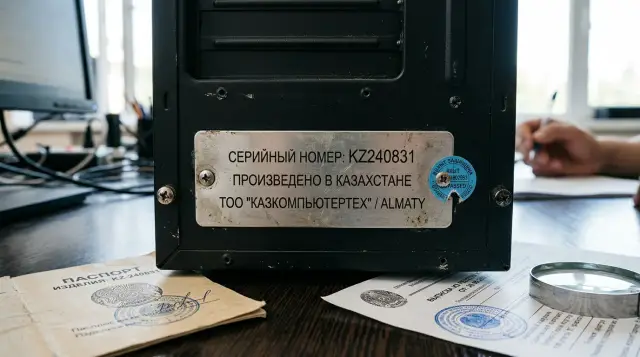
Assembly in Kazakhstan creates an advantage in public procurement only when the legal rules for a particular lot tie admission or evaluation to local production. A "Made in Kazakhstan" label on the case, an old certificate, and the supplier's registration in the country do not create that advantage by themselves.
On 28 July 2026, the review must start with neither the computer brand nor the manufacturer's advertising claim. First check the KTRU code in the plan and notice, then the current national treatment exemption and its published list, and finally the entry for the manufacturer and product in the required register. If one link does not match, the commission cannot infer origin from an invoice or a photograph of a factory floor.
An exemption restricts admission, while origin proves the right to enter
A national treatment exemption changes the pool of participants rather than merely giving a local computer a few notional points. Article 9 of the current Law of the Republic of Kazakhstan On Public Procurement allows the Government to close selected procurements to foreign goods temporarily to protect the domestic market and support Kazakh producers. National treatment remains the default rule, and an exemption works as a specifically enacted exception.
These concepts are often blurred. A "Kazakh supplier" is a legal entity or sole proprietor registered in Kazakhstan. A "product of Kazakh origin" is a particular product made in the country that meets the prescribed production and technological operations. A "Kazakh producer" is a manufacturer whose company and particular product entry appear in the state register. A dealer for a local factory does not become the manufacturer, and a Kazakh company that imports finished system units does not turn them into local goods by replacing the packaging.
When an exemption is active, the Public Procurement Rules approved by Order No. 687 of the Minister of Finance provide for procurement among persons listed in the Register of Kazakh Producers or, for the relevant electronic products and software, in the Register of Trusted Software and Electronic Industry Products. The portal checks this automatically against data from the competent authorities. The right to submit a bid therefore depends on the digital record, not on how persuasive an attached letter sounds.
Producer support can also apply in a procurement without closed admission. For example, the current Rules link certain evaluation and contract performance terms to matching register data. That is a different mechanism. A buyer should not call every support measure an "exemption," and a supplier should not expect a closed tender merely because its product is local.
The KTRU code and notice date matter more than the product name
The buyer must check the exact KTRU code and the state of the list on the date of the procedure. The words "computer," "workstation," "server," or "all-in-one" are too broad. Similar devices have different codes, and exemption lists change with government resolutions and ministerial orders.
In 2024, Government Resolution No. 207 applied to electronic industry products, while other temporary acts covered several categories of industrial goods. The public procurement portal now marks Resolution No. 207 as no longer in force. Resolution No. 447 remained effective through 6 July 2026. A buyer cannot cite either act in a new notice after its expiry simply because an older tender with the same title was previously limited to domestic producers.
Government Resolution No. 314 has applied since 9 May 2026. It establishes exemptions for listed products in the mechanical engineering, chemical, metallurgical, construction, and furniture industries when such products are made in Kazakhstan. The resolution identifies industries, while the list of codes sent to the portal defines the working scope. The portal announced an update to this list on 4 June 2026. For computer equipment, open the current list and find the full lot code instead of drawing a conclusion from the phrase "mechanical engineering."
This is the minimum review that a procurement team can reproduce:
- Copy the full KTRU code from the approved plan item.
- Find that code in the current list on the portal's "National treatment" page.
- Record the act number, its expiry date, and the exception for a product not made in Kazakhstan.
- Check which register the portal uses for admission under that code.
- Repeat the check before publishing the notice if time has passed since planning.
Save the result in a working note using the format KTRU code | act | list row | expiry | register | check date. That row is more useful than a general conclusion that the "product is local." The next employee can reproduce the finding, and internal control can see its legal basis.
The two registers answer different questions
The Register of Kazakh Producers confirms the producer and the products it makes, while the Register of Trusted Software and Electronic Industry Products supports the special regime for the electronic sector. A company's presence in one list cannot automatically be carried over to the other.
The unified Register of Kazakh Producers has operated through e-Ondiris since 1 January 2026. Its rules were approved by Order No. 327 of the Minister of Industry and Construction dated 27 August 2025. They define a Kazakh product as one produced wholly in the country or processed by completing the minimum required production and technological operations. The conditions are set separately for product groups, so a building and employees do not prove the origin of every model the company sells.
A register entry contains details that allow a reviewer to match the producer's business identification number, product name, classification codes, production site, and other parameters. The competent authority conducts digital verification and subsequent monitoring. An extract shows the state of an entry, but it does not override that entry. If the producer has been removed or the relevant product details have changed, a saved PDF should not grant admission against the current system data.
The second register is published on the public procurement portal. It shows the participant, its business identification number, and the document supporting the entry. This list is not a universal register of every computer made in Kazakhstan. It applies when the legal basis and procurement code specifically lead to the trusted software or electronic industry regime.
A company may appear in both data sets. This is neither duplication nor an invitation for the supplier to choose the more convenient document. The buyer follows the verification route set by the portal and the Rules for the particular lot. If the system does not admit a bid, a letter saying that the factory is "being added" does not create legal status.
The extract must match the product, not just the company number
The buyer checks both the company name and the link between the register entry and the subject of supply. The most common error looks plausible: the producer is in the register, but the extract covers a different type of equipment, another product description, or a product outside the lot code.
For a computer, compare at least:
- the producer's business identification number and full legal name;
- the register product name and code against the lot's KTRU code;
- the model or family if the register entry distinguishes them;
- the production site address and current entry status;
- production capacity or volume when those details apply to the position and contract terms.
A trademark does not settle origin. The same mark can appear on an imported device and on equipment that has completed sufficient operations in Kazakhstan. The reverse also occurs: the case and product passport carry a local mark, but the register does not contain the offered configuration. The commission cannot repair that gap by assuming that the models are "almost the same."
The manufacturer and the potential supplier must also be distinguished. Resolution No. 314 admits persons listed in the Register of Kazakh Producers. For some vehicle categories, the Rules separately mention representatives, distributors, and dealers, but that exception cannot be transferred to computers without a direct rule. If the notice is restricted to producers, a routine dealer letter does not replace the required status.
A useful negative test for the buyer is simple: can an independent reviewer find the same active entry using only the business identification number and KTRU code? If not, admission rests on a document that cannot be properly verified.
The portal checks status, while the commission checks the bid
An automated register check does not relieve the commission of reading the technical specification. The portal answers the narrow question of whether the participant appears in the connected register, while the commission compares the proposed computer with the procurement requirements and bid documents.
Under the standard auction and tender documents, the supplier states the applicable standards or the functional, technical, quality, and operating characteristics, the manufacturer's name, and the place of origin. If the buyer lawfully requires a technical passport, product conformity certificate, or manufacturer letter, the participant attaches it under the documentation. When a document is issued only upon import or delivery, the Rules allow a guarantee letter promising to provide it with the goods.
A separate scanned origin extract should not be required automatically if the portal already receives register status and the documents provide no lawful basis for the file. An extra demand creates a dispute risk and may restrict participants. The buyer may still keep the verification result in the procurement file and, during review, request explanations or information from authorities and organizations within the Rules.
By acceptance, the evidence becomes unit-specific. The buyer checks markings and serial numbers, configuration, the manufacturer named in the passport, the delivery note, electronic invoice, conformity documents, warranty papers, and current register information. The records must describe the units actually delivered. An extract for a desktop computer does not cover a server, and a passport for the base model does not explain a system unit swapped after award.
The contract should connect acceptance to specific identifiers in advance: model, serial number, product code, and required records. The phrase "provide documents of Kazakh origin" is too vague, especially after the register reform.
ST-KZ and the industrial certificate are no longer the main pass
Old ST-KZ certificates and industrial certificates cannot serve as an independent pass into a 2026 procurement. Law No. 188-VIII on country-of-origin matters created a transition: those documents and the related official acts remained valid until 1 January 2026. From that date, verification moved to the digital Register of Kazakh Producers.
In practice, an old file often remains in the producer's folder and looks more official than a new electronic extract. That is a psychological trap. The document may prove a historical state of production, but it does not prove a current entry for the required position after the transition period. The buyer must check the live register, and the supplier must update its procurement file and bid templates.
ST-KZ must not be confused with origin certificates used under other legal regimes. For example, EAEU rules use information from the Eurasian Register of Industrial Products and the ST-1 document for certain procurements by member states. That is a separate verification route. A product entry in the Eurasian register does not automatically mean the company is listed in the Kazakh register under Rules No. 327, and the reverse is also true.
The National Product Catalogue is another adjacent data set used for unified product identification from 2026. Its product card includes country of origin and manufacturer information, but a catalogue card does not replace the admission decision under an exemption. The catalogue answers "what is this product," the producer register answers "who makes it in Kazakhstan and on what basis," and the exemption list answers "is this lot closed to foreign origin."
A bundle cannot hide its code and origin
Combining a computer, monitor, software, delivery, and setup into one bundle does not erase the origin of its parts. If a substantial component has a separate code and can be procured independently, the organizer must justify the technological connection. Otherwise, the bundle looks like a way to bypass admission rules or narrow competition.
Court practice shows that the risk is real. In the ruling of the administrative judicial panel dated 4 March 2026 in case No. 6003-26-00-4k/92, the court considered a procurement of 40 computers under code 262013.000.000011 with an exemption flag. The court upheld a finding of noncompliance where the proposed bundle included separate components of foreign origin and failed the terms of the restricted procurement. This finding should not become a rule that "every imported part is prohibited." Modern computers use components from different countries, and national origin depends on the prescribed operations and register entry. The supplier must, however, explain the boundaries of the registered product and must not substitute separate imported positions for it.
The popular advice to "call everything one bundle so the portal sees only the main code" is wrong for this reason. The portal does apply the flag at plan-item level, but the commission, auditors, and court examine the content of the specification. Saving a few lines in the plan can lead to cancellation of the result or a dispute at acceptance.
The buyer should separate independent goods when they do not form an indivisible functional system. A requirement for workstations can describe compatibility without artificially placing everything in one box. For a server complex, the documentation should define the system boundary, installation, software, and which positions fall within the manufacturer's confirmed product description.
The advantage disappears in four ordinary situations
Kazakh origin does not restrict competitors when the product code is absent from a current exemption list. It also does not close admission if the act expired before the new procedure. An old notice and a new tender can have different regimes even though the equipment and buyer remain the same.
The second situation appears in the resolutions themselves: the exemption does not apply to products not made in Kazakhstan. A buyer cannot invoke this clause on an oral claim. It must rely on the process and data used by the competent authority to build the list, as well as the actual absence of suitable production. A buyer cannot write an excessively narrow specification around an imported model and then declare that no local alternative exists.
The third situation follows a failed restricted procurement. Paragraph 23 of Rules No. 687 says that if the procurement fails because no bids were submitted, the following procurement is conducted by a competitive method among all potential suppliers. This is not permission to plan an import from the outset. The restricted procedure must first occur, and the ground for expanding participation must arise under the Rules.
The fourth situation concerns the subject of procurement. Integration services, equipment rental, and supply of computers use different legal structures. The local status of a computer cannot automatically cover an entire implementation contract, and the Kazakh status of an integrator cannot transfer to imported equipment. In a mixed procurement, review every component and choose a method that does not disguise goods as services.
There is also a simple procedural limit: a register entry grants a right to participate, not a guaranteed win. The producer still proves its qualifications, offers compliant equipment, provides bid security, and competes under the chosen method.
The buyer needs a review file that another person can reproduce
A proper admission decision must be reproducible from documents without calling the manufacturer. The procurement file should retain the approved plan item, the version of the list showing the code, the details of the current resolution, the result of the automated participant check, the extract or register details for the product, the technical specification, and the commission minutes.
Before publication, use a short control table:
- Subject: record the full code, name, and unit from the plan and KTRU.
- Regime: record the act, term, and list row from the "National treatment" page.
- Participant: record the business number, status, and check date from the connected register.
- Product: record the code, product description, and producer from the register entry and extract.
- Delivery: record the model, contents, serial numbers, and records from the specification and contract.
This table adds no new supplier requirements. It forces the buyer to connect existing legal grounds. An expired act in the "Regime" row becomes visible before the notice. A mismatch between the register code and lot code will not surprise the commission an hour before signing its minutes.
The supplier needs a mirror file: a current extract, a sheet for every offered configuration, a documented link between the model and registered product description, technical passports, conformity documents, and proposed unit markings. The supplier should test in advance how the portal sees its business number and status. Fixing an integration problem on the last bid day almost always happens too late.
For locally produced equipment, GSE.kz can prepare a comparison between the required configuration and its current computer, workstation, and server lines together with the applicable production information. The buyer still makes the regime and admission decision under the law, the code, and portal data.
Challenge the wrong regime before submitting a bid
A supplier should raise an incorrect exemption flag during preliminary discussion of the documents rather than wait for the admission minutes. The objection must connect the specific plan item, full KTRU code, current list, and register route. A bare statement that "the requirement restricts competition" lets the organizer reply in general terms.
A good submission uses a testable structure: the lot code is absent from the list version dated X | the cited act has expired | the portal routes the code to another register | the proposed bundle combines independent goods. Attach an export or dated screenshot of the portal page, the details of the act, and the relevant part of the draft technical specification. An older procurement is useful as evidence of a possible inconsistency, but it is not a current legal basis.
The organizer must address the substance. The reply "the portal sets the flag" does not resolve the issue if the buyer selected the wrong code, joined different goods in one item, or cited an expired act in its justification. Automation applies the entered data, but it does not make incorrect source data lawful. If the comment is right, amending the plan and documents before bids open is safer than defending the minutes after the procurement.
Separate a technical failure from a legal dispute. When the code and register entry match but the portal cannot see the business number, the supplier sends the register owner and technical support the notice number, business number, product code, entry identifier, error time, and screenshot of the message. Do not ask the commission to "admit the bid manually," because it may have no such control. The supplier must obtain data synchronization before bidding closes and retain the case number.
If the error remains and affects the result, the supplier uses the review procedure established by the Law and the portal. Preserve the original and amended documents, the request, the reply from the organizer, the blocking notice, the minutes, and the exact time of every action. A screenshot without an identifiable notice and date is weak, while a chronological record shows when the breach arose and whether the organizer could have corrected it.
A register entry needs continuous maintenance
A manufacturer must treat its register entry as working data about current production rather than a permanent award for a factory inspected once. Models, components, production addresses, process routes, and classification codes change. If the sales offer moves ahead while the entry stays behind, the first serious review will find the gap.
Before the procurement season, compare a matrix in the form model | KTRU code | registered product description | site | required operations | passport | marking. Every configuration offered for sale needs a clear path from its commercial name to the competent authority entry. An internal stock number does not help the buyer if it cannot identify the registered product position.
Changing a processor, storage device, or amount of memory does not always create a new type of product, but the sales team should not decide that alone. Check the production conditions for the product group, the structure of the entry, and identification requirements. If the change moves a model outside the registered family or alters independent positions in a bundle, update the information before bidding.
The production file should explain more than component purchases. It should record the operations actually performed in Kazakhstan, such as incoming inspection, assembly, firmware installation, testing, assignment of serial numbers, marking, and issuance of a product passport, to the extent that the product-group rules require them. Do not add operations to make the list look impressive. A mismatch between the declared process and the shop log is more dangerous than a short but accurate description.
The competent authority conducts digital verification and monitoring after inclusion. Tax information, staffing, equipment, capacity, and production records must therefore remain consistent. Selling through another participant, moving a site, or temporarily stopping a line does not always end status automatically, but these events cannot be hidden when they affect the recorded information or conditions of inclusion.
One week before a particular tender, the manufacturer should check its own entry as an outside employee would see it: search by business number, open the required position, compare the code, export the current details, and test portal admission. This dry check prevents more rejections than a thick folder of letters praising the reputation of the factory.
Production creates an advantage only with an exact record
In 2026, computer origin works as a verifiable chain: a current act, the exact code in the published list, the correct register, an active producer entry, and a matching delivery configuration. No element replaces another.
Manufacturers should stop circulating an old ST-KZ as their main argument and concentrate on data quality in the register. Buyers should stop writing only the word "domestic" in their justification and retain the list row, check date, and comparison result. Local production will then receive the advantage where the state established it, rather than where someone finds it convenient to assume one.
Frequently asked questions
Must every public buyer purchase computers made in Kazakhstan?
No. The restriction depends on the exact KTRU code, a current act, and the list in force on the procurement date. If the code is outside an exemption, the general regime and any support measures under the Rules apply.
Is it enough for a supplier to be registered in Kazakhstan?
No. Registration of a local company proves the company's status, not the computer's origin. Restricted admission requires an active entry in the applicable register and a product that matches the registered description.
Must a supplier attach a producer-register extract to every bid?
The portal checks register status automatically, so a separate file should not be required out of habit without a basis in the Rules and documents. The buyer still compares the product details and may retain the check result in its file.
Does an ST-KZ certificate still work in 2026 public procurement?
It no longer works as the main independent pass into the producer register because the transition ended on 1 January 2026. Current status must be checked in the Register of Kazakh Producers.
Can a dealer participate instead of the manufacturer?
Only if the applicable act and Rules expressly admit that type of representative. For computers, an ordinary dealer letter does not replace presence in the register used by the portal for restricted admission.
Are foreign components prohibited in a Kazakh computer?
Not automatically. Origin of the finished product depends on prescribed production operations and the register entry, but separate imported products cannot be hidden inside a bundle. The supplied contents must match the confirmed product description.
What if the portal incorrectly fails to recognize the producer?
Contact the register owner and technical support before bidding closes, providing the business number, product code, and entry details. The commission cannot override the portal's validation control manually with a supplier letter.
Can a buyer purchase an imported computer after a failed tender?
If the restricted procurement failed specifically because no bids were submitted, the Rules allow a subsequent competitive procurement among all potential suppliers. The buyer must record that ground and sequence rather than switching to imports in advance.
Does the National Product Catalogue replace the producer register?
No. The catalogue identifies a product and stores its details, while the producer register confirms the manufacturer and its product range. Admission also requires a current exemption list that includes the code.
Which records are checked when computers are accepted?
The buyer compares the specification, markings, models and serial numbers, delivery note, electronic invoice, passports, conformity records, and current register data. The exact set follows the contract, but every record must concern the configuration actually delivered.
