8 min read
Which operations prove computer localization?
Learn how computer localization is proven through serial numbers, route sheets, registry records, testing, and traceable factory data.
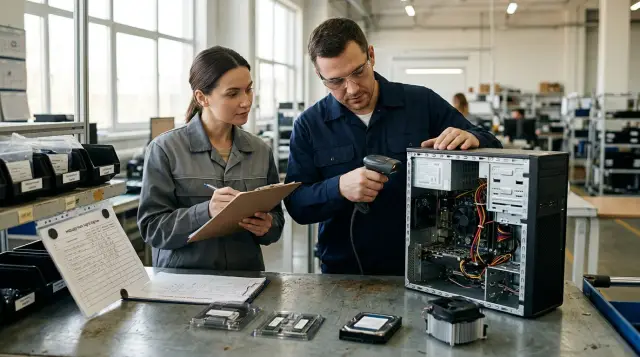
A "Made in Kazakhstan" label proves nothing by itself. Local production is established by a connected chain of operations: a company receives components, turns them into a product with its own identity, configures it, tests it, releases it, and can show a digital trail for every transition.
You should check whether four things agree, not count the supplier's folders: the entry in the state register, the actual process at the declared site, the documents for the specific batch, and the data for a specific serial number. If even one layer exists in isolation, you are looking at either weak production records or resale presented as manufacturing.
Manufacturer status and batch origin prove different things
An extract from the Register of Kazakhstani Commodity Producers confirms the status of the company and the declared product, but it does not replace verification of a specific delivery. Procurement teams often blur this distinction: the committee sees a valid extract and treats the origin of every computer as settled. That is a mistake.
Since January 1, 2026, an extract from the Register has replaced ST-KZ certificates of origin and industrial certificates as the current mechanism for confirming domestic producer status. The Rules for maintaining the Register were approved by Order No. 327 of the Minister of Industry and Construction of the Republic of Kazakhstan, dated August 27, 2025. Production conditions and operation lists are set by Order No. 392 of September 25, 2025, which was amended in 2026. A buyer should therefore read the current row for the relevant product code, not the supplier's guide from last year.
The Register uses an important distinction. Under the Rules, the production localization level is tied to the number of technological operations performed from the prescribed list, while the share of domestic value is calculated separately using the cost of foreign materials and the cost of finished goods. The localization percentage, domestic value share, and proof that a specific batch was made are not interchangeable. One measure cannot stand in for all three.
Request an extract in which the manufacturer's business identification number, actual production address, product name, and classification codes all match. Compare the contract model with the model in the technical documentation and on the label. If the extract covers a broad equipment family, ask the supplier to show in writing how the delivered configuration falls within that entry.
An old industrial certificate is useful only as a historical record of an earlier assessment. It must not replace a current extract. A standard EAEU declaration of conformity answers another question as well: the product meets applicable safety requirements, but the declaration does not show that it was made at a site in Kazakhstan.
Manufacturing begins before anyone picks up a screwdriver
Local assembly begins with controlled component intake, not when a worker tightens the first screw. The company must know which motherboard, memory module, drive, chassis, and power supply went into each computer, which supplier provided each part, and which document recorded its receipt.
At receiving, a properly run factory assigns an internal batch number, checks the item and quantity against the delivery note, records the incoming inspection result, and places the material in a defined storage location. For sensitive components, staff check the model, revision, factory number, physical condition, and basic operation where applicable. If records begin only when parts reach the line, investigating a substitution or defective batch becomes nearly impossible.
Imported components leave a contract, invoice, delivery record, import details, and warehouse movements. Locally sourced parts need the same traceability back to the supplier, and any claim of Kazakhstani origin must be checked separately. Buying a chassis from a local trading company does not make the chassis local.
Ask for an export covering one completed batch, not screenshots from unrelated months. It should show, in order:
- receipt of components with item names and quantities;
- incoming inspection result and release status;
- movement of materials from the warehouse to production;
- issue of components to a production order;
- receipt of finished computers against that same order.
Prices may be hidden if the supplier has a legitimate need to protect commercial information. Item names, dates, quantities, batch numbers, and document relationships must remain visible. A fully redacted delivery note proves nothing.
The first strong test is simple: choose one serial number from the delivery and ask the supplier to trace it backward to the incoming batches of its main components. Then choose a component from an incoming batch and trace it forward to the finished machines. Traceability must work in both directions, or the supplier is showing an archive rather than a working system.
Assembly must change the product's status
Assembly supports a localization claim only when recorded components become a finished product at the site under an approved specification. Unpacking a complete system unit, adding a drive, and applying a new label provide far too little basis for treating the process as full manufacturing.
Each batch needs a production order or an equivalent record. It identifies the model, configuration, quantity, specification version, planned date, line or work area, and person responsible. A route sheet is linked to that order: the sequence of stations, completed operations, operators, times, and inspection results. The form's name does not matter. The links between its data do.
On an assembly line, you would normally see chassis preparation, installation of the power supply and motherboard, fitting of the processor and cooling system, memory, drives, and expansion cards, and cable connection. The exact list depends on the computer type and the current regulatory conditions. An all-in-one, a workstation, and a desktop system unit do not need identical routes.
Buyers often demand a photograph of a worker holding a screwdriver. That is weak evidence because it can be staged once for any batch. A route-system record is stronger when it shows the order number, product serial number, station, timestamp, operator, and result. It is stronger still if scanning a component label prevents an incompatible part from being fitted under the specification.
Check how the factory controls specification changes. Replacing a motherboard or power supply with an "equivalent" without an approved procedure breaks the evidence chain: one configuration was tested, another was used for the cost calculation, and the customer received a third. Every revision should have an effective date, a change list, and the person who approved it.
A contractor may perform an individual operation if the rules and agreement permit it, but moving all assembly to an unknown site makes the declared address meaningless. Ask for the subcontract, service completion records, quality requirements, and the route taken by the unfinished product. Then compare the service volume with the applicant's production capacity. A factory that exists only on paper cannot produce more machines than its people, equipment, and shifts allow.
A serial number connects the hardware to its records
The serial number should be created inside the production process and connect the physical computer to its order, build composition, tests, and release. A label printed after delivery solely for acceptance paperwork cannot do that.
A sound identification scheme separates the model, configuration part number, and unique unit number. The model describes a family, the part number fixes the component set, and the serial number distinguishes one machine from another. If all three values are mixed into one arbitrary string, every configuration change becomes a manual spreadsheet edit.
Request a machine-readable serial number register for the delivered batch. At minimum, it should contain the product serial number, production order, part number, assembly date, test date and result, and release status. Components with their own serial numbers can sit in separate fields or a child table. A PDF hundreds of pages long may be suitable for signing, but it is poor material for finding duplicates.
Run four checks:
- The list contains no duplicate serial numbers.
- Every number on a chassis can be read without guessing and appears in the batch register.
- Dates follow a possible order: component receipt, assembly, testing, release, and shipment.
- The configuration for the number matches the contract specification and the hardware actually installed.
Review the relabeling rules separately. A damaged label sometimes needs replacement, but the system must retain the reason, old value, new value, date, and approval. If someone can quietly delete one number and print another, traceability is gone.
A useful control artifact for a contract can be one row of data with five fields:
- Product serial number: KZ-PC-2026-000184
- Production order: PO-2026-041
- Configuration part number: L200-CFG-07
- Test: PASS, report FT-2026-041-184
- Release: 2026-07-18 16:42, inspector 023
This is not a mandatory government format. It is a minimum contractual format that lets an acceptance committee choose a machine, find its test record, and verify its composition without a week of correspondence.
Configuration and testing leave their own trail
Installing an operating system does not turn a finished imported computer into a local product. Yet software image preparation, firmware, configuration, and testing matter within a real release process because they show that the manufacturer accepts responsibility for its configuration's operation.
The manufacturer should control its reference image: assign a version and checksum, keep a driver list, and record the approval date. The system records which image was applied to each machine. Otherwise, two computers in the same batch can receive different drivers, security settings, or untested updates.
The test route varies by product, but it will normally check startup, memory, storage, ports, network, audio, cooling, and stability under load. A measurable result with acceptance limits matters more than an impressive test name. A record that says only "QC passed" without a test identifier, duration, and result does not reveal what staff actually checked.
Ask to see a report for a passing machine and a report for one that failed. The second document says more about process maturity than the first. It should show a defect code, action taken with the machine, replaced component, repeat test, and release decision. If the defect count is always zero, the factory probably does not record failures.
Compare digital logs with physical capacity. If a station runs a one-hour test, one station cannot produce hundreds of independent one-hour reports in a shift. Identical completion seconds, identical measurements across every machine, and report numbers generated in one batch after shipment all need an explanation.
During acceptance, repeat part of the factory test on a sample. The buyer, not the supplier, chooses the sample. Record the serial numbers first, use an agreed procedure, and attach the machine output to the acceptance record. This test does not prove the entire localization claim, but it quickly exposes a gap between the release register and the delivered goods.
A digital trail is hard to falsify consistently
One document is relatively easy to falsify. Reconstructing consistent warehouse records, production orders, station logs, tests, quality decisions, and shipping records after the event is much harder. Verification should therefore look for agreement among independent records, not a "main certificate."
The most useful traces arise as a side effect of work. A scanner records that a board was issued, a test station saves a measurement, a printer logs a label job, a version-control system stores approval of an image, and the warehouse issues a box. A specially prepared presentation is weaker than these dull records.
An export should retain original identifiers and timestamps. A screenshot displays an interface but hides filters and omissions. Request a CSV or another tabular export for the selected order, then count unique numbers, find blank fields, and sort events by time. If the supplier provides only a PDF, request the source table behind the signed document.
A file hash helps show that an export did not change after it was captured, but it does not prove that the original data were true. A digital signature confirms the signer and the integrity of the signed object, not the computer's physical origin. These controls help only as part of the complete evidence chain.
Watch the time zones and time sources. The warehouse system may store local time, the test server may use UTC, and a line controller may have an incorrect clock. The manufacturer should explain normalization. A small difference may be acceptable, but an impossible event sequence is not: a machine cannot pass its final test before its components were issued.
Backups and access rights matter too. If any operator can edit a completed route without an audit log, the data are not durable evidence. Ask to see user roles, the correction procedure, and the audit trail for one real correction. Error-free production exists only in presentations. Controlled production retains errors and their corrections.
A site visit tests capacity for the claimed volume
A site visit should confirm the ability to perform the declared operations in a normal flow, not a staged assembly of one computer. A supplier with advance notice can arrange tools, but it is harder to create consistent inventory, work in progress, trained staff, and equipment utilization history.
Start with material movement. Follow the route from receiving to quarantine, storage, kitting, assembly, testing, packing, and shipment. At each transition, keep one order number and compare it with the container label and system record. If the guide repeatedly switches to a "similar" batch, return to the one you selected.
Look for signs of regular work: tool calibration, electrostatic protection where required, workstation instructions, product status, separation of accepted and blocked materials, and test-station maintenance records. Cleanliness proves nothing on its own. A dusty but controlled area can be more honest than a spotless room with no production orders.
Compare capacity with simple arithmetic. Use available shift time, station count, the duration of the bottleneck operation, and actual utilization. You do not need a complex model. If the claimed monthly output requires one station to work faster than the test's physical duration, ask for additional stations or evidence of another operating mode.
Speak with an operator away from the manager, if site rules permit. Ask the operator to show what happens when a component does not match the specification or a test fails. Someone who performs the operation can usually open the right form and explain the next action. A rehearsed statement about a "full cycle" does not replace the action.
Tie site photographs and video to a date, location, order, and observed operation. The Register Rules expressly allow declared operations to be assessed using video that shows the technological production process. But a video without readable batch identification remains an illustration, not evidence for your delivery.
Resale appears in gaps between the layers
Resale becomes visible through incompatible documents and physical goods, not one suspicious clue. A supplier may own a workshop, employ staff, and hold manufacturer status, yet deliver imported finished machines that never passed through that workshop.
A common scenario looks like this. The contract names a local model, the delivery note uses the broad description "computer," the chassis carries a local label, and the firmware and packaging show another factory identifier. The serial number register was created on the shipment date even though its assembly dates are a month earlier. When asked for the composition, the supplier sends one unversioned specification for the whole product family.
Another gap appears in volumes. The accounting records show a purchase of five hundred finished system units and a small quantity of memory, while the production report claims five hundred computers made from components. The memory was indeed installed locally, but the purchase pattern shows the modification of finished goods. The committee must name the work accurately and check whether those operations meet the current conditions for the item. It must not rename an upgrade as a full cycle.
The warranty process provides a third signal. If the manufacturer cannot identify the configuration and release date from its own serial number and immediately forwards the request to a foreign supplier, its production record does not work. An external component warranty is acceptable. The absence of an internal product history is not.
Do not demand that every chip, processor, and drive be made in Kazakhstan. That is an unrealistic standard for the computer industry and not the question addressed by the production-operation conditions. Establish which operations are mandatory for the relevant product, who performed them, where and when they occurred, and which data prove it.
It is equally wrong to accept any local work as sufficient. Translating a manual, replacing a label, repacking, or installing one program may create costs in Kazakhstan, but these actions may not meet the minimum operation threshold. The popular advice to "look only at the local-content percentage" fails for this reason: expensive local services do not prove the required technological route.
The contract should require data, not promises
Evidence requirements belong in the procurement documents before bids arrive. After delivery, the phrase "provide all localization evidence" starts an argument over the meaning of "all" and gives a dishonest supplier time to assemble a convenient folder.
In the technical specification, name the current Register extract, product and manufacturer identification, batch data, serial number register, test reports, and the buyer's right to inspect a sample. State the export format, delivery deadlines, and which prices may be hidden. Require advance approval for configuration changes and preservation of revision history.
Set the date on which documents must be valid. An extract obtained with the bid may change before delivery, and a model may receive a new configuration revision. A sensible term checks status during bid evaluation and again before acceptance. The supplier must notify the buyer if the Register entry, production address, or product specification changes between those dates.
Define the consequences of incomplete data in advance. They may include pausing acceptance until a discrepancy is resolved, repeating a test at the expense of the party responsible under the contract, or rejecting units that cannot be traced. Do not invent a penalty at the warehouse door. It should follow from the agreement and apply equally to all bidders.
The committee record should preserve not only the conclusion "complies" but also the verification method. Record the selected computer numbers, systems reviewed, export range, discrepancies, supplier explanations, and the decision on each deviation. If the committee viewed data on screen for confidentiality reasons, note which fields it saw and how it connected them to the batch. A year later, that record will be more useful than a general factory photograph.
Do not request passwords, a full copy of the company's database, or personal data for every operator. That is excessive and creates a new risk. The manufacturer can provide a restricted account, an export for one order, or a controlled viewing session. The purpose is a reproducible connection between facts, not a copy of someone else's infrastructure.
An acceptance matrix works well when every row answers one verifiable question:
- Manufacturer and product are in the Register: compare the current extract with the business ID, address, codes, and model.
- Components arrived at the site: compare receipt and incoming inspection with warehouse movements.
- The machine was assembled to specification: compare the order and route sheet with the physical composition.
- The unit passed testing: check its serial-number report by repeating the test on a sample.
- The batch was released and shipped: connect the release register with the delivery note and acceptance record.
Do not appoint one document as the "only proof." The matrix works because each fact can be read in at least two sources created by different participants. A discrepancy does not always mean deception, but it must be resolved before the acceptance record is signed, and the explanation should be attached.
Confidentiality terms must not prevent verification. A manufacturer may hide purchase prices, employee personal data, and sensitive system parameters. The buyer still needs identifiers, quantities, the operation sequence, and a link to the delivery. Those fields can be shared in an anonymized export or shown to the committee on site with the result recorded.
For a large or regulated procurement, include a production technologist, a quality specialist, and someone who can analyze tabular data. A lawyer can verify document status but may not spot impossible test-station throughput or identical test results. Technical and legal reviews answer different parts of the same question.
Convincing production withstands a one-number test
The most honest computer-localization check fits into one serial number. Using that number, the manufacturer should be able to show the order, composition, incoming batches, route, image version, test report, release decision, and shipping document without improvisation. Those records must then match the machine on the table.
GSE manufactures computers at three facilities in Kazakhstan and controls the cycle from design and production to delivery and support, so this evidence route should be treated as a normal part of a delivery rather than an extra marketing service. A buyer should still verify the specific model and batch under the same rules applied to any supplier.
Do not replace this check with a tour, a management-system certificate, or a long presentation. ISO 9001 concerns quality management, ISO 14001 environmental management, and ISO 45001 occupational health and safety. Those certificates are useful, but none establishes the origin of a specific computer.
If the chain for the chosen number comes together in minutes and survives a reverse cross-check, you are probably looking at live production records. If each new document appears only after a call to someone else, dates conflict, and the model changes names between forms, stop acceptance. Fixing the records before payment is cheaper than proving the origin of an accepted batch later.
Frequently asked questions
Which document now confirms Kazakhstani manufacturer status?
Since January 1, 2026, the current extract from the Register of Kazakhstani Commodity Producers provides that confirmation. Compare the manufacturer, site address, product, and classification codes in the extract with the procurement item.
Is a Register extract enough to accept a computer delivery?
No. The extract confirms the manufacturer and product status, while the acceptance committee must separately connect the specific batch to production orders, serial numbers, tests, and shipment.
Does installing an operating system count as local manufacturing?
Installing an operating system alone will not normally prove that the minimum production-operation threshold was met. It carries weight within a controlled route when the image version and configuration result are linked to every serial number.
Which warehouse records should a buyer request?
Request component receipts, incoming inspection results, production movements, issues to orders, and receipts of finished units. Dates, quantities, batch numbers, and item names should form one continuous sequence.
What should be checked in a serial number register?
Look for duplicates, omissions, and impossible date sequences. Each number should connect to a configuration part number, production order, assembly date, test report, and release status.
Does an EAEU declaration of conformity prove Kazakhstani origin?
No. The declaration confirms compliance with applicable requirements but does not establish where or how production operations occurred. Origin requires Register information and batch-level evidence.
Should a buyer visit the factory before a large order?
A visit is justified for a large batch, especially when the cost of an error is high. Inspect material flow, live orders, equipment utilization, and defect handling rather than watching only a prepared assembly demonstration.
How can local assembly be distinguished from repacking?
Local assembly connects incoming components, a specification, work operations, testing, and the product serial number. In repacking, that chain usually begins with a finished computer and ends with a new label.
Must a local computer contain only Kazakhstani parts?
No. The review concerns prescribed conditions and technological operations, while material origin and cost are accounted for separately. Requiring every semiconductor to be local does not match the industry's actual structure.
What if the supplier's records contradict each other?
Do not sign acceptance until the supplier explains the discrepancy and provides a verifiable correction with change history. Record the conflict against a serial number and compare it with the physical unit and independent system records.
