8 min read
Windows Power Profiles: Policies for Office, Development and Operator Machines
Role-based Windows power profiles: how to set policies for office, developer and operator PCs to cut heat and energy without losing usability.
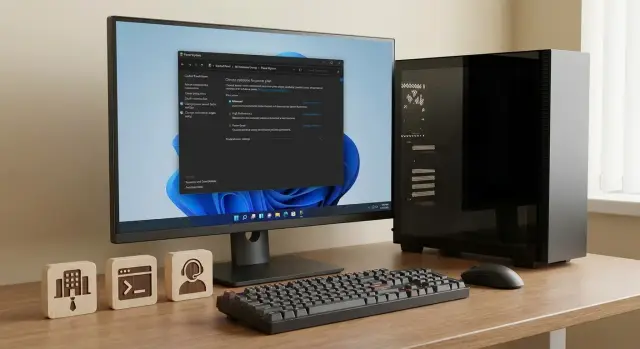
The problem: power, heat and user complaints
In an office it usually looks like this: some desktop PCs start to get loud after lunch, operator machines heat up by the end of the day, and developers complain that their laptop or workstation discharges quickly and the fans run constantly. IT hears something different: “don’t change anything, it will get slow.” Often the conflict comes from a simple decision: the same power plan is applied to everyone.
Windows power profiles directly affect how long the CPU stays at high frequency, how quickly the system goes to sleep, how PCIe and disk power management behave. If settings are too aggressive, responsiveness drops: windows open with a delay, the browser “thinks”, and heavy tasks take longer. If settings are set to “maximum” everywhere, you get heat, noise and extra kilowatts — especially when many identical PCs are running in the company.
It’s important to separate symptoms that are really power-related from those that only look like it. Constant noise and high temperature are often caused by dust, dried thermal paste, poor ventilation under the desk, or an incorrect fan curve in BIOS. Slowdowns are frequently due to antivirus scans, updates, a full disk, or heavy browser extensions.
Before changing settings agree on the goal and how you will know things improved. A practical formula is usually: quieter and cooler at idle and during normal work, but no surprises in key applications. To align expectations, document in advance:
- which roles need instant responsiveness and which can prioritize quiet
- which applications are critical and what “normal speed” looks like
- when sleep is acceptable and after how many idle minutes
- what we consider a problem: temperature, noise, power use, response time
- how quickly changes can be rolled back if users notice degradation
This way you reduce heat and consumption without turning power settings into a permanent fight between users and IT.
User roles and performance expectations
The same power configuration does not suit everyone. If you give an "economy" mode to people who compile code or work with heavy spreadsheets, you'll get complaints about slowness. If everyone is set to "maximum performance" you'll pay more for electricity and get extra heat and noise. It's better to tie Windows power profiles to roles.
Office
Office users usually work in short bursts: mail, documents, browser, video calls, 1C/CRM. Load spikes happen but are short. Quiet, moderate temperature and fast wake are often more important than constant maximum frequencies.
Development
Developers and engineers produce long peaks: project builds, multiple environments, VMs, containers, data analysis. They need stable high performance and predictability: “it built in 5 minutes yesterday and should do so today.” Saving is acceptable but carefully, so builds don’t get longer or performance dips don’t occur during sustained loads.
Operator
Call center agents, cashiers, dispatchers and medical registries work in a conveyor mode: repetitive apps, often all day without stopping. Main requirements: stability, fast UI response and no sleep/wake failures. It can be critical that the screen doesn’t turn off at the wrong moment and the system doesn’t go to sleep during a session.
To decide where saving is acceptable, follow a few simple rules:
- where users will notice a delay (builds, calculations, VMs) allow fewer CPU limits
- where PCs idle between tasks, be more aggressive with sleep and screen off
- where quiet is important, favor lower heat over constant maximum
- where work is continuous, minimize automatic sleep but set a clear display timer
Example: on office all-in-ones (for example, M200) you can be more aggressive about idle savings, while developer workstations should stay closer to a “responsive balance” so builds aren’t slowed.
Which settings affect speed and temperature
A Windows power plan controls how fast the CPU raises frequency, how the system reacts to user activity and how soon it reduces performance to cut heat. The same PC can feel “snappy” or “slow” depending on the plan and a couple of parameters.
Processor and cooling
The most noticeable settings are in "Advanced power settings."
- Minimum processor state: controls how low the frequency can drop at idle. The lower the value, the less heat and noise in pauses. Downside: small delay when a sudden task starts.
- Maximum processor state: limits the upper performance bound. It’s a strong lever against overheating and noise, but if set too low you'll quickly get complaints about speed.
- System cooling policy (active/passive): with active cooling Windows spins fans first; with passive it first reduces frequency. Passive is quieter, but short spikes can feel "sluggish."
Sleep, display and idle timers
Turning off the screen and using sleep often save more than throttling the CPU. A reasonable screen-off timer reduces power and heat with little impact on work. Sleep and hibernation are useful for machines idle for hours, but timers that are too short interfere with users who keep windows, remote sessions or calls open.
Check settings that should be changed cautiously: disk turn-off, USB selective suspend, network adapter power saving. They save power but can cause USB devices to disconnect, delay wake or create network instability. For operator stations and workstations with peripherals this can be critical.
Step-by-step: create and tune a power plan on one PC
Start with one representative computer and one typical user. This lets you see which settings actually affect heat and responsiveness and avoids a wave of complaints after a mass rollout.
First check what’s enabled now. Open Windows Settings -> System -> Power & battery (or Control Panel -> Power Options) and note the active plan and basic values: when the screen turns off, when it sleeps, whether battery saver is on.
Then create a separate plan based on the existing one. It’s convenient to copy "Balanced" and name it clearly by role, for example "Office – quiet and cool" or "Development – no extra sleep." This approach is easier to maintain: one template, a clear name and predictable behavior.
Keep a consistent workflow:
- choose a base plan and create a copy named by role
- open "Change advanced power settings"
- adjust key parameters and save
- record chosen values: plan name, date, what you changed
- test 1–2 typical scenarios for 10–15 minutes
Key settings to start with (they often affect temperature and noise):
- processor power management: "Minimum state" (often 5–10%), "Maximum state" (commonly 85–99% to reduce heat without noticeable loss), "Cooling policy" (active or passive)
- sleep and hibernate: separate values for AC and battery (for laptops)
- display: screen-off timeout often saves more than aggressive sleep
- USB settings: selective suspend helps save but may affect unstable devices
Testing should be practical. For "office," open a browser with 10–15 tabs and start a video call. For "development," run a project build. For "operator," open the main application and check connected devices (scanner, headset). If users don’t notice slowdowns and the fan is quieter, you’re on the right track.
Step-by-step: deploy policies to a group of devices
Once a plan is verified on one PC, it’s easier to transfer it as a file and apply it to dozens or hundreds of devices. Windows' powercfg is useful here: it lists plans and can export/import settings without manual clicks.
powercfg /list shows available plans and their GUIDs. powercfg /export saves a chosen plan to a file, and powercfg /import adds it on another PC. After import you can activate a plan with powercfg /setactive <GUID>.
Prepare a reference and move it
Build the reference plan on a test machine where your requirements for sleep, display and CPU are already set.
- configure the plan on the reference PC and verify no complaints for 1–2 days
- export the plan to a file (usually .pow)
- store the file where admins can access it (repository, shared resource, package in MDM)
- import the plan on target PCs and set it active
- record the plan GUID and version date in documentation
Apply by groups: GPO or MDM
In a domain environment GPO is common: bind the policy to an OU or device group, for example office PCs, developer workstations or operator all-in-ones. In MDM (for example, Intune) the logic is similar: create a profile and assign it to device or user groups. Use whichever management system you already have.
Decide where a plan should be applied per-device and where per-user. For shared operator terminals, device-level assignment is usually better so switching users doesn’t change behavior.
To ensure rollback, agree on a pilot and keep previous settings. Practical minimum:
- save the current plan GUID before changes
- keep the old plan file next to the new one
- set a pilot period and rollback criteria
- create a simple script to restore the old GUID and reboot
- roll out in waves: 5%, then 25%, then the rest
This reduces the risk of mass complaints and lets you revert quickly if behavior is unexpected on some hardware variants.
Recommended profiles for office / development / operator
Below are practical Windows power profiles that usually reduce noise and heat without triggering a flood of tickets. Start from "Balanced" and change only a few parameters. Such profiles are easier to explain and support.
Office: quiet, cool, quick wake
For mail, browser and 1C it's more important to be predictable and wake quickly than to run at full speed constantly.
- AC maximum processor state: 85–95% (often reduces heat by limiting Turbo)
- sleep: 20–30 minutes, hybrid sleep enabled
- display: turn off after 5–10 minutes
- cooling policy: "Active" (fans kick in earlier, but overheating is less likely)
Development: steady builds without constant max
Developers need fast builds. You don’t always need the CPU at max all day.
- on AC: maximum processor state 100% (or 95–99% if builds are rare and noise is an issue)
- sleep: later, e.g., 45–60 minutes so processes aren’t interrupted
- hibernate: enabled (e.g., after 2–3 hours) so a laptop won’t drain in a bag
- disk turn-off: usually leave unchanged for SSDs (little effect)
Operator: responsive UI and no unexpected sleep
For call centers, dispatchers or front-desk staff the workplace must not "fall asleep" during pauses.
- on AC: disable sleep or set a very long timer
- display: turn off after 10–15 minutes if that doesn’t interfere
- wake from keyboard/mouse: enabled
- maximum processor state: 95–100% (based on user feel)
For laptops and all-in-ones keep separate values for AC and battery. On battery it makes sense to reduce maximum processor state (e.g., 70–85%) and turn off the screen sooner.
Set exceptions in advance: VIPs, accounting during close periods, 24/7 dispatchers. It’s easier to have 1–2 "boosted" profiles to assign selectively than to constantly revert policies after complaints. On homogenous hardware (for example, PCs and all-in-ones from GSE) results are usually more predictable due to similar components and drivers.
How to verify improvement: a simple QA
A power plan is successful when users complain less and PCs run cooler and quieter — not when it has attractive numbers. You can check this without complex tools.
First capture the "before": 1–2 workdays on old settings. Then compare with the "after" under the same scenarios (morning start, office work, calls, browser with 10–20 tabs, typical corporate apps).
Simple metrics are usually enough:
- temperature and noise: is it quieter during normal work and toward the evening?
- frequencies and load: in Task Manager check the CPU isn’t stuck at high frequencies for no reason
- UI responsiveness: app launch time, window switching, printing, scanning
- wake time and number of "weird" hangs after wake
- number of support tickets about "slow" or "overheating"
Collect feedback uniformly with three short questions after rollout:
- In which tasks is it noticeably slower or faster?
- Were there hangs, sleep/wake problems, VPN, token or printer issues?
- Is it quieter and cooler during the day?
Run a pilot on a small group (e.g., 10–20 people) for 1–2 weeks. Include different roles: office, development, operator. If your fleet has identical models (e.g., standard office PCs and all-in-ones) comparisons are easier and surprises fewer.
If complaints focus on short performance bursts (first seconds of startup, heavy tabs, a build), raise limits carefully: start by increasing minimum processor state or relax an overly aggressive power saving mode. If performance is fine but noise and heat are high, save more: more sleep, lower CPU max, fewer unnecessary wake events.
Compatibility with corporate apps usually breaks because of sleep/hibernate, not frequencies. Test critical things separately: VPN, disk encryption, terminal sessions, printer and scanner drivers, and specialized operator software. If errors begin after sleep, adjust sleep parameters first rather than changing CPU limits.
Common mistakes and traps when tuning power
A frequent reason for complaints after changes is overly aggressive timers. If sleep is set to 5–10 minutes and disk spin-down to 1–2 minutes, users experience micro-pauses: wake, re-login, app re-opening and lost connections to network resources.
Another trap is applying identical limits to all roles. A CPU cap acceptable for office work may ruin developer build times. A common error is lowering the "Maximum processor state" to 70–80% — it looks harmless but under sustained load it increases task times and user irritation.
USB is a separate story. Toggling "USB selective suspend" on or making it too aggressive can make headsets, barcode scanners, smart cards, printers and webcams drop out. For operator stations peripheral readiness is critical.
Mixing policies creates chaos: local settings on a PC conflict with domain rules. One user on similar devices may see different behavior and IT won’t know where to look. This is especially apparent when you tune a plan manually during testing and then enable domain policies.
Short list of the most common things that spoil user experience:
- sleep/hibernate enabled without considering remote access and overnight tasks
- aggressive disk and PCIe power saving
- identical CPU limits for office PCs and developer workstations
- USB parameters not tested with real headsets and scanners
- no clear owner of the policy and no single source of truth
Finally, an organizational trap: no rollback plan and poor communication. Before mass deployment agree where users should report issues and keep a quick rollback method. Example: after updating plans in a call center PCs started sleeping during short pauses between calls. If operators aren’t warned and you don’t have an easy rollback, you’ll get a flood of tickets and resistance to future improvements.
Quick checklist before mass rollout
Before rolling power profiles out to hundreds of workstations, agree on rules and check basic things. This saves time and reduces the risk of users complaining about slowness or unexpected sleep during work.
What must be ready before start
Define clear roles and owners: who approves settings for "office", "development", "operator" and who decides in disputes (usually IT plus a department manager).
Ensure reference power plans are named and documented consistently. A practical scheme: short name (e.g., "GPO-Office") and one note listing parameters and reasons. In six months you won’t need to guess why a decision was made.
Short pre-rollout checklist:
- roles defined, profile owners assigned, approval process clear
- reference plans have consistent names and descriptions (what was changed and why)
- key parameters configured: sleep, display off, CPU min/max
- pilot completed on a small group and a decision: deploy, tweak or rollback
- exceptions prepared and a rule for new PCs (so they get the right plan immediately)
After the pilot, document how you will deploy settings: via GPO or another method, and who supports them.
Minimal exceptions template
Exceptions are almost always needed so you don’t break special workplaces. For example, operators must not have the screen go off, and developers sometimes need long builds.
Define 2–3 reasons for exceptions in advance (e.g., "long computations", "constant display needed", "nonstandard software") and a clear process to restore the standard profile quickly.
Practical note: if your fleet has identical PCs (e.g., office L200), you will more quickly notice that heat dropped without loss of responsiveness. Hardware and workload are comparable, making pilot results easier to evaluate.
Example scenario: how it looks in a real organization
A company with 200 seats: accounting, sales and HR in the office, 15 developers and a call center with 60 operators. PCs are of mixed age: some new workstations, some standard office systems. In summer complaints began about noise, heat under the desks and "slowness," especially after updates.
IT decided to rationalize power profiles by role, not with a single plan for everyone. A 20-machine pilot used these variants:
- office: balanced plan, sleep 20 minutes, display 10 minutes, AC maximum processor state 85–90%
- development: high performance, sleep 60 minutes, display 15 minutes, max 100%, min 10%
- operator: balanced, sleep disabled, display 15 minutes, max 80–85%, fast wake
First 3–4 days brought expected reports. Office users’ “slow wake” complaints were actually about sleep triggering during long calls and meetings. The fix was simple: increase the office sleep timer to 45 minutes and disable sleep in meeting rooms where external monitors are often connected.
Developers reported "the compiler got slower." Investigation found that a CPU maximum limit accidentally made it into their plan. It was restored to 100% and only display turn-off was made more aggressive to avoid heating overnight.
After two weeks the effect was noticeable: quieter in normal hours, less hot air under desks, fans spun up less often. The call center saw fewer reboots from overheating and operators stopped changing settings themselves.
Results were solidified by:
- deploying plans via GPO by device groups
- writing a short memo: which plan for which role and what to do when a complaint appears
- adding a power plan check to the new Windows install checklist
- monthly sampling of active plans, timers and deviations from the standard
Next steps: lock policies and simplify support
For power profiles to last they must become a clear standard, not a one-off tweak. Start with a simple inventory: which PC models do you have, where are all-in-ones, deskside towers and thin clients. Different form factors have different cooling headroom, which affects noise and heat complaints.
Map hardware to roles and tasks. Don’t do "all office" — be specific: mail and browser, 1C and peripherals, IDE and builds, two-shift data entry. This prevents over-tightening settings where performance drops are noticed immediately.
A practical path:
- create 2–3 reference profiles and document their differences (sleep, display, CPU limits, idle behavior)
- run a pilot on a small group (5–10 people per role) and collect feedback
- assign a policy owner: who changes settings, approves exceptions and stores the golden configuration
- prepare a quick rollback: one clear way to restore the previous plan if tickets spike
- agree simple metrics: temperature, noise, ticket count, wake time
Also define support steps in advance. If an operator reports input lag, first-line support should check whether sleep triggered, whether CPU maximum is limited, and whether USB peripherals are working before changing the profile or granting an exception.
When renewing hardware, consider thermal design and placement. For typical office tasks it’s often wiser to choose quiet desktops or all-in-ones with adequate cooling.
If you need help standardizing the fleet and rolling out policies you can work with an integrator. For example, GSE.kz (gse.kz) as a manufacturer and systems integrator in Kazakhstan can provide a turnkey solution: select devices by role (L200, M200, S200), assist with deployment and offer support via their service network.
Frequently asked questions
What does a Windows power plan actually change and why does it affect noise and speed?
A power plan determines how quickly the CPU raises frequencies, when the system turns off the screen and goes to sleep, and how aggressively it saves power on devices. This directly affects heat, fan noise, battery life and the subjective "responsiveness" in typical tasks.
Where should I start if users complain about overheating and constant fan noise?
If a PC gets noisy mainly in idle or after short tasks, a more "economical" idle behavior often helps: turn off the screen earlier and slightly limit Turbo via the "Maximum processor state". But first rule out basic causes: dust, poor ventilation under the desk, dried thermal paste and odd fan curves in BIOS.
Which power plan usually fits a typical office?
For offices it's usually best to start from the "Balanced" plan and change the minimum. Limit the maximum processor state on AC to roughly 85–95% and set reasonable screen and sleep timers. This typically reduces heat and noise without a noticeable drop in responsiveness for email, browser, video calls and 1C/CRM.
Why can't developers just use the same "economy" mode as everyone else?
Developers need predictable performance under long loads, so too-low CPU limits quickly turn into longer builds and tests. A basic approach is to keep the AC maximum at 100% and carefully configure sleep and hibernate so processes aren't interrupted and a laptop doesn't drain in a bag.
How to configure power for operators so the PC doesn't sleep at the worst moment?
For operators it's critical that the workstation does not sleep during pauses and that peripherals stay available. Usually sleep on AC is disabled or set to a long timer, the screen timeout is chosen so it doesn't interfere, wake-from-keyboard/mouse is enabled, and USB/peripheral stability is checked.
How to test settings on one computer before wide deployment?
Start with one typical PC and one typical user. Make a copy of the "Balanced" plan and name it by role. Change only key settings, then immediately test 1–2 real scenarios for 10–15 minutes to observe noise and responsiveness without surprises.
Which settings most often cause the feeling of "slowness" after changes?
Check "Maximum processor state" and the cooling policy first. A too-low maximum (e.g., 70–80%) often causes a visible slowdown under sustained tasks. A "passive" cooling policy can make short load spikes feel "sticky" even though it reduces fan noise.
Why can USB devices and the network start to "drop" after changing power settings?
Aggressive power saving can cause devices to drop or create delays after idle. Common culprits are USB selective suspend, network adapter power saving and some sleep parameters. For workstations with peripherals, test these settings with real headsets, scanners and printers.
How to deploy the same power plan to dozens of PCs and have a quick rollback?
Export the reference plan and import it to other PCs with `powercfg`, and assign it via GPO or MDM per device group. Prepare a rollback by saving the GUID of the old plan and keeping the previous plan file nearby so you can restore it quickly if complaints appear.
How to tell that a new profile actually improved things, not just changed settings?
Measure behavior rather than "nice" numbers: is it quieter during normal work, did responsiveness in critical apps worsen, and did the number of sleep-related problems increase? Compare "before/after" on the same scenarios and collect short feedback from the pilot group before rolling out widely.
