7 min read
Migrating to Windows 11 in an Organization: A Disruption‑Free Work Plan
Migration to Windows 11 in an organization: an operational plan for inventory, TPM and CPU checks, pilot, updates and rollback to avoid process disruption.
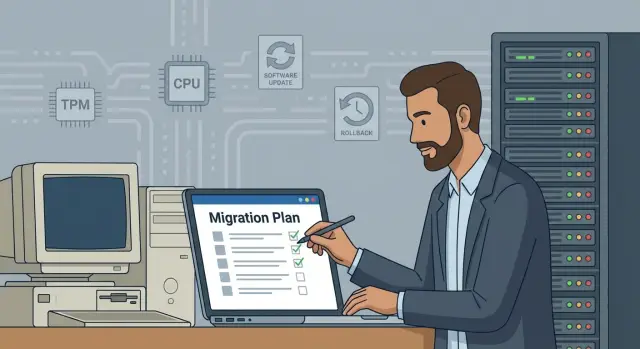
Why migrations fail and how to avoid it
Migrations to Windows 11 usually fail not because of the OS itself but because of small overlooked details: one workstation has no TPM, another has an old driver that won’t start, and on a critical day an update triggers a reboot. To move an organization to Windows 11 smoothly, break the work into stages and don’t update everyone at once.
Common problems:
- The update fails or rolls back due to requirements (TPM, Secure Boot, CPU support, disk space).
- Peripherals stop working: scanners, tokens, printers, and specialized USB devices.
- Critical software behaves differently (macros, plugins, old bank-client versions).
- Users lose time due to unexpected reboots and lengthy profile preparation.
- The IT team gets stuck in manual fixes because there’s no unified playbook and no clear owners.
A simple split into critical and non-critical workstations helps a lot. Critical roles typically include accounting, cash registers, contact centers, medical stations, dispatch, and admin stations. These need the most cautious pace and separate checks. Non-critical devices (some office staff) are suitable for the pilot and early waves.
Before you start, lock in basic decisions so you’re not arguing on the fly: maintenance windows and blackout dates, risk owners by department (IT, business, security), success criteria and the threshold for stopping a wave.
The main filter is simple: update “now” if the current version is going out of support, there are security or audit demands, or the fleet is ready and migration will reduce maintenance costs. If critical software is untested and the fleet is heterogeneous, start with preparation and a pilot rather than a mass update.
What to clarify before you start: editions, support, constraints
Before you begin migrating to Windows 11 in an organization, agree on the rules: which edition will be deployed, how often you’ll update, and which security requirements must be met from day one. That removes half the risks before the pilot.
Companies usually choose Windows 11 Pro or Enterprise. Pro is often enough for small offices. Medium and large environments more commonly need Enterprise for advanced policies, update management and protection features. Education and public sector organizations may use Education. Make sure the edition matches how you manage devices (domain, MDM) and policies.
Planning depends on the lifecycle of releases. Windows 11 receives feature updates regularly, and support for a specific release is time-limited. Decide in advance whether you’ll update every year, every two years, or only after compatibility of key apps is confirmed.
Security and audit questions often include: is Secure Boot enabled, is disk encryption in use, how are accounts and privileges organized, are logs centralized, and is endpoint protection in place?
Also check licensing and activation: which devices have OEM licenses and which are corporate; whether upgrade rights exist; how activation will work (KMS, MAK, etc.); whether separate licenses are needed for VDI/remote desktops; and who manages keys and procurement compliance.
Example: if accounting PCs mix OEM and corporate licenses, inconsistent editions and activation approaches will produce differing feature sets and questions during audits.
Inventory: devices, roles, applications and peripherals
Migrations to Windows 11 usually fail not at installation but because of surprises: “the register has a different driver,” “the doctor’s scanner is not detected,” or “a remote user lacks access to a digital signature.” Start with an inventory that shows not only hardware but who uses it and what must not be lost.
List all device types, including nonstandard ones: office desktops and laptops, all‑in‑ones, thin clients, terminals, kiosks, shop-floor workstations, and reception PCs. Note locations (head office, branches, remote users) and ties to critical processes. The same PC can be “normal” until it turns out to be a contact-center workstation.
For each endpoint capture a minimum: model and key specs, department/owner, role (office, accounting, contact center, etc.), key applications with versions, critical drivers and utilities, and attached peripherals and dependencies (printers, scanners, MFPs, digital signatures, tokens, smart cards).
Create a dependency map by role. Accounting often depends on bank‑client software, crypto providers and tokens. Contact centers depend on headsets, softphone software and call recording. This map shows which groups cannot be updated first and where compatibility tests are required before the pilot.
Requirements check: TPM, Secure Boot, CPU and resources
Before starting a Windows 11 migration, collect facts for each PC: is it in UEFI mode, is Secure Boot enabled, is TPM 2.0 present, and which CPU is installed. These parameters are often not obvious “at a glance,” and knowing whether a device needs configuration or replacement saves weeks.
How to quickly collect data
Checks can be done centrally (with a script) or manually on problematic machines. On a single PC you can view system information (UEFI and Secure Boot) and check TPM via the management console. IT teams often use a simple command for reports:
Get-Tpm
If TPM exists but is disabled or uninitialized, it is usually a BIOS/UEFI setting: enable TPM (Intel often calls it PTT, AMD calls it fTPM), then initialize it in Windows. Coordinate this with security: enabling Secure Boot and changing boot mode can affect old images and some drivers.
CPU and resources: what is a blocker and what is a risk
For CPUs the rule is simple: an unsupported CPU is usually a blocker for the standard upgrade path, even if everything else is fine. Resource shortages are typically risks that can be mitigated by configuration or upgrades.
- Blockers: no UEFI, no TPM 2.0 at the hardware level, unsupported CPU.
- Risks: TPM present but disabled; Secure Boot disabled; low free space for the upgrade.
A practical minimum to aim for is 8 GB RAM and enough disk space for the update. In practice plan for 30–40 GB free space.
Classify devices as “configure,” “upgrade (RAM/SSD)” or “replace.” This quickly separates machines that can be prepared by settings from those better replaced or reassigned.
Step-by-step work plan: from assessment to mass rollout
To avoid surprises, agree early on what counts as success. For example: key applications run, printing works, sign-in time hasn’t increased, and support receives no more than X tickets per 100 users per week.
Run the project as a chain of stages where the next stage begins only after a clear verification:
- Set goals and success criteria.
- Split the fleet by risk (critical, standard, test).
- Prepare a baseline configuration: image/config package, policies, accounts, encryption, and security requirements.
- Run a pilot and collect feedback.
- Roll out in waves: low risk, then medium, then critical roles.
For each wave assign a maintenance window, owners and a channel for urgent requests. After an update check basic services: domain sign‑in, network drives, VPN, printing, user profile, and 1–2 key programs for each role.
Close the project by updating procedures (installation, updates, support), documenting decisions for exceptions and preparing a final report. If hardware upgrades are planned in parallel, decide which workstations will get new PCs to reduce fleet heterogeneity.
Pilot: choosing users and test scenarios
The pilot catches issues before mass rollout. The best pilot group reflects reality: diverse roles, offices and device models. If the fleet is mixed (all‑in‑ones, desktops, laptops), include each device type that will be updated.
Follow simple rules when selecting pilot users: include key roles (accounting, sales, contact center, IT, managers), add 1–2 branches or remote users, and include people who frequently print and use peripherals. Don’t limit the pilot to “power users.” Assign 1–2 contacts per role to provide regular feedback.
Tie test scenarios to daily tasks. Test not only sign‑in but also items that commonly fail unexpectedly:
- VPN and access to network shares.
- Printing on main printer/MFP models.
- Digital signatures and crypto providers (signing, encryption, portals).
- 1C and related plugins/drivers.
- Browsers, email, and video calls.
Define success criteria in advance: how many critical failures are allowed, maximum acceptable downtime, and the acceptable increase in support requests. Keep a unified issue log: what happened, on which device, how to reproduce, a workaround and the final fix. This speeds up rollout.
Pilots typically run 2–4 weeks. Shorter tests risk missing “real” cases: month‑end accounting, rare digital‑signature tasks, driver updates and peak loads.
Update policy: pace, windows and risk control
An update policy prevents migration turning into a series of unexpected reboots and disruptions. Start with the basics: when can user work be interrupted, and who decides to postpone an update.
Tie maintenance windows to department schedules. Accounting may prefer late evenings when reports aren’t due; contact centers need short windows between shifts. Set reboot rules: how many times reboots can be deferred, how to notify users, and what to do with devices that are offline for weeks.
Use update rings to catch issues on a small scale first:
- Test: several IT devices for cumulative updates.
- Pilot: 5–10% of users across roles.
- Main wave: the rest, rolled out by branch or other grouping.
Monthly security updates are usually applied on schedule, while feature updates (new Windows versions) are installed only after pilot validation and a pause to process feedback and verify compatibility.
For branches with slow links plan delivery in advance: bandwidth limits, night downloads, and different schedules for sites with traffic caps. This avoids updates saturating the link and disrupting remote work.
Basic security settings that rarely interfere: enabled firewall, up‑to‑date endpoint protection, BitLocker on laptops at risk of loss, and no local admin rights for regular users.
Backup and rollback plan
Agree on a simple rule before starting: any device must be quickly restorable to a working state if an update goes wrong. This reduces user anxiety and protects critical processes.
What to back up before an update
The set depends on the PC’s role, but commonly you must preserve user data (work folders, local files, mail cache, templates), settings (VPN, Wi‑Fi, printers, shortcuts, app settings), keys and credentials (BitLocker recovery keys, certificates, tokens), and critical app configs.
Decide whether you rely on centralized profile backups, system images, or both. On the pilot test actual restore time: a backup may exist, but returning a device to its previous state can still take half a day.
Rollback options and decision authority
Rollback may mean different things: the built‑in return to the previous version (usually available for a limited time, often about 10 days), image restore, or a clean reinstall with data restore. Define the default rollback method and what counts as “failure.”
Common rollback reasons:
- Critical application or peripheral stopped working.
- Loss of access to network resources or domain.
- Repeated failures after several reboots.
- Performance hinders work.
Make rollback decisions formal: who initiates, who approves and within what timeframes. Verify that rollback won’t break encryption and access: BitLocker must be handled correctly, recovery keys available, and domain/VPN sign‑in work as before. Provide a short instruction for Service Desk and local admins: what to ask the user, which logs to collect, how to start rollback and how to confirm data integrity.
Software and hardware compatibility: how to test and resolve issues
Most migration risks come from the ecosystem around the OS: drivers, management utilities and uncommon peripherals. Treat compatibility testing as a mini‑project: inventory, tests, fixes and approvals.
Old drivers often surface (especially for printers and scanners), along with encryption utilities, management tools, corporate VPN clients, antivirus and DLP agents, and custom add‑ons for office apps. Record not just the name but the version, installation method and owner (who is responsible for support).
For peripherals don’t assume “it should work.” Assemble typical workstations and run short scenarios: printing from different apps, duplex printing, scanning to a network folder, camera use in corporate apps, and smart card/token reads. The same MFP model can behave differently with different drivers.
If specialized software is unsupported on Windows 11 choose a business‑least‑impact option in advance: upgrade to a supported version, replace the product, dedicate an isolated PC running the old OS for the task, virtualize or provide remote access to the legacy environment, or move to a web version if available.
Example: an update breaks the submission signing module for accounting, while contact‑center cameras are not detected by call recording software. These issues cannot be “fixed later.” Agree windows and workarounds with process owners so critical operations aren’t interrupted.
Common mistakes and how to avoid them
The most common cause of failure is starting updates without knowing exactly what runs on each PC. Dependencies then surface: a scanner driver, a specialized warehouse printer, POS software or a small utility that a team needs to close the day.
Mistake one — inventory only by PC, not by work scenario. Collect user roles, critical apps, peripherals and how everything connects (USB, network, remote access). Then requirements and compatibility checks become specific, not “company‑wide averages.”
Mistake two — piloting on an overly convenient group. Testing only on IT or office users will miss real loads. Include different tasks and devices: a contact‑center operator with a headset and softphone, an accountant with a token and printing needs, and a branch employee with a slow link.
Mistake three — updates and reboots during business hours. Define maintenance windows and rules up front: what installs automatically and what requires process-owner approval.
Mistake four — forgetting branches and remote sites. They often reveal issues with links, local printing services and access limits. If the pilot includes at least 1–2 branch workstations, you’ll see far fewer surprises during rollout.
Another frequent problem is the lack of a clear “stop signal.” If a pilot breaks a critical scenario, it must be clear who decides whether to pause a wave, roll back, or introduce a temporary procedure until a fix is ready.
Quick checklist before mass updates
Before you start migrating hundreds of devices to Windows 11, check the items that most often delay projects: hardware requirements, update manageability and support readiness.
Short checklist:
- For each device confirm TPM 2.0, Secure Boot, CPU compatibility and sufficient RAM and disk; flag problematic models.
- Approve rollout waves: who updates first, who later, and which devices will temporarily remain on the current version (with reason and review date).
- Configure update rules: installation pace, maintenance windows, ban unexpected reboots during work hours and a quick method to pause a wave if incidents occur.
- Pilot completed and documented: which scenarios were tested, what was critical, what was fixed and which workarounds are permitted.
- Backups and rollback verified: there is a restore point for a typical PC, a procedure for IT, and confirmation rollback won’t break encryption, accounts or access to key services.
Prepare Service Desk scripts: how long the update takes, what to do with a black screen, how to restore sound/printer and a clear escalation path to level‑2 and engineers.
If you have many identical workstations, agree an exemplar configuration with a supplier or integrator. Then identical PCs update predictably and support doesn’t have to guess what’s installed.
Example scenario: a pilot in accounting and the contact center
To avoid impacting critical processes, run pilots in waves where each group has its own “cost of error.”
Wave 1: office and accounting
Start with 10–15% of users: some accountants, HR and office staff. The goal is not just to install a new OS but to verify the working day runs as usual.
In the first 3–5 days focus on:
- Domain sign‑in, access to network shares, printers and scanners.
- Bank‑client software, digital signatures, browser plugins and crypto providers.
- 1C or similar accounting systems: printing, data exchange and exports.
- Email, calendar and video calls.
A simple metric keeps focus: (minutes of downtime) x (employee hourly cost) + losses from missed deadlines. Don’t ignore small incidents (for example, 10 minutes to set up a printer): at scale they become costly.
Wave 2: contact center
The main risk in a contact center is lost time on calls. Pilot on a small shift that experiences real load: inbound calls, recording, CRM and headsets.
To avoid a spike in missed calls measure baseline KPIs and compare them on Windows 11: average answer time, drop rate, time to open a customer card and headset latency.
If the pilot reveals outdated PCs, solutions usually fall into three options: BIOS tweaks (TPM/Secure Boot) and driver updates, replacing critical peripherals, or moving the device into a non‑updated pool for a limited time. For critical roles replacing unsupported models is often the simplest option.
Document pilot results in one artifact: tested scenarios, incident statistics, fixes for problem models and readiness criteria. Then expand the wave to similar teams.
Next steps: rollout plan and post‑migration support
After the pilot you’ll have what matters: confirmed compatibility, known risks and a list of fixes before mass rollout. Consolidate this into a plan so the project doesn’t become a series of firefights.
Start with a final inventory by status. In one registry mark which workstations can be updated immediately, which need configuration (for example enabling TPM or Secure Boot), and which should be replaced. This registry will drive procurement and the wave schedule.
Agree how rollout will proceed. Typical deliverables: a device list (update/configure/replace), a calendar of waves with windows and readiness criteria, responsibility split between IT and business, and updated instructions for users and support.
If part of the fleet needs replacement, map hardware choices to roles: accountants and contact centers need stability and peripheral support, engineers and analysts need performance. In Kazakhstan many organizations also consider locally produced hardware to reduce variety and simplify support. For example, GSE.kz manufactures desktops, all‑in‑ones and servers and offers integration and support, which can help when refreshing hardware alongside OS migration.
Assign an owner for the “first 30 days” after migration: they track tickets, initiate quick fixes, update the golden image and create short tips. This helps stabilize results and reduces pressure on the service desk.
Frequently asked questions
When is it really time to start migrating to Windows 11, and when is it better to wait?
Start when there is a clear reason: the current Windows version is reaching end of support, there are security or audit requirements, or your fleet is already ready and migrating will reduce support costs. If critical software or peripherals haven't been tested, it's better to prepare and run a pilot first and postpone mass updates until compatibility is confirmed.
How can I quickly tell if my PC fleet is ready for Windows 11?
Collect, for each PC, facts about UEFI, Secure Boot, TPM 2.0, CPU model and free disk space. Do this centrally with a script where possible, and check ambiguous machines manually to quickly separate “needs BIOS settings” from “needs hardware replacement.”
What should I do with computers whose processors are not supported by Windows 11?
Unsupported CPUs typically block the standard upgrade path and turn the project into a set of exceptions. Practical options: make a separate list of these devices and decide whether to replace them, move them to non-critical roles, or keep them on the current OS with a fixed review date and stronger controls.
There is a TPM but it’s disabled. Is that a problem or just a setting?
If TPM 2.0 or Secure Boot are merely turned off, it is usually just a BIOS/UEFI setting and an initialization step in Windows. Do this under agreed procedures with your security team, since changing boot mode or enabling Secure Boot can affect old images and some drivers and may interact with disk encryption.
How do I pick users for a Windows 11 pilot?
Choose a group that represents reality: different roles, offices/branches and PC models, and include scenarios that rely on printing and digital signatures. In practice 5–10% of users is often enough, but coverage of scenarios is more important than size to reveal issues before mass waves.
Which scenarios should I test in the pilot to avoid missing critical problems?
Create a short checklist of daily tasks per role and run the same tests on all pilot PCs. Be sure to verify domain sign-in, VPN, network shares, printing and scanning, digital signatures/tokens, and the behavior of key applications in typical tasks — not just whether they open.
How can I avoid unexpected reboots and service interruptions during work hours?
Set maintenance windows and reboot rules in advance so updates do not fall into peak work times. Use rings: first test on a few IT devices, then run a pilot, then roll out in waves. Stop a wave if a pre-agreed incident threshold is reached.
How should rollback be organized if something goes wrong after the update?
Keep a simple rule: any device must be quickly returnable to a working state if an update goes wrong. Predefine the default rollback method and decision authority, remembering that the built-in return to the previous version is usually time-limited; for critical roles recovery from an image or a clean reinstall with data restore may be more reliable.
What should definitely be backed up before a mass upgrade to avoid losing data and access?
Save what users are most likely to lose in the first hours: user files, access settings, certificates and keys, VPN and printer settings, and critical application configurations. On the pilot, test not just that a backup exists but the actual restore time to “as it was” so you know the real downtime cost.
How do I reduce the risk that printers, scanners or tokens will stop working after Windows 11?
Start by inventorying peripherals by role and test them on representative workstations in critical departments. If some devices or drivers are consistently unsupported, plan for replacement or standardization; if you’re updating hardware in parallel, choose uniform configurations (including locally produced options) to reduce variety and simplify support.
