8 min read
Timeframes for Warranty Diagnostics and Repairs in a Contract: Structure
How to fix diagnostics and repair timeframes in a warranty contract: clause structure, loaner equipment, notifications, liability and sample wording.
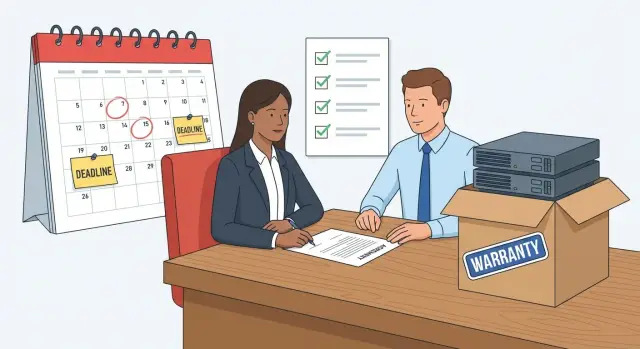
Why a contract needs deadlines for warranty work
Deadlines in warranty service are not about being "strict" — they make sure everyone has the same understanding: when work starts, when to expect results, and which actions are required at each step. When a contract explicitly sets diagnostics and repair deadlines, the service becomes a managed process instead of endless back-and-forths.
For the Customer, deadlines help plan people and equipment and reduce downtime. For the Supplier and the service provider they are also useful: fewer conflicts, clearer engineer workloads, and easier pre‑agreement on exceptions (for example, waiting for parts). The result is fewer "fires" and fewer calls like "what's happening with our equipment?".
Without fixed deadlines the same disputes repeat: a device sits "in diagnostics" for weeks and it's unclear who delayed. Equipment gets "lost" between pickup, warehouse and service because there are no fixed checkpoints. The Customer counts time from the service request date, the Provider — from the date the device was received. Downtime costs rise and the obligation to provide a loaner is not described. Evidence is scarce: no acts, notices or status updates.
A lawyer needs deadlines that are measurable and tied to an event that is documented. An IT specialist needs events that reflect reality: "device accepted", "request registered", "diagnostic conclusion issued", "readiness communicated", "device returned".
A good clause relies on the chain "event -> document -> timeframe". For example: diagnostics time starts from the date of the acceptance-transfer act at the service, while repair time starts from the date of agreement of diagnostics results (or confirmation of a warranty case). This reduces the risk of disputes and helps restore operations faster, especially when downtime is critical.
Basic definitions and counting points
To keep timeframes aligned with reality, first agree the terms. Lawyers use this to tie liability to documents; IT and service teams use this to follow a predictable process. Without it, the phrase "we'll fix it in a reasonable time" turns into endless correspondence.
Below are sample definitions for a section on warranty diagnostics and repair timeframes in a contract:
- Diagnostics: checking the device to confirm the defect and determine the way to fix it, with results recorded in a conclusion or act.
- Repair: restoring functionality by work and/or part replacement without changing the device's serial number (unless otherwise agreed).
- Replacement (exchange): issuing a new or equivalent device instead of the faulty one, with a handover act and serial numbers recorded.
- Loaner equipment: temporary issuance of a device for the diagnostics/repair period without transfer of ownership.
- Completion of work: the moment the device is ready for issue and confirmed by a document and notification.
Most important is deciding which event starts the clock. It's better to choose one main reference point and make others clarifying so there is no "double start." A common approach is to start deadlines from the request registration date (confirmed by a request number), while noting that diagnostics physically begin after the device is handed over by an acceptance act.
Also clearly define what counts as "transfer to service": the provider's acceptance-transfer act, the courier's receipt note, or the date the device was accepted at the service center warehouse. If the Supplier collects equipment itself, specify that internal logistics do not shift deadlines.
Separately define what counts as completion: not just "we repaired it", but readiness for pickup + notification (email/internal message) and an acceptance certificate. For example, the service may finish repairs on Tuesday but notify the Customer on Friday. The contract must state which date closes the stage and stops liability accrual.
Request process: what to record before diagnostics
For deadlines to actually work, the moment of request must be documented. Otherwise the dispute will be about when the warranty process actually began.
Start with who can submit a request and by which channels. Usually an authorized Customer representative (IT, facilities, engineer) and several channels: official email, service portal, phone (with mandatory follow-up confirmation). If phone is allowed, state that timeframes start only after written confirmation.
Then fix the minimal data required for a request to be considered complete and to start timeframes:
- model and serial number (or inventory number if serial is unavailable);
- description of symptoms and when they occur;
- contact person, phone, and the device location address;
- preferred service method: on-site visit, delivery to service, courier.
Photos, screenshots and operating conditions (overheating, dust) can be requested "if possible" — but missing non‑critical items shouldn't automatically invalidate the request.
Specify how the Provider confirms receipt: request number, date/time, responsible person's name and role, and a list of accepted data. This prevents disputes about what was handed over at the start.
Set a deadline for an initial response. For example: within 4 business hours or 1 business day the Provider confirms the request and sends instructions for handover (service address, reception window, packaging requirements, documents list).
Example: a hospital IT specialist sends a request by email with serial number and a photo of the error. The reply contains a request number and handover instructions. From that point it's easy to prove the start of the clock and check the stages regardless of whether you are supported by a major manufacturer or a local service like GSE.kz.
How to set deadlines: stages and a single formula
A timeframe clause is easiest as a chain of stages with clear start and end points. Lawyers can then calculate liability and IT knows when to expect results.
Typically the clause covers acceptance, diagnostics, agreement on actions, repair, testing and issuance. Immediately specify time units: working days for ordinary cases, hours for critical systems (servers, POS nodes).
Below is an example "formula" you can adapt to your numbers. It helps describe warranty diagnostics and repair timeframes in a contract without vague wording.
Сроки выполнения гарантийных работ:
1) Прием Оборудования в сервис и регистрация заявки - не более A (рабочих/календарных) дней с момента фактической передачи Оборудования и комплекта документов.
2) Диагностика - не более N (рабочих/календарных) дней с даты регистрации заявки.
3) Уведомление о результатах диагностики и предложенном решении (ремонт/замена/отказ с обоснованием) - не более B дней с даты окончания диагностики.
4) Гарантийный ремонт - не более M дней с даты уведомления о результатах диагностики.
5) Тестирование после ремонта - не более C дней.
6) Выдача Оборудования Заказчику (или готовность к отгрузке) - не более D дней после тестирования.
Общий срок считается как сумма этапов, если иное не указано.
To prevent the clock from "stalling," the clause should also state when timeframes are paused and what the Provider must do. Exceptions (weekends and holidays, force majeure, waiting for rare components) are possible, but only with mandatory notification and a new planned date.
A quick check for feasibility: each stage has a starting event and a clear outcome; time units are unambiguous; pauses are tied to facts (e.g., "waiting for Customer confirmation") rather than vague terms; delay notifications have their own deadlines; procedures for inability to repair are described (replacement, return, alternatives).
Loaner equipment: conditions and issuance deadlines
Loaner equipment is not a formality — it's meant to keep critical operations running: workstations, critical services, medical rooms, financial systems. If loaners are not specified, disputes start with "are you obliged to provide a replacement or is it discretionary?"
To make the clause clear to lawyers and IT, tie loaners to a measurable event: confirmation of a defect after an initial check or diagnostics. That aligns well with the overall logic of warranty diagnostics and repair timeframes in a contract.
When a loaner is provided and within what timeframe
Loaners are usually mandatory for a pre‑agreed list of equipment (servers, doctors' workstations, POS terminals) and optional for other items. Fix the issuance timeframe in one sentence: "within X business days after defect confirmation" (or after acceptance to the service, if administratively simpler).
To avoid loaners becoming a mere formality, specify minimal requirements: comparable performance and key characteristics, OS/domain/driver and peripheral compatibility, and compliance with security requirements (encryption, TPM, policies). Decide in advance who provides licenses and access and for how long.
Loaner return and liability
Return should be by act with a check of completeness and condition. The contract can state: loaner is returned within Y days after notification of the repaired device's readiness or after the actual replacement.
Split liability clearly: the Provider is responsible for the loaner's working condition at issuance; the Customer is responsible for damage, loss or unauthorized changes (e.g., opening the case or replacing components without consent). Also note that signs of normal use are acceptable to avoid disputes over minor scratches.
Example: if a clinic's front-desk all‑in‑one fails, the contract may require a loaner within 1–2 business days after defect confirmation, compatible with the cash register and scanner. Return by act within 3 days after the repaired device is installed.
Logistics and handover: so deadlines don't "get lost"
A common cause of warranty disputes is not diagnostics but the gray time between request and the device actually arriving at the service. If the contract doesn't cover this, parties will count start times differently and the deadline clause becomes useless.
Fix where the clock starts
There are two logical options: start from request registration at the Provider or from device receipt at the service (or signing of the acceptance act). To avoid ambiguity, explicitly state the start point for each stage: pickup, delivery, diagnostics, repair, return delivery.
It's often better to treat logistics as a separate SLA rather than hiding it inside repair deadlines. For example: "pickup of equipment within X business days from confirmation of request", "delivery to service within Y days after pickup." This is important when the site is far from the service center.
Handover: documents and facts
Specify minimum rules both lawyers and IT will understand: who organizes and pays for transport (there and back), packaging and, if needed, insurance; when risk transfers (usually at the acceptance-transfer act); what the act must include (serial number, model, defect description reported by the user, date and time); inventory of accessories (cables, PSU, drive trays, rails), seals and signs of opening.
Photo evidence at handover (case, connectors, seals, completeness) is acceptable proof. Also state: if the device is handed over without required accessories or without manufacturer packaging, timeframes may be paused until the problem is resolved, but only with written notice within, for example, 1 business day.
For remote sites use simple mechanisms: courier pickup, regional partner or nationwide service network. For organizations with branches across Kazakhstan this removes disputes about who accepts equipment and where the act is signed so deadlines don't depend on geography.
Notifications and documents at each stage
Deadlines break down when it isn't clear who reports status and by what documents. Lawyers need evidence, IT needs clear statuses and dates. Therefore describe notifications and the document set for each step so warranty diagnostics and repair timeframes in the contract can be verified by correspondence and acts.
Usually fix three things: notification channel, response time and what counts as a received message. For example: notifications are sent from the service address to the address in the contract details; critical statuses are duplicated by phone with a follow-up email the same day.
A document package can be described without extra bureaucracy:
- Acceptance to service: acceptance-transfer act (serial number, kit, external condition, date/time, defect description from the customer).
- Diagnostics result: diagnostic act/conclusion (defect, tests, conclusion: warranty/non-warranty case, date of diagnostics completion).
- Repair: list of performed works and replaced units (what was replaced, with what, firmware versions if needed, date).
- Readiness: readiness notification and document for issuing (date, place, authorized recipient).
- Delay: notice of schedule change with reason and a new planned date.
Also explicitly define "non-warranty case." A good practice is to require the Provider to notify within 1–2 business days after detection and attach evidence: photos/logs, description of breach of operating conditions, reference to a specific warranty clause (not general wording).
If paid work is needed, formalize approval: estimate (works, parts, execution time, price validity) and a response deadline for the Customer. State what happens on silence: repair is paused and warranty timeframes do not resume until written consent is received.
Example: a server is accepted on Monday at 10:00 by act. On Tuesday the Provider sends a diagnostics conclusion. If it's a non‑warranty case, the conclusion includes justification and an estimate. The Provider won't start paid repair while waiting for the Customer's reply, but records the status with a separate notification.
Common mistakes in deadline clauses and how to avoid them
A typical problem: parties think they agreed deadlines but it's unclear when the clock started, when it stopped, and who confirms the next step. Disputes end up as "we were waiting for you."
Deadlines are usually missed for three reasons: missing parts, missing decision or data from the Customer, or the device was handed over incomplete or with an undisclosed defect. You can account for these reasons, but not leave them as open defaults.
Vague phrases to avoid
If deadlines matter, avoid wording that can't be measured or checked. Use numbers, events and documents instead.
On practice, trouble comes from phrases like "reasonable time", "where possible", "subject to parts availability" (without lead times and Provider obligations), or "the term may be extended" (without limits and a procedure).
Controlled pauses without losing control
Pauses are sometimes inevitable, but they must be manageable. A good rule: a pause is allowed only with a written request and a recorded start and end date.
Common pause reasons:
- waiting for a written Customer decision (approval of paid work);
- waiting for missing documents or access for diagnostics;
- waiting for parts, provided the Provider ordered them within N business days and informed the Customer of the expected delivery date.
To avoid abuse, add the Provider's obligation to offer an interim option: a loaner, temporary replacement of similar class, or another agreed solution. If the Customer refuses, the refusal is recorded in writing.
Mini scenario: a server won't boot. The Provider confirmed the faulty power supply. If the part isn't in stock, the contract should require: order the part and send a delivery forecast within 2 business days; if forecast is over 10 business days — offer a loaner for the waiting period. This keeps deadlines from "dissolving."
Liability for missed deadlines and limits of responsibility
If you set deadlines, the next legal question is simple: what happens if a deadline is missed. Without clear liability, the deadline clause becomes a wish, not a working rule.
Penalties or service credits
The most straightforward option is a penalty for each calendar day of delay in a stage (diagnostics, repair, issuance). To work and avoid disputes, set a formula and a cap in advance.
Common practice: a daily rate (percentage of the device price or the service contract value per day), a cap (maximum sum, e.g., not more than X% of the device price), define when delay starts (after documented acceptance and start of counting) and list exceptions (delay due to missing access, passwords, documents or Customer approvals).
Sometimes service credits are used instead of money (discounts on future services). This is easier administratively, but define how and when credits are applied and note that credits do not replace the actual repair obligation.
Downtime compensation: when appropriate
Downtime compensation seems fair but is hard to prove. If included, limit scope: only with a downtime act, only for critical systems, only after refusal of a loaner or for delays beyond an agreed buffer. Typically set an upper limit and exclude indirect losses (lost profit, third‑party penalties).
Data and security
Include liability for data separately. Typical clause: the Customer should back up and remove confidential data where possible; the Provider is responsible for storage media safekeeping and is not liable for data loss if data recovery isn't in the agreed scope.
Warranty on repairs and replaced parts
Add a short clause: repairs and replaced parts carry a separate warranty (term and conditions), and the overall product warranty is not shortened. Also useful: repeat failures for the same cause are handled with priority.
Practical scenario: how it works in practice
An accounting department PC fails to boot, and in the same week a rack server fails. The contract already specifies diagnostics and repair timeframes, loaner rules and required documents at each step.
Workstation with a loaner during repair
On the failure day the responsible person files a request: model, serial number, symptom, criticality level, contact for access. The Provider confirms receipt and schedules a handover window.
At handover both parties sign an acceptance-transfer act: contents, external condition, seals, whether drives were handed over — date and time. From that moment diagnostics time starts.
After diagnostics the Provider sends a result: defect confirmed, warranty case, required work and an estimated completion date. Because the department is critical, a loaner is issued by act with configuration and return deadline.
After repair the Provider issues a final report (what was done, which parts replaced), a service completion act and the device is returned. The loaner is returned by a separate act.
Branch points that often occur
If diagnostics show a non-warranty issue (e.g., signs of tampering), the Provider sends a reasoned refusal with evidence and the Customer chooses: paid repair per estimate or return without repair.
If warranty is confirmed but the part is unavailable, follow the contract: extend the term only by written notice and a new planned date, or replace with an equivalent unit, or provide a long-term loaner. All dates must be fixed by notices so deadlines don't float.
For servers, the logic is the same but also specify who handles backups and who is responsible for server room access. This avoids disputes about why the device wasn't accepted or why diagnostics didn't start on time.
Checklist before final approval and next steps
Before final approval check that the text clearly shows when counting starts, when it ends and what to do if something goes wrong.
Cross-check:
- Start and finish events are unambiguous and supported by documents (request registration, acceptance-transfer act, readiness notice, issuance act).
- The timeframe is split into stages (request confirmation, diagnostics, agreement, repair/replacement, issuance) with limits for each stage.
- Pauses and exceptions are defined: waiting for access, missing serial number, incomplete kit, waiting for approvals or parts, force majeure.
- Loaner terms are included: when issued, for how long, who delivers, who is responsible for safekeeping.
- Notifications and documents are listed for each step (request, acceptance-transfer act, diagnostic report, repair report) and the acceptable forms are clear.
If gaps remain on this checklist, disputes are likely and parties will "count time differently." This is especially critical for warranty diagnostics and repair timeframes in a contract where any ambiguity leads to downtime for workstations or servers.
To bring the document to an operational state, typical next steps are: agree KPIs separately for PCs, all‑in‑ones and servers; put the SLA for service and repair into an annex (stages, deadlines, exceptions, priority rules); attach templates (request, acts, diagnostic report); and check logistics (who picks up, who packs, how transfer time is recorded).
If procurement is combined with integration, you can request a standard service commitment structure from GSE.kz, including 24/7 support and a national service network, to speed up building the SLA appendix for your device fleet.
Frequently asked questions
From which date is it correct to count the warranty diagnostic period?
It's best to start counting diagnostics from a date that is supported by a document: the acceptance-transfer act at the service center or the carrier's/receiver's timestamp showing the device was received. Registration of a request can be a separate quick step (for example, confirming the request and giving instructions), but it shouldn't be the only starting point for the repair period — otherwise logistics disputes will appear.
Why shouldn't a contract say "repair within a reasonable time"?
Because "a reasonable time" cannot be verified and is almost impossible to defend in a dispute. A practical approach is to fix measurable stages with numbers and tie each stage to an event and a document, so both parties clearly see when each stage starts and ends.
What data in a request are mandatory so timeframes start?
Minimally you need: model and serial number (or inventory number if the serial is missing), a description of symptoms, a contact person and address, and the preferred service format (on-site visit or delivery). If these are missing, the contract should state that the request is incomplete and timeframes do not start until the missing information is provided.
Which stages are best to highlight in warranty service timeframes?
A typical sequence is: acceptance of the device at the service, diagnostics, notification of result (warranty / non-warranty), repair or replacement, testing, readiness for pickup and actual return. The more precisely intermediate statuses and documents are defined, the less "gray time" there will be when the device is somewhere without a clear deadline.
When is it acceptable to suspend warranty repair timeframes?
The most common rule: pause timeframes only for periods that can be proven — waiting for a written decision from the customer, waiting for access/passwords/documents, or waiting for parts provided the provider has placed the order in time and notified the customer of the expected delivery date. The contract should say that a pause starts only after the provider's written request and ends when the cause is resolved (also in writing).
How to set up loaner equipment so it is actually provided?
If swap equipment is critical, make it mandatory at least for an agreed list of devices and tie issuance to an event, for example confirmation of a defect after an initial check or after diagnostics. Specify the issuance timeframe, compatibility requirements (OS, domain, drivers, peripherals) and return procedure by acceptance act once the primary device is ready.
How to account for delivery to the service so timeframes don't get "lost"?
Separate logistics into its own timeframes so you don't argue about who delayed: confirmation of request, pickup, delivery to service, return delivery or readiness for shipment. Also clearly define what counts as transfer to the service and which document confirms it; otherwise the start of timeframes will be interpreted differently.
Which documents and notifications should accompany each stage?
You need fixed checkpoints: acceptance-transfer act at handover, diagnostic report/conclusion, list of repair works and replaced parts, readiness notice and the document for issuing the device. Also define how and within what time the provider must notify of delays and what counts as a received notification, otherwise deadlines can shift without proof.
What if the service declares a "non-warranty case"?
The provider must quickly report the non-warranty conclusion, attach evidence (photos, logs, test descriptions) and refer to a specific warranty clause, not general statements. Then the customer chooses: paid repair per estimate or return without repair. During the decision period, warranty timeframes should be explicitly suspended.
How to fix responsibility for missed deadlines so the clause is enforceable?
A clear sanction for missing a deadline works best: a fixed penalty or service credits with an upper limit and a clear rule when a delay starts. Also add limits and exceptions (for example, when delay is due to the customer's failure to provide access or approvals), otherwise penalties will be disputed.
