8 min read
Server Room Fire Safety: Penetrations, Materials, Documentation
Server room fire safety during modernization: how to choose cable penetrations and fire-resistant materials, prepare as-built documentation, and pass inspections without comments.
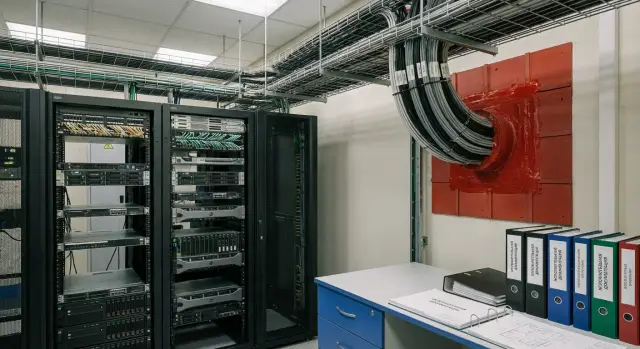
Why it matters: where server rooms most often fail inspections
Modernizing a server room almost always involves cables, racks, UPSs or air conditioning. That’s often when things that had been "hidden" for years become apparent: the fire-resistance of partitions, the sealing of penetrations, and the logic of cable routes. As a result, the actual condition no longer matches the original design.
The most common simple problem: new holes for cables appeared, but they were forgotten or filled with whatever was at hand. Unsealed penetrations act like chimneys: smoke and hot gases flow into adjacent rooms, and fire gets air and a path to spread.
The second typical cause is chaotic cable routing. When lines are laid in bundles "wherever possible", without trays and proper fixings, they are hard to maintain and almost impossible to protect correctly. Any small tweak turns into new holes, temporary ties and removed covers.
At acceptance and inspections they usually don’t judge aesthetics but specific things: the integrity of fire barriers (walls, floors, doors), the quality of penetration sealing, the suitability of materials for their purpose, the presence of markings and tidy routing (no sagging, damage or overheating). A trigger for remarks is "temporary solutions" like foam, rags, cardboard and open holes.
Documentation is as important as materials. Even if everything is done correctly, without certificates, diagrams and confirmations the inspector has nothing to "close the case" with. But a perfect folder won’t help if penetrations are sealed incorrectly.
Saving on small things usually results in two outcomes: remarks and urgent rework. A typical scenario: a contractor added a couple of lines to a rack, left a gap around the bundle, and at the first walkthrough there’s a demand to open, redo and re-document the work.
Basic concepts: penetrations, barriers and fire resistance in simple terms
To speak the same language with designers, installers and inspectors, it helps to agree on terms. Most problems arise not from "complex norms" but from confusion: what is a penetration, where a barrier ends, and which documents prove the result.
Think of it this way: the server room is a separate zone, and its walls, floors, doors and partitions must hold back fire and smoke for a specified time.
What is a penetration and what is a barrier?
A barrier is a construction that separates a room or fire compartment (a wall, floor, partition, door). A penetration is any place where an opening appears in the barrier for a cable, pipe or tray and must be sealed with fire-resistant materials.
Cable routing includes the lines themselves and everything that holds or protects them: trays, ducts, conduits, corrugated sleeves, pipes, and entries into cabinets and racks. It’s at the crossings with barriers that fire protection is most often lost.
Fire resistance is the time during which a construction or seal withstands fire without collapsing or letting flames and hot gases through. Smoke is also important: it’s dangerous for people and quickly damages equipment.
Who is responsible and how is it confirmed?
Typically roles are divided like this: the design sets solutions and material classes, installation follows the technology, technical supervision checks compliance, and operations ensure new cables don’t compromise existing seals.
Safety is confirmed not by words but by a set of documents: material datasheets and certificates (or declarations), test reports (fire-resistance classes) for penetration systems, hidden-work certificates, as-built diagrams of routes and penetration locations with photos, work logs and signatures of responsible parties.
Before work starts: survey and recording the initial condition
Many inspection remarks don’t come from new cables but from inherited holes and temporary fixes. Before modernization, first understand what already exists in the room and record the initial state. This clarifies where you improved things and where the risk was present from the start.
Begin by inventorying every place where services pass through walls and floors. Note the number of penetrations, their locations and the barrier material (concrete, brick, drywall, sandwich panel). This is the baseline: the fire-sealing solution is chosen not by habit but for the specific construction and cable set.
Next assess the current condition. Sometimes an old seal can be left if it’s intact, labeled and documented. More often you find assemblies without a clear composition, with cracks, settlement or "foam used incorrectly". Such spots are better replaced immediately.
Look separately for hidden risks: voids behind cladding, cable shafts, old reserve holes and temporary routes from past work. These often become paths for smoke and fire.
For a smooth acceptance a simple record before starting is usually enough: photos of each penetration (close-up and a general plan with position reference), a diagram (at least a plan with numbers), notes "to be removed/stays/requires check", a list of contractors and areas of responsibility, and coordination with operations and safety (who authorizes, who powers down, who accepts).
If you work with a system integrator like GSE.kz, it’s convenient to agree the format of the initial record and the future as-built documentation in advance to avoid rework at the end.
Designing cable routes with fire requirements in mind
A good route starts with a simple principle: the fewer holes and crossings through walls and floors, the fewer places where fire protection can fail. The plan should predefine the main route, branch points and a sensible reserve for tray fill so you don’t have to "drill more" later.
Consider exactly what the cables will pass through. Concrete and brick more often allow standard grouped penetrations, while drywall partitions, sandwich panels, raised floors and ceilings often require specific solutions. The weak point is not only the opening but the construction itself: under fire it may fail faster if the wrong assembly is chosen.
People often forget entries into racks and cabinets (brushes, plugs, entry panels), communication channels and shafts, transitions between rooms with different regimes (server room, corridor, switchgear), and zones of dense packing where it’s hard to maintain and restore seals.
Heat and combustible materials near each other are a bad idea. Around UPSs, PDUs, power supplies and other hot zones avoid random plastic ducts and "temporary" fixings. If polymers are unavoidable, specify required properties in the design.
Clear marking helps inspections and future changes: cables, trays and penetrations should be readable on site. It’s enough to show direction, purpose (e.g., network, power, backup) and where crossings through barriers occur.
Penetrations: how to choose a fire-resistant seal for your wall type and cables
A fire-resistant penetration is the assembly that restores the fire resistance of a wall or floor after cables are routed through it. It’s one of the most common inspection items: they check not only that there is a seal but that it suits your construction and cable set.
First identify the barrier type: concrete slab, brick wall, drywall partition, sandwich panel. Then describe the "contents" of the penetration: how many cables and their diameters, whether pipes or sleeves are present, and whether more cables will be added later.
Common solutions include modular systems (convenient for dense bundles and future additions), sleeves for plastic pipes and single lines, mastics and sealants for small or oddly shaped gaps, blocks and boards for large openings and ducts, and combined assemblies.
It’s important that all elements "work together": the cable (sheath material, flammability), tray or conduit, fixings, sleeve and the sealant. Often a tested system only works for a specific wall thickness, a certain fill density or with a metal sleeve. If conditions aren’t met, the node may be rejected even if it looks neat.
Before purchasing, request from the supplier and installer the documents and parameters specific to your case: certificates and test reports for your wall/floor type, scope of application (which cables, pipes, trays and sizes are allowed), the fire-resistance limit and conditions to achieve it (thickness, fill), requirements for hole preparation and permissible gaps, and rules for repair and re-opening.
Typical selection errors are using "universal foam" without proven tests and copying a solution from another site with different walls and fill.
Fire-resistant materials and components for cable routing
Materials for cable routes are often chosen by price and convenience. But in inspections the key question is different: how will the system behave in a fire and is there documentation to prove it?
Cables are evaluated not only by cross-section and category. Check burning propagation, smoke generation and the toxicity of combustion products. In server rooms and adjacent corridors it’s common to choose cables that burn less and produce less smoke so people can evacuate more easily and equipment suffers less from aggressive combustion products.
Trays and ducts are also part of the solution. Fire protection isn’t always required, but it becomes important where routes pass between zones with different requirements, near escape routes, and where heating and rapid fire spread are possible. Properties must be supported by documents: product datasheet, certificate, test report or a technical conclusion for a specific system (tray + cover + fixings + fire-protective coating).
Fixings and hangers affect whether a tray will hold under heat. If anchors melt or fail, cables will fall, damage penetrations, obstruct escape routes and accelerate fire spread. Specify fixing types and allowable loads in the design and procurement, and avoid swapping to an "equivalent" on site without agreement.
Hidden voids under raised floors and above ceilings are dangerous. Leaving these voids undivided and unsealed lets fire and smoke pass into adjacent zones unnoticed. The rule is simple: any penetrations in slabs, partitions and ducts must be closed with prescribed solutions, not construction foam "just in case".
Before purchase and installation check cable marking and batch (must match documents), presence of datasheets, certificates and test reports, component compatibility as a system, storage conditions and shelf life of compounds, and appoint a person responsible for material acceptance and photo records.
A practical example: under a raised floor some cables were replaced but old plastic clips left in place. The cable met specifications, but the clips didn’t hold the required temperature. The remark was about the route as a whole, and the area had to be redone along with the as-built records.
How to do it right: the order of installing penetrations and routes
Correct installation of fire-resistant penetrations resolves half the inspection issues. The other half is site discipline: do not leave "temporary" holes, do not change materials without agreement, and do not hide constructions until they have been checked.
Work sequence on site
-
Prepare the holes: edges and base must be even, free of dust, debris, oil and old sealants. If the instructions require priming or a certain surface moisture, do this beforehand.
-
Lay cables without tension or sharp bends. Leave a reasonable service reserve but don’t turn the penetration into a storage of loops. Try not to leave large voids in the opening: they complicate sealing and often lead to remarks.
-
Build the penetration assembly strictly per the manufacturer’s instructions: layer order, thickness, fill depth, permitted cable types and maximum fill. If you mix power and low-voltage lines, verify in advance whether the chosen solution allows such mixed routing in one penetration.
-
Immediately apply marking: node type, fire-resistance class, date of work and installer. This saves time during maintenance and reduces future guessing.
Before closing ducts, raised floors or wall cladding, perform an internal check: the seal is intact without gaps; the fill matches the project and instructions; marking is present and cables are neatly laid.
Regarding recording: photograph each area before and after so the images show the cables, the opening and the finished penetration. Collect datasheets, certificates, instructions and hidden-work certificates — these form the as-built documentation and significantly simplify acceptance.
Common mistakes that lead to remarks
Most remarks arise from small, visible issues or things that can’t be proved with documents.
The most frequent findings are:
- Penetrations are made but lack marking and location reference. The seal exists but it’s unclear what type it is, its fire-resistance and who installed it.
- The seal was made "as it turned out": voids left, incorrect fill depth, mixed compounds in one hole, and sleeves and cables not matching the manufacturer’s solution.
- Cables were added after handover and the seal was not restored. Usually this looks like a new cable and a neatly cut fire seal around it.
- Materials lack confirmation: no certificates, test reports, datasheets or hidden-work certificates.
- Temporary openings remain: unsealed sleeves, technological holes, bundles without fixation and without clear routing.
A particular headache is when power and low-voltage lines are mixed without logic. Even if allowed by the design, without diagrams and marking it looks like an unauthorized change.
Imagine a typical case: after modernization a couple of patch cords and one power cable for a UPS were added to a rack. The penetration was "slightly widened", the cable pulled through and left until the next maintenance. At inspection this is almost guaranteed to be flagged.
If a contractor or integrator (for example, the GSE.kz team) does the work, agree in advance that any cable addition must include restoring the penetration and a note in the documentation. This is cheaper than rework before acceptance.
As-built documentation: what to prepare to be accepted at first attempt
Inspectors evaluate not only the installation but whether it can be proven. If documents describe the design rather than the as-built state, you’ll receive remarks even for tidy work.
Start with as-built diagrams. This is the factual picture: where routes actually went, where ducts and trays sit, where penetrations were made and which solutions were applied.
To make the package convenient for inspection, assemble it so each penetration can be quickly found: as-built route and node diagrams referenced to rooms or clear landmarks, hidden-work certificates for areas that will be covered, datasheets and certificates for penetration materials (sealants, mastics, sleeves, fire-resistant ducts), a work log and photo record (before, during, after), and a penetration register with IDs.
Photos are best taken so the ID marking, a general plan and a close-up of the node are visible. This speeds acceptance considerably.
Think through the change process. In server rooms cables are added constantly and without a procedure documents quickly become outdated. A practical approach: every addition through a penetration is logged with a request, registry update (same ID, changed contents), new photos and a journal entry.
Quick checklist before acceptance and inspections
Set aside 1–2 hours before acceptance for a walkthrough with the installer and the person who will handle operations.
On site
Check there are no unsealed openings, sleeves or voids. Walk the penetrations: the seal is dense, without cracks or delamination; no gaps around cables. If some cables were removed, the node should not become an open hole.
Compare markings to as-built diagrams: wall markings and documents must match. Inspect routes: fixings in place, no sagging, cables not resting on sharp edges or pinched by covers. Near hot equipment zones allow clearance and neat routing.
Ensure additions are only through prescribed solutions (modules, sleeves, boxes). Remove "DIY" fixes like foam, rags, tape and "quick patches" immediately.
For acceptance have someone uninvolved in the work walk from the main entry to the rack and note anything that looks temporary.
In documents
Prepare material confirmations (certificates/declarations, test reports, scope of application), as-built route and penetration diagrams with references, hidden-work certificates and logs (if kept), and a penetration register (ID, location, barrier type, solution composition, date, responsible person). Keep two sets: one for operations (how to change and add cables safely) and one for inspectors (acts, diagrams, confirmations).
Case study: modernizing a server room without "losing" fire protection
In one server room they added new racks and a dedicated trunk to a neighboring room. The initial plan implied 12 new penetrations through walls and floors. The risk was obvious: many openings, different cable types, and the final safety depended on how uniformly and neatly the penetrations were executed.
To avoid multiplying weak points they revised the routing. Some cables were grouped into common routes, reserve tray capacity was planned, and clear points for future additions were left. The number of penetrations was reduced, and the remaining ones made larger and more serviceable.
At each penetration they followed one template: choose the seal type for the wall material and cable composition, assign an ID and mark it nearby, take photos before closing and after (showing fill and materials), and record the installer and date.
They also assembled an "object folder": current route diagrams, hidden-work certificates, material certificates, a penetration list with ID, location, type and fire-resistance. This sped up acceptance and eliminated questions during inspection.
The most useful result came later: operations had a clear map for adding cables without damaging fire protection. The next step was to appoint an owner for changes and approve a short procedure: new cables only through accounted penetrations, with list updates, photos and a record in documentation.
What to do next: maintaining safety and making careful changes
After handover everything depends not on one acceptance but on how you add cables and maintain penetration nodes. Problems tend to appear in 3–6 months when racks get crowded and someone runs a "temporary" new line.
Appoint a process owner: a specific person or role (for example, an operations engineer) responsible for the condition of penetrations, storage of certificates and acts, and control of any changes.
Simple cable-addition procedure
The rule is short: "no new cable without restoring the fire-resistant penetration and recording it in the documents." Steps are: agree the location and penetration type before work, perform routing and immediately restore the seal with proper materials, take before/after photos and log the change (date, location, installer), update the route diagram and the penetration list.
Periodic inspections and spare materials
Schedule inspections quarterly (or every six months if few changes). Look for simple signs: cracks, voids around cables, unclosed holes, drill marks nearby, and mismatched markings.
Keep a small stock of typical materials to avoid leaving nodes "temporarily open." Usually kits for common diameters and a couple of options for different wall types are enough.
If a comprehensive modernization is planned (new racks, servers, power, structured cabling, engineering changes), it’s often easier to manage under a single plan: design, supply, installation and as-built documentation. In such projects GSE.kz (gse.kz) can assist as a manufacturer and system integrator, especially when it’s important to align cable infrastructure with server equipment and follow-up support.
Frequently asked questions
Where should I start a server-room modernization to avoid fire-safety remarks later?
Start by inventorying every place where cables and other utilities pass through walls and floors, and record the "as-is" condition with photos and a simple diagram. Inspections often flag not the new work but old unfilled penetrations and long-standing "temporary" fixes. If you don’t document the initial state, it becomes difficult later to prove what you improved and which assemblies need full replacement versus which can be kept.
Why do inspectors focus so much on cable penetrations through walls and floors?
Because barriers (walls, floors, doors) must contain fire and smoke for a specified time, and any opening compromises that protection. An unsealed opening becomes a channel for smoke and hot gases to spread quickly to adjacent spaces. Even if there are few cables, the gap around them can still trigger remarks and represents a real fire risk.
What is a "penetration" and how does it differ from a barrier?
A penetration is the assembly that restores the fire-resistance of a barrier where a cable, pipe or tray passes through. The barrier is the construction that separates the room or fire compartment. In simple terms: the wall was "whole" and kept out smoke and fire; you made an opening, and the penetration must return the wall’s required properties at that spot.
How do I choose a fire-resistant penetration for my wall type and cable set?
Look at three things: the barrier material (concrete, brick, drywall, sandwich panel), the penetration make-up (how many and what cables, whether there’s a sleeve or pipe), and whether future additions are planned. Choose a solution for the specific assembly, not out of habit. Before purchase, request the scope of application and test evidence for your wall/floor type and fill conditions. If test conditions don’t match your case, the assembly may be rejected even if it looks neat.
Can I temporarily seal a penetration with construction foam and fix it properly later?
Foam, rags, cardboard and other ad-hoc fixes typically lack test evidence as a fire-resistant penetration system. At best you’ll get a formal remark and an order to redo the work; at worst it’s a real path for smoke and fire. Use only solutions designed and documented for penetrations, and ensure they are installed per instructions with correct depth and no voids.
What documents related to penetrations and routes are usually required at acceptance?
Inspectors will ask for product datasheets and evidence for penetration materials, and test reports or documents showing the fire-resistance rating and conditions for its achievement. Also required are hidden-work certificates (for items that will be concealed), as-built routing diagrams and a register of penetrations with photos. The simple idea: the inspector must be able to quickly match the wall assembly to a document that explains exactly how it was made.
Why mark penetrations and cable routes if everything is visible?
Marking reduces the chance of unauthorized changes and helps maintenance: it shows what the assembly is, its fire-resistance class, when and by whom it was installed. Without marking, a penetration looks like an unknown repair that cannot be confidently accepted or safely opened. Practical minimum: an ID, type/class, date and installer so any later cable addition doesn’t turn into guesswork.
What if cables are added after handover and the penetration is slightly opened each time?
Small ad-hoc additions are often done "quickly", and these works create gaps, cut fire protection or leave sleeves open. Inspections see a new cable with no restoration of the penetration as a clear violation. Set the rule: any addition through a barrier must include restoration of the penetration with approved materials and an updated photo and registry entry.
Why are "cable bundles laid wherever convenient" considered a problem if the system works?
Chaotic routing complicates maintenance and causes repeated drilling, temporary ties and ad-hoc fixes. That increases the number of penetrations and places where fire protection can fail, and raises the chance of damage, overheating and sagging. A proper route with trays, secure fixings and a clear path reduces the number of penetrations and makes the remaining ones larger, controllable and serviceable.
How can I quickly check the server room before an inspection to avoid obvious violations?
Compare the site and the paperwork against a single checklist: all openings sealed, penetrations without cracks or gaps, markings readable and matching as-built diagrams, no temporary fixings, no sagging or damage. Check under raised floors and above ceilings for hidden voids that often contain unnoticed openings. For documents, verify that each applied system has evidence and that concealed sections have hidden-work certificates and "before/after" photos so the inspector doesn’t need to open finishes on site.
