7 min read
Server rack and heavy server delivery: how to prepare the site
Prepare your site for rack and heavy server delivery: a checklist to check passages, elevators and floor loads before delivery so equipment doesn’t get stuck at the entrance.
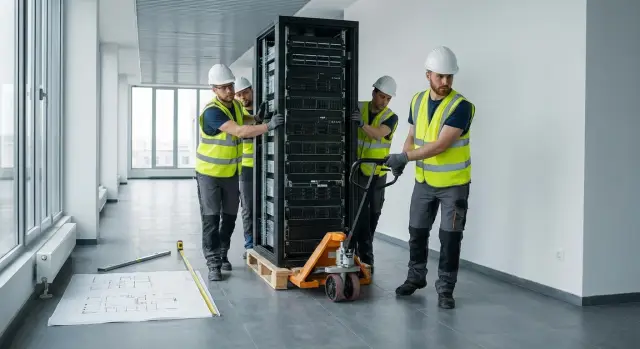
Why inspect the site before delivery
Even if a building looks convenient, most often the rack or a heavy server gets stuck not at the server room but on things along the route. An extra cabinet by the entrance, a tight turn in the corridor, or an elevator that won’t fit the packaging can easily ruin the schedule: the equipment stays on the ground floor and the crew stands idle.
BTI plans and confident answers from security help only partly. Plans rarely show turnstiles, mats with raised edges, door closers, protruding radiators, or temporary partitions. And the reception desk may not know the elevator’s load limit, the real width of an opening, or the unloading rules at certain hours.
If the route isn’t checked in advance, everyone is at risk. IT gets delays and postponed launches. Facilities management faces conflicts with the landlord and building services. Contractors face re-visits, crew downtime and responsibility for damage to walls, doors and the equipment itself. This is especially critical for server racks: they are large, hard to maneuver, and carrying them by hand is often prohibited.
Usually the same things cause trouble: doors and “clear” passages are narrower than on paper, turns have a small radius, elevators have short cabins, there are thresholds and level changes, and floors have load restrictions.
An inspection needs more than just centimeters. Consider the weight, type of packaging (pallet, wooden crate), center of gravity height, and how a trolley or pallet jack will turn the load. In integration projects such checks are often done before the delivery date so the right rigging method can be chosen and plans don’t have to be changed on site.
What information to collect before going to the site
Before you go, gather information about the cargo. Otherwise you’ll measure passages "on average," and on site you’ll find the rack doesn’t fit because of the packaging.
-
Dimensions. Request the dimensions of the rack and each server exactly as packaged: crate, pallet, protective corners, top strapping. Clarify any protruding elements. Often the cabinet itself fits but the pallet does not.
-
Weight. You need the weight of each package separately and the total weight of the shipment. For a fully assembled rack or heavy servers, it’s important to know where the center of gravity is: this affects the choice of trolleys, straps and number of people required.
-
Handling rules. There may be restrictions on tilting, requirements to transport strictly upright, or bans on laying equipment on its side. If you ignore these, the packaging can be damaged before entering the building.
-
Unloading conditions. Decide in advance whether unloading will be "from the tailgate," whether a tail-lift vehicle is needed, if there is a ramp, and whether the vehicle can approach close to the entrance. These details save hours on delivery day.
-
Contacts and decision authority. Record contacts for the person responsible for acceptance, security, elevator access and the server room. Clarify who can quickly approve a route change if a restriction appears on site.
Step-by-step inspection route: from street to server room
The inspection starts not at the building door but at the actual unloading point. You need to understand where the vehicle can legally and safely stop and how many meters the load must be rolled to the entrance.
Check the site: the width of the driveway, the possibility of reversing, presence of a barrier, space for a tail-lift and pallet jack. Surprises often begin with small details: parking bollards, a narrow driveway into the yard, or a no-stopping rule during working hours.
Then walk the route with a tape measure and note obstacles. Pay attention to curbs, ramps and slopes as well as the floor surface. On tiled floors with joints a heavy load moves worse than on smooth concrete: wheels can catch on a seam and jam.
At the entrance, clarify access rules: passes, permitted carry-in hours, where you can wait without blocking an evacuation exit.
Inside the building, move along the path the load will take: the same corridors and doors. During the walkthrough it’s convenient to mark five points:
- where you will unload and which entrance you’ll use
- the narrowest spots (doors, vestibules, 90-degree turns)
- where you can safely stop and set the load down for a minute or two
- access restrictions (controlled areas, "by request only," elevator lobbies)
- finish: the server room or temporary storage area and who opens it
If the server room is not ready to receive equipment immediately, agree in advance on a temporary storage spot near the route. Otherwise heavy items may need to be moved across the building twice.
Passages, doors and turns: what to measure
Most problems on delivery day happen along the route, not at the server room. It’s important to account not only for the cargo dimensions but also how it will pass in packaging, on a trolley, and with people walking alongside.
Start with doors along the whole route: the entrance group, turnstiles, vestibule, elevator lobby, floor doors and the server room door. Measure the clear opening width and height at the narrowest point. Account for protrusions: closers, handles, readers, frames, and also that packaging adds several centimeters all around.
Separately check thresholds, strips, mats, door guides and narrow vestibules. If there’s a level difference, decide in advance whether a ramp or small plate is needed.
For turns, the turning radius matters: the trolley and load need space not only between the walls. Mark spots where a 90-degree turn is required and check whether there is enough space to rotate the rack without tilting or hitting walls.
A practical check order is simple: find the narrowest opening and compare it to the packaged dimensions; check whether there’s room for hands and helpers at turns; mark doors that can be fixed open.
Sometimes a problem is solved in five minutes—but only if everything is agreed. Example: a rack fits by width but hits a door closer at the top. With access to the fasteners and permission, the closer can be removed or fixed quickly. Without approval you can easily lose an hour waiting for a responsible person.
Corridors and internal obstacles
Inside the building, protrusions and "temporary" items not shown on plans cause the most trouble. Measure corridor widths not just wall-to-wall but accounting for radiators, columns, fire cabinets, turnstiles, security desks and furniture. Height surprises also happen: suspended ceilings, cable trays and signs sometimes hang lower than expected.
Look at the floor covering. Tile can be slippery, carpet slows a trolley, and resin floors have joints with level differences. Note thresholds and door guides separately: a small step can easily "break" a wheel and force you to tilt the load.
Corners and maneuvering areas often solve everything. Even if a straight corridor is wide, a turn may not have enough space. Find points where you can safely stop, level the load and continue without blocking the passage completely.
Before delivery day confirm that the route will be clear: no repairs or temporary barriers, corridors not cluttered, doors opened, keys and responsible persons on site, and no queue at reception due to access control.
Elevators and stairs: check before delivery day
The elevator often determines whether delivery will be fast or require carrying in parts. Check it beforehand, not when the equipment is already at the entrance.
First, make sure the load physically fits. Important are the cabin dimensions, door opening and the diagonal. A rack on a pallet or a server in a rigid crate can have protrusions that catch at the last moment. If there are vestibule doors before the elevator, measure them as well.
Next, check rated load and real restrictions. Sometimes the nominal capacity is enough, but there are rules about weight distribution or bans on pallet jacks with small wheels without protective mats. On site, record: cabin and opening dimensions (including height), allowable mass, whether there is a freight elevator and who grants access, the ability to approach and turn near the elevator doors, and thresholds and tracks.
If there’s no freight elevator or it’s unavailable, assess the stairs. Look not only at the stair width but also at landings: where you can place the load, turn and pause safely. On steep stairs the risk of impact and injury increases.
In many business centers the freight elevator must be booked in advance, and security won’t let riggers in without a request. Plan a time window and confirm it a day before.
Floor load, ramps and point loads
Even if everything fits through doors and elevators, surprises often wait at the final spot—the floor where the rack will stand. It’s important to understand in advance where the rack will be placed and what the slab can bear at that specific point, not just "average per floor." If no documents exist, request allowable loads and floor type from the building manager.
The issue isn’t only total weight. Point loads are critical: rack feet, wheels, rigging rollers, jacks. The same cabinet may be safe on a solid slab but risky on a raised floor or soft covering.
On site check the floor type, support points, thresholds and slopes, whether rollers can be used without damage, and what to protect the flooring with (mats, plywood, steel plates).
Assess ramps and slopes realistically: the heavier the load, the higher the risk of runaway or loss of control. If the incline is significant or there’s a turn on an inclined section, plan safeguards (slings, winches, extra staff) and protect the covering with plates.
Rigging, packing and work safety
Deliveries often fail on the simplest things: nothing to move the load off the pallet, no one to control movement, packaging obstructs handling or creates risk for people. Rigging and safety are better thought through in advance.
Choose equipment by weight and dimensions, not "what’s available on site." Typically you need at minimum: a pallet jack or trolley with the right capacity, rigging rollers for short sections, straps and a spreader bar (if using a hoist or crane), jacks for precise placement of rollers, and guide plates or ramps for thresholds.
Packaging should protect not only from impacts but also from corner damage and tilting during movement. It’s convenient when equipment is secured to a pallet, has a rigid crate for long transports, straps and a marked center of gravity. Decide in advance where to put pallets, stretch film and crate material so evacuation routes aren’t blocked.
On-site safety plan
Assign one movement leader: they give commands and stop work if risk appears. Before starting agree on simple rules: one person commands, others follow; maintain a "clean" zone without bystanders; people wear proper footwear and gloves; monitor thresholds, slopes and wet floors.
Consider environmental conditions. If equipment arrived from the cold, don’t unpack it immediately in a warm server room. Let it acclimatize to avoid condensation getting inside.
Common mistakes that cause cargo to get stuck
Delays almost always come from details.
The most common mistake is using passport dimensions and forgetting packaging, pallets and protrusions. "600 mm" can easily become "700+" and the load won’t fit a doorway or elevator.
The second mistake is checking only the main entrance. In practice things get stuck at turnstiles, vestibules, reception desks, framed doors and turns. Sometimes a door is wide enough but only opens to 80 degrees, and that’s enough to stop the carry-in.
The third problem is overestimating the elevator. People often look only at rated capacity and don’t consider cabin size, opening, diagonal clearance, and the need to book it.
The fourth mistake is ignoring point loads. The floor may bear the total weight but rollers, pallet jacks or jacks concentrate load on a small area. On tiles, raised floors and at covering seams this easily leads to damage and a stop to the work.
And one more thing people forget: plan B. Have an alternate route (another door or elevator) and a temporary storage place in case access to the server room is suddenly closed.
Short checklist 24 hours before delivery
A day before the truck arrives confirm the critical items. A small thing like a closed service entrance can ruin the delivery.
- Route confirmed on site: where you will unload, which entrance is open, which corridors you’ll take, which elevator is working, how you enter the server room.
- Dimensions checked against packaging: doors, elevator (opening and cabin), corridor widths and turns. Check if a leaf can be removed or stops taken off temporarily.
- Delivery window agreed: security, building manager, parking and freight entrance access, elevator mode, passes for the crew.
- Protection ready: floor protection (cardboard, plywood, rubber), corner protectors, tape, straps.
- Responsibilities assigned: contacts on site, at the supplier, security and elevator dispatcher. It’s clear who decides on site.
If the delivery includes heavy servers and a rack, request a final sheet with weight and dimensions of each packaged unit and the distribution across positions. It’s easier to understand what can actually go in the elevator in one trip and where you need a pause to check the floor and fastenings.
Practical example: a delivery to an office building without surprises
A new 42U rack and two heavy servers needed to be delivered to a server room on the 3rd floor. On paper the building looked simple: a freight entrance, elevator and wide corridors. But deliveries on such objects often fail on small things.
The inspection found two stop factors. First — a narrow vestibule at the main entrance: the packaged rack couldn’t turn on the corner. Second — the elevator’s capacity was enough but length-limited: when the doors closed the rack didn’t fit diagonally because of a protruding handrail and panel.
They made decisions in advance. Facilities agreed on an alternative entrance from the parking side where a straight corridor had no vestibule. On the floor they temporarily removed one door leaf by agreement, and protected the corridor and elevator floor with sheets and film. The rigging plan and work time were approved in advance, so the crew didn’t stand idle.
For approvals they prepared a simple package: photos of the route from the street to the server room, measurements of openings and packaged cargo dimensions, elevator data, a letter to temporarily remove a door leaf and protect the floor, and contacts of responsible persons from security and facilities.
Next steps: how to organize delivery and installation
It’s best to put inspection results into one clear document so every participant sees: what we’re bringing, where we’re going and who decides if something goes wrong.
Start with a delivery card: dimensions and weight of each unit, packaging type, how many people needed, required equipment (trolley, pallet jack, tail-lift), and the exact route from unloading to the server room with narrow spots marked.
A day before arrival a short confirmation call is useful: security, passes, entry procedure, where the truck can park, how to get to the elevator and who opens the server room.
Prepare the destination. The server room should be free, the route covered with protective sheets where needed, and the installation area should have space for unpacking and removing packing. If installation isn’t the same day, define a safe temporary storage area with restricted access.
If delivery includes installation, agree in advance on rigging time (including the building’s "quiet hours"), lift and carry points, required permits and briefings, and readiness of power, grounding and the installation spot.
For complex projects it’s convenient when a single contractor links inspection, delivery, rigging and ongoing support into one plan. For example, GSE.kz (gse.kz) as a manufacturer and systems integrator often gets involved at this stage to prevent a situation where equipment is already on site but the "on-site conditions" are not ready.
Frequently asked questions
Why inspect the site before delivering a server rack?
Conduct a site survey before confirming the delivery date. Compare the route from the unloading area to the server room with the packaged equipment's dimensions and weight.
Which elevator parameters should be checked?
You need the cabin's width, depth, and height, door-opening dimensions, permitted load, and room to turn in front of the elevator. Also check thresholds and freight elevator booking rules.
How should a doorway be measured correctly?
Measure the clear width and height at the narrowest point with the door fully open. Account for handles, closers, card readers, thresholds, and palletized packaging.
Why might a rack not fit through a wide corridor?
Check the corridor width, taking furniture, radiators, columns, and fire cabinets into account. At turns, assess the space needed for the trolley, the load, and the people accompanying it.
Do you need to check floor load capacity?
Ask the building management for the permitted load and clarify the floor type. Separately assess the load from trolley wheels, rollers, and the rack's feet, especially on a raised floor.
What should be prepared for unloading equipment?
Decide where the truck will stop, whether a tail lift or loading dock is needed, and how many meters the load must be moved to the entrance. Confirm unloading hours and crew passes.
What rigging is needed for a heavy server or rack?
Use a trolley or pallet jack with suitable load capacity, floor protection, and equipment for crossing thresholds. For heavy items, appoint a work supervisor and agree the command sequence in advance.
Should packaging be considered when taking measurements?
Compare openings with the external dimensions of the crate or pallet, not the cabinet itself. Protective corner guards and strapping often add several centimeters.
What should you do if the main route is unexpectedly closed?
Arrange an alternate entrance or elevator and a safe temporary storage area. This prevents equipment from being left at the entrance if access to the server room is delayed.
What should be checked the day before delivery?
Confirm the route, site access, elevator operation, passes, and responsible contacts. Check the packaged load dimensions again against doors, the elevator, and turns.
