6 min read
IT Trends 2024: What Changed in Hardware and Infrastructure
IT trends 2024: what changed in IT, desktop and server hardware, which ideas became mainstream and how to factor them into plans for 2025.
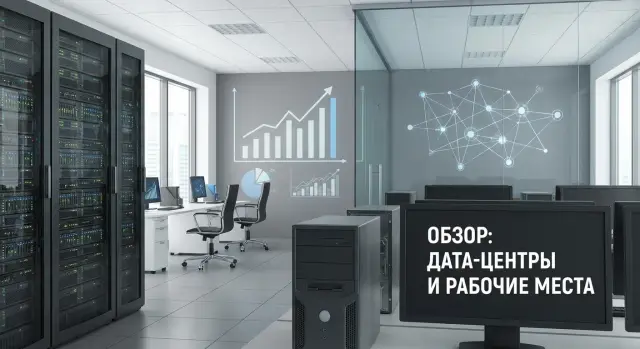
What this overview is about and how to read it
2024 turned out to be important not because of a single big announcement, but because infrastructure requirements changed quickly. AI workloads became a routine task, procurement still required planning for lead times and budgets, and security started being treated as basic hygiene rather than a standalone project.
This text helps you quickly understand what really changed and what to consider when refreshing PCs and servers. Look at each point through a simple question: what will you do differently next quarter?
We don't talk only about “boxes” but about how everything works together: endpoints, servers and racks, network, storage, backups, observability, security and support. The weak spot is usually not where you “lack cores”, but where there is no monitoring, storage is miscalculated or updates are not planned.
You can read it straight through or pick sections: if you manage the office start with the PCs section; if you're responsible for infrastructure go to servers and approaches.
Main IT shifts of 2024 in one place
2024 reinforced a simple idea: infrastructure no longer lives separately from the organization's tasks. Priorities became more pragmatic: deliver results faster and take fewer risks when load, energy price or supply availability change.
AI stopped being an “experiment” and became part of workflows: internal document search, in‑app suggestions, ticket analysis, draft generation. This raised requirements for workstations and servers: memory and storage speed were hit more often, and GPU needs started to be evaluated selectively. Many organizations settled on a compromise: keep some tasks on CPUs and add accelerators where they pay off.
The second shift is attention to energy efficiency and total cost of ownership. People increasingly count not only purchase price but also electricity, cooling, downtime, support and expansion planning. Questions like “watts per unit of work” and “what will this look like in three years” returned to discussions.
The third is demand for predictable deliveries and supply‑chain transparency. For regulated organizations this became a practical requirement: component origin, lead times, service network, and the speed of replacing a node without stopping critical systems.
In practice, four themes came up most often: upgrading PCs without user disruption, data growth and backup needs, security as a standard, and teams short on time wanting more automation.
A telling 2024 scenario: an organization updates office PCs while rolling out an internal AI assistant. If you choose minimal configurations “like before,” within months the browser, video calls and new tools will hit memory and disk limits. So teams increasingly start from workload profiles, then fix specs and timelines.
Computer hardware 2024: what's changed in the office
In 2024 office PCs moved closer to AI tasks, even when a company doesn't buy discrete GPUs. A notable shift is the growing role of NPUs (neural processors) and built‑in AI features. Users see this in everyday things: noise suppression in calls, improved webcam images, local app suggestions. In some scenarios it's useful that part of processing can be done locally without sending data outside.
At the same time the move to new CPU generations and wider DDR5 adoption accelerated. For the office this is not about “wow speed” but about a 3–5 year buffer: more tabs, heavier files, more background security and management agents. Remember operations: a new platform may require unified BIOS policies, up‑to‑date drivers and correct power settings — otherwise gains will be invisible and problems will increase.
Repairability became the number one criterion
After years of supply instability many organizations choose PCs to be serviced quickly on site. Simple rules work: standard SSDs and memory, clear component access, predictable batches. This reduces downtime and simplifies spare‑parts inventory.
Before procurement check three things: how standard and available components are in your region, whether disks and memory can be replaced without complex disassembly, and how warranty and service for an office fleet are arranged.
Bottlenecks moved to the periphery
In 2024 performance issues more often came from peripherals: monitors, docking stations, cables, cameras and headsets. More meetings and hybrid work made video quality and ease of connection almost as important as compute performance.
Typical repeat issues: a dock won't drive two monitors at the needed resolution, a USB‑C cable doesn't carry power, a camera conflicts with a driver, a headset works intermittently with corporate software.
To avoid hitting this after delivery, run compatibility tests on your corporate image in advance: drivers, security agents, disk encryption, update policies and key apps. Only then finalize the configuration.
Servers and data centers 2024: practical trends
In 2024 server discussions increasingly started with: how much work do we get per watt and per rack? Higher energy prices and power limits in server rooms made density and efficiency key parameters.
Efficiency and accelerators: CPU is no longer the only hero
Performance per watt became decisive because the bottleneck often isn't computation but power consumption and cooling. When upgrading, teams count not only server cost but also monthly power bills, UPS needs and conditioning.
GPUs in servers in 2024 stopped being only about model training. They were deployed for big‑data analytics, accelerating VDI and graphical workstations, visualization (CAD and medical imaging), video analytics and recognition.
GPUs add not only speed but requirements for power, ventilation and chassis space. Check these constraints before purchase, not after rack installation.
Data, network and cooling: what actually changes reliability
A simple shift in storage: SSDs became standard where latency and predictable throughput matter (virtualization, databases, hot datasets). HDDs remain suitable for archives, backups and cold storage where cost per terabyte beats response time.
Networks were upgraded “as needed.” Demand grew for faster links between servers and storage, and even more for headroom. Many now design with spare capacity so they don't hit a ceiling within a year because of more VMs, replication and backups.
On cooling the common question is: when to think about liquid cooling? Usually when dense racks with powerful CPUs and GPUs appear and temperature and noise exceed comfort levels.
A practical example: a hospital updates servers for medical systems and image archives. Databases and current research are sensible on SSD; the archive on HDD; and a GPU added to speed image processing. Success depends on grounded checks: is there enough power on PDUs, can air conditioning cope, and won't the network become the bottleneck?
Infrastructure approaches: hybrid, automation, observability
The focus shifted from “where to deploy” to “how to reliably run and support.” Hybrid models became entrenched: some systems stay on‑prem, some move to the cloud, and management is unified as much as possible.
Hybrid as the norm: what lives where
On‑prem normally keeps what requires strict control, predictable latency and transparent operations. The cloud hosts what is easier to scale and quicker to spin up.
In practice the split often looks like: critical databases and accounting systems remain on‑prem; test environments and temporary loads go to the cloud; remote access and integrations live at the “edge” where access policies and logs matter; backups and key management should be consistent everywhere.
Containers and platforms are chosen not “for Kubernetes’ sake” but for clear operations: updates without downtime, consistent environments, fewer manual steps. Solutions that the existing team can support win over options requiring rare specialists.
Observability as basic hygiene
Where previously “server monitoring” might have been enough, the minimum now is to see the whole request path and quickly find bottlenecks.
A good starting base: three signal sources connected together — metrics (utilization and latency), logs (errors, audit, security events) and traces (where time is lost across services).
The quickest wins come from automating routine: repeatable deployments, configuration templates, update checks, and self‑healing for common failures. This helps release changes more often without dropping reliability.
Cybersecurity 2024: what became the mandatory minimum
In 2024 it became clear: attacks are routine. Ransomware, mass phishing and supplier compromise — when issues come through an update, contractor or service account — were common. The main conclusion is simple: security must work even when people make mistakes.
“Just antivirus” no longer covers basic scenarios. It catches some malicious files but is often powerless against stolen passwords, email spoofing, legitimate admin tools abused by attackers and attacks on backups.
The minimal set that became normal for almost any organization in 2024:
- MFA everywhere that accesses mail, VPN, admin panels and cloud services.
- Network segmentation: separate workstations, servers and critical systems.
- 3‑2‑1 backups, including an offsite copy and regular restore verification.
- Patch management: quick deployment of critical patches and clear maintenance windows.
- Privilege control: fewer local admins and separate admin accounts.
A particular pain point in 2024 was patches. A missed critical update often becomes an entry point. A fixed process (who, when, how tests and rolls out) is better than “when there's time.” Even small teams benefit from a weekly rhythm and a list of systems where update delays are unacceptable.
Agree RPO/RTO and system priorities with management ahead of time. When numbers are set, it's easier to decide where hot standby is needed, where backup suffices, and where isolation and strict access matter more.
How to convert 2024 trends into action: a step‑by‑step plan
Trends are easy to read as news but harder to turn into decisions. Start with real tasks and measurable constraints: where it's slow, where things break, where risk lies.
Five steps that bring clear results
Assemble IT, security and key service owners and follow this plan:
- Record services and bottlenecks: performance, reliability, security, and how they are measured (response time, downtime, incidents).
- Split endpoints into 3–4 classes and describe a typical user day: apps, tabs, video calls, graphics.
- Estimate server and storage load for 12–24 months: data growth, new systems, downtime requirements, backups.
- Choose 2–3 standard configurations and verify compatibility: OS, drivers, peripherals, encryption, security policies, licenses.
- Plan operations: spare parts, repair windows, migration plan and where support is needed.
A small example
If ticket volume at the service desk grows, the cause is often not “weak PCs overall” but mixed models and varying OS images. A couple of standard endpoint profiles and a unified support approach usually deliver quick improvements.
Typical mistakes when choosing PCs and servers after 2024
In 2024 many refreshed hardware faster than usual: sometimes because of AI workloads, sometimes because of procurement transparency needs. In the rush the same mistakes repeated, and most hit operations, not the purchase itself.
The first trap — buying the “most powerful” instead of the right profile. For the office quiet operation, driver stability and a fast SSD often matter more than a top CPU. For servers it's more important to pick memory, disks, network interfaces and expansion headroom correctly than to chase more cores.
Second — underestimating power and cooling. A new server may not fit the rack's power budget, fail thermal limits or require a different class of UPS. Result: hardware bought but constrained or idle while racks and electricals are reworked.
Third — remembering service only after failure. Without clear repair times, spare parts and service coverage, a small failure becomes long downtime. For critical systems, validate 24/7 support and how it works in your regions in advance.
Fourth — mixing incompatible generations and losing weeks on images and drivers. One “special” PC or controller breaks a unified image, complicates updates and raises error risks.
Fifth — skimping on backups and recovery tests. Budget often gets cut for storage, secondary sites or regular checks, and downtime becomes expensive.
A short pre‑purchase checklist:
- Define 3–5 typical scenarios (office, analytics, 1С, virtualization) and their requirements.
- Calculate power and heat for racks, UPS and the room.
- Verify SLA, service and spare‑part availability in your cities.
- Check compatibility with current images, OS, drivers and security policies.
- Plan backups and a restore test before production launch.
Case study: refreshing an organization's IT fleet
A company with 450 employees decided to update desktops and part of the server room. Old PCs slowed work, support spent time on “floating” issues, and servers couldn't keep up with VM growth. The goal: speed up work and reduce downtime without stopping accounting, mail and internal services.
IT first grouped users into clear categories. This removed the “everyone the same” debate and helped budget more accurately.
Office needs: mail, documents, web services and video calls. Engineering roles: heavy spreadsheets and occasional CAD. Contact center: stable operation all day, headsets and several concurrent apps. Managers: mobility and frequent meetings, often with two monitors. Shared zones (meeting rooms, reception, training) prioritized easy maintenance and uniform configurations.
Server choices were task‑driven, not name‑driven. For virtualization they allocated headroom for CPU and memory. File services focused on disks and clear backup policies. Databases got a faster disk subsystem and failover planning. AI pilots were placed deliberately so experiments wouldn't affect production services.
The migration plan was “no surprises.” Key services were stood up in parallel on the new infrastructure, load tests were run, data moved in stages and a short cutover window scheduled outside business hours. For endpoints they ran a pilot with 20 people, fixed typical issues (profiles, printers, permissions) and then rolled out.
Results were measured by downtime per quarter, ticket count and app startup times. The business saw fewer freezes, faster task completion and an IT team spending more time on development than firefighting.
Quick checklist before procurement and upgrades
Buying hardware often becomes “faster and cheaper.” In practice winners are those who first fix tasks and operational requirements, then compare models.
Before finalizing specs, check five items:
- Workload profile: for PCs (office, analytics, graphics), for servers (virtualization, databases, file services) and what will grow in 12–18 months.
- Performance headroom: memory usually runs out before CPU. For servers plan expansion paths.
- Storage and resiliency: disk types per workload, RAID, IOPS and capacity forecasts, failure scenarios.
- Network and manageability: port speeds, compatibility with current switches, remote management, access and encryption requirements.
- Operations: monitoring, backups, restore tests, asset tracking, plus lead times, service and spare parts.
Also verify paperwork: regulatory requirements for your industry, internal security rules (passwords, encryption, log retention) and who approves the threat model. These often appear late and stall procurement.
What to do next: a plan for 2025 and practical next steps
The most useful lesson from 2024 — those who plan updates early and validate solutions with small pilots win. Use the year's conclusions as input, but turn them into concrete tasks for 2025: what to update, why, by when and by which metrics we'll judge success.
Start with a short inventory: where are current bottlenecks (old PCs, overloaded servers, weak security points), and where risks will appear in 6–12 months (data growth, new storage requirements, staffing shortages). Then build a quarterly roadmap: pilot, procurement, deployment, training, and control.
If you lack resources for design and rollout, consider bringing in a systems integrator and include ongoing support where it's critical. For organizations in Kazakhstan that need local support, transparent supply and procurement compliance, consider the local manufacturer and integrator GSE.kz — the company has domestic PC and server production and a 24/7 support network.
Frequently asked questions
Where to start when upgrading PCs so you don't pick the wrong configurations?
Start from workload profiles, not a “generic PC”. - Split users into 3–4 groups (office, analytics, engineering, contact center). - For each group record: applications, typical tabs/files, video calls, peripherals. - Based on that, choose 2–3 standard configurations and pilot them with a small user set.
Which PC characteristics became more important in 2024 for office use?
Plan for extra RAM and a fast SSD — these are the components that run out first. Practical minimum for most office roles: - RAM: provision extra for 3–5 years, especially with heavy browser use and video calls. - Storage: a fast SSD is more important than a top-end CPU. - Compatibility: verify drivers and policies (disk encryption, security agents, updates) before locking the model.
Why did repairability become the key criterion when choosing PCs?
Because downtime usually comes from small failures, not lack of performance. What to check in advance: - standard SSDs and RAM for quick replacements; - component access without complex disassembly; - predictable production batches (fewer surprises with drivers and images); - warranty terms and realistic repair times.
How to avoid issues with docking stations, monitors and headsets after delivery?
Problems often come from the surrounding equipment: docks, cables, cameras, headsets. To avoid surprises: - test on your corporate image (drivers, agents, disk encryption); - verify dual‑monitor operation at the required resolutions; - ensure USB‑C cables carry power and video as needed; - test common video‑call scenarios.
What matters most when choosing servers in 2024?
Count not just “how many cores” but “how much work per watt and per rack”. Minimum questions before buying: - is there enough rack power (PDU, UPS, room limits)? - can the cooling handle your density?; - where is the bottleneck: CPU, memory, disks, network?; - how will you scale in 12–24 months?
When does a server really need a GPU, and when can you manage with CPUs?
Buy a GPU when you have a clear task and a measurable benefit. GPUs are usually justified for: - video analytics and recognition; - VDI/graphical workstations; - visualization (CAD, medical imaging); - big‑data analytics. Before purchase check power, ventilation, chassis space and cooling requirements — these constrain more than the price of the accelerator.
What to choose for storage: SSD or HDD, and how not to miss the mark?
Basic rule: - SSD — for virtualization, databases and “hot” data where latency and consistent speed matter. - HDD — for archives, backups and cold storage where cost per TB matters more than latency. Also estimate IOPS, capacity and failure scenarios (RAID/replication) in advance so storage doesn't become an unexpected bottleneck.
When should you consider liquid cooling and rethink the server room?
When rack density and heat dissipation grow sharply: powerful CPUs, GPUs and high utilization. Signs to recalculate cooling: - temperature and noise exceed acceptable levels; - the rack hits power limits; - frequent throttling and instability under load. Even if you don't move to liquid cooling, calculate heat now and plan rack distribution.
How to tell if hybrid infrastructure is right for you, and what to place where?
Hybrid is the norm when you need tight control over some systems and fast scalability for others. Typical split: - on‑prem: critical databases and ERP systems where control and latency matter; - cloud: test environments and temporary loads; - edge/border: remote access and integrations where policies and auditability are key. Key principle — unified rules for backups, keys and access across environments.
What is the "mandatory minimum" for cybersecurity that became standard in 2024?
The minimum that should work by default: - MFA for mail, VPN, admin panels and cloud services; - network segmentation (separate workstations, servers and critical systems); - 3‑2‑1 backups including an offsite copy and regular restore tests; - a managed patch process (rhythm, maintenance windows, owners); - privilege control (fewer local admins, separate admin accounts). This covers common scenarios: phishing, ransomware and human error.
How to analyze 2024 trends and apply them: a step‑by‑step plan?
Start with real problems and measurable constraints: where it's slow, where failures happen, where risks are. Five steps that deliver clear results: - List services and bottlenecks: performance, reliability, security, and how you measure them (response time, downtime, incidents). - Classify endpoints into 3–4 tiers and describe a typical user day: apps, tabs, video calls, graphics. - Forecast server and storage load for 12–24 months: data growth, new systems, SLA requirements, backups. - Pick 2–3 standard configurations and test compatibility: OS, drivers, peripherals, encryption, security policies, licenses. - Plan operations: spare parts, repair timelines, migration plan, and where support is required.
What to do next: a practical plan for 2025 and next steps?
Common checklist before purchase: - Define 3–5 typical scenarios (office, analytics, 1С, virtualization) and their requirements. - Calculate power and heat for racks, UPS and the room. - Verify SLAs, availability of service and spare parts in your locations. - Check compatibility with your current images, OS, drivers and security policies. - Schedule backups and a restore test before going live. Also review regulatory requirements for your industry, internal security policies (passwords, encryption, log retention) and who approves the threat model — these often surface late and delay procurement.
