8 min read
Importing enterprise equipment into Kazakhstan: project timelines
Importing enterprise equipment into Kazakhstan: how to allocate time for certification, customs and logistics so the project doesn't fail.
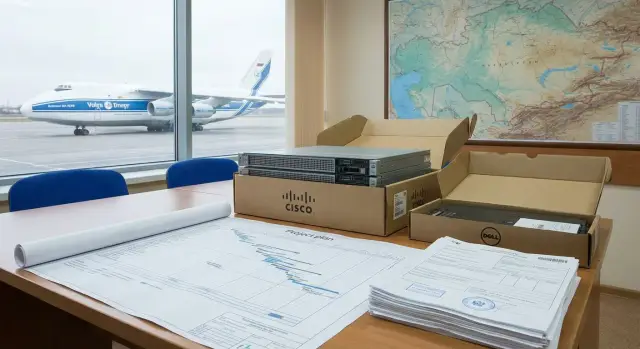
Where projects most often lose time
Schedule slips usually don't come from a single big failure, but from a chain of small delays that no one accounted for. With importing enterprise equipment into Kazakhstan this is especially visible: the shipment can be "on schedule," yet commissioning gets pushed back by weeks.
Three groups of reasons usually break the timeline.
The first is paperwork. Different parties have different understandings of which certificates and letters are required, who prepares them and by what date.
The second is customs. Even with correct tariff codes and invoices, clearance can take longer if a complete package wasn't prepared in advance or questions arise about the item's purpose.
The third is the site. Racks may not be ready, there may be no power, work windows may be uncoordinated, or server-room access may be limited.
It's important to separate "delivery time" from "commissioning time." Delivery ends at the warehouse or on site. Commissioning requires people, access permits, installation, tests and often integrator involvement. A server may arrive on time, but launch will be delayed if the data center still lacks power lines or agreed network changes.
Almost always several roles are involved, and each can unintentionally stop progress if there isn't a single owner of the schedule. Typically these are procurement (contract and payment milestones), IT (configurations and site requirements), legal/compliance (documents and license nuances), logistics/brokers (routing and customs procedures) and the integrator (deployment plan, work windows, acceptance tests).
A common source of disputes is what to consider the "delivery date." Fix this in the contract and the project plan: delivery to the border, to a warehouse in Kazakhstan, to the site or acceptance by act. It helps to agree in advance which documents close each stage: waybill, acceptance act, serial numbers, photos of packaging, completeness notes. That way timelines are comparable instead of "everyone meaning something different."
If you work with a local manufacturer and integrator, some coordination risks are usually reduced, but dates and responsibilities should still be written down before start.
What an enterprise delivery includes and how it affects the schedule
When people talk about importing enterprise equipment into Kazakhstan they often imagine a single box with a server. In reality the delivery almost always comprises a set of interdependent parts, and a delay of one item easily shifts the whole project.
An "enterprise kit" usually includes not only the devices themselves, but everything needed to rack them, power them on and accept them into operation. If you don't plan for this, the installation team and the site will wait for "one last small thing."
Items that most often affect timelines:
- Servers, storage systems (SAN) and network equipment — the core with the longest lead times for production and delivery.
- Options and consumables — rails, power supplies, SFP modules, cables, expansion licenses. These are often forgotten in the initial order.
- Racks and infrastructure — rack space, power, PDUs, cooling, grounding.
- Software and licenses — activations, account bindings, keys, entitlement for updates.
- Deployment services — design, installation, migration, testing, training. These also need calendar windows.
Lay out dependencies in advance. The network must be ready before cluster configuration. Specific firmware versions and compatible adapters may be required for virtualization. A separate risk point is power: if it turns out different plugs, additional lines or more capacity are needed, timelines will slip even if the hardware was delivered.
A simple approach helps: split the delivery into "critical for start" and "can be added later." First you typically need core servers, a minimal network, racks and everything required for powering on and initial tests. The rest can be planned in a second wave.
What can be covered locally to save time
Some items can be replaced by a local equivalent without losing requirements, especially workstations or standard servers for common tasks. For example, the Kazakhstan manufacturer GSE.kz has server lines S200 and PCs L200 that in some projects can reduce import wait times. The key is to document requirements (performance, form factor, compatibility, warranty) and agree on the substitution before procurement.
Mini scenario
If the project is for a bank and it's critical to quickly raise a test environment, the first phase brings a basic set of servers and switches. Disk expansion, additional licenses and some workstations are planned for a second phase. This way configuration and acceptance start earlier even if the "tail" of the delivery is delayed.
Certification and permits: what to check in advance
If you plan to import enterprise equipment into Kazakhstan, collect documents before placing the order. Most often time is eaten not by transport but by clarifications on paperwork when the cargo is already ready to ship.
What documents are usually needed before and at import
The required package depends on equipment type and what exactly is imported (servers, storage, network, UPS, modules, cables). Typically authorities ask for proof of conformity (certificate or declaration) and a technical description showing purpose and key characteristics.
Check separately whether any functions require additional approvals. Devices with Wi‑Fi/Bluetooth, radio modules or encryption capabilities can fall into special procedures and may require specific conclusions or notifications. Even if they usually pass, allocate time for checks in advance.
Before shipment request from the manufacturer/supplier:
- exact commercial name and model (as on the nameplate);
- technical description and specification (for the correct HS/TN VED code);
- conformity documents (certificate/declaration and attachments listing models);
- list of serial numbers or rules for their formation;
- information about radio modules and encryption (to immediately determine if extra procedures are needed).
Where questions most often arise
The most frequent cause of delays is inconsistent wording. The invoice may list one model, the certificate another (or a series named broadly), and the box a third. Customs and control bodies look for matches in "name–model–purpose."
Second risk area is serial numbers and kit composition. Enterprise deliveries include many items: chassis, power supplies, controllers, disks, licenses. If serial numbers are required for an acceptance act/register but the supplier provides them only after assembly at the warehouse, this can easily add 3–7 days.
Third — the HS/TN VED code. A wrong code can unexpectedly trigger a document requirement no one expected. Therefore the technical description should be simple and precise, without marketing terms.
Translation, notarization and agreeing wording
Clarify in advance in which form documents will be accepted: are English copies enough or is translation into Russian/Kazakh required, is notarization or stamps needed, are originals required? It is often critical to align identical wording in invoice, packing list and conformity document.
Example: for a government buyer you purchase a rack with servers, storage and switches. If the certificate specifies a series but not concrete module models, a manufacturer's letter with a breakdown may be required. Better obtain that letter before shipment, otherwise a border delay will cost more than preparing and agreeing the text in advance.
If part of the project is closed locally (for example, with standard servers), compare import and local parts against document requirements beforehand. This helps avoid the schedule being held up by "the smallest paper."
Customs: stages and real risk points
Customs often looks like a single item in the plan, but in practice it is a chain of actions where any inaccuracy adds days or even weeks. For importing enterprise equipment into Kazakhstan, assume that release depends not only on the carrier's speed but on the quality of documents.
The process usually consists of three steps: classification and description of the goods (code, name, characteristics), preparing the package and filing the declaration, then inspection, possible physical check and release.
The most frequent risk point is an incorrectly determined code and a vague description of the item. Servers, storage systems, network switches and components may be described similarly in specs, but the supporting document requirements and inspector questions differ. It's important that names in the invoice, packing list and specification match in meaning and detail: model, quantity, units, serialization (if indicated), and kit composition.
To avoid unexpected pauses, build a buffer not only for transport but for inspections. Time is most often spent on requests for clarification about characteristics, discrepancies between documents (quantity, currency, delivery terms), selective inspections and recounts, a missing document in the chain and adjustments after declaration filing.
A practical rule is to prepare a "clean" specification where each item is described identically in all documents. If the shipment includes racks, rails, cables, licenses or spare power units, list them as separate lines rather than hiding them in a generic "kit."
Example: an organization ships a batch of servers and rack accessories. The invoice lists rails as part of the kit, while the packing list itemizes them separately. On inspection they ask what exactly is in the boxes and request clarification on the composition. If clarification and correction take 2–3 days, not only delivery but also data center work windows shift.
The earlier you agree codes, wording and kit composition, the lower the chance that customs becomes an unexpected bottleneck.
Logistics: from the warehouse to the deployment site
Logistics often looks like "just delivery," but this is where importing enterprise equipment into Kazakhstan can lose weeks. It is important to decide in advance not only how to ship but how to receive, unload and transport items to the server rack.
Route choice changes the picture significantly. Air is usually faster but more expensive and sensitive to restrictions on batteries, magnetic media, high-power PSUs and dimensions. Road transport often gives a better price/time balance but depends on borders, queues and road conditions. Rail is convenient for large batches and heavy racks but requires precise scheduling and often adds time for transshipment and terminal paperwork.
Seasonality also matters. In winter, weather increases delay risks, and holiday periods create peaks at borders and transport hubs. If the project ties to a branch opening or the end of a financial period, build in buffers and set firm acceptance dates in advance.
Packaging and documentation matter as much as the route. Servers, storage and network devices should travel in sturdy crates, clearly marked with package numbers and serial numbers. Insurance should cover not only total loss but damage during handling. Delivery and acceptance terms should be agreed before shipment: who bears risk at each segment, who signs the act, how damage is recorded.
The "last mile" often becomes a surprise. Delivery to a data center or office may require passes, agreed entry times, elevator reservations and a rigging crew. Gate clearance height, axle load limits, corridor widths and the ability to bring a rack to the required floor can be critical.
Before shipment check the transport and dimensional restrictions, seasonal risk plans, packaging and marking (including photo documentation), acceptance conditions (who signs and where) and last-mile readiness (passes, unloading, lifting, storage space).
Example: a batch of servers for a site in Almaty arrives on time but building access is only at night and the elevator is smaller than the packaging. As a result unpacking happens outdoors, extra security is needed and installation is delayed. Such issues are revealed in advance with a simple on-site walkthrough and confirming the delivery window.
How to plan project timelines: a step-by-step scheme
In enterprise projects timelines slip not because of "bad delivery" but because certification, customs, logistics and site preparation live in different calendars. Gathering them into one plan up front significantly reduces the risk of surprises.
A simple rule: first fix what exactly is being shipped and by what date it is realistically needed on site, and only then choose the route and shipment dates.
Practical 5-step scheme
-
Describe the delivery composition at item level and by roles. Mark separately what is "critical for start" (without which launch is impossible) and what "can be delivered later."
-
Assemble the document package in advance and align wording for each item. Delays often arise from different names in the invoice, technical description and certificates or from missing exact characteristics (model, serial conventions, purpose).
-
Choose the delivery scheme and set checkpoints in the calendar: supplier warehouse readiness, shipment, arrival in country, customs release, delivery to site. Assign a responsible person and a confirmation format for each stage.
-
Add buffers and a plan B for bottlenecks. A buffer is not "just in case" but targeted for specific risks: documents, customs, mis-sorts, or missing small items.
-
Prepare the site so that on arrival you don't wait for electricians and access. Equipment may already be "in town," but the project will still stop if racks aren't ready.
To make buffers meaningful, attach them to events, not to vague "weeks in the air." Commonly reserve time separately for customs release and potential queries, for replacement/reorder of critical elements (e.g., an SFP module or rails), and for server-room access and downtime windows.
Example: for a rack server and network switch delivery to a branch site, agree in advance who receives the cargo, where it is stored until installation and who opens access to the server room.
Common mistakes that shift timelines
The most frequent source of surprises in projects importing enterprise equipment into Kazakhstan is expectations that don't match reality. On paper it looks simple: order, ship, deliver, install. In practice there are many small steps between those points and any one of them can stop the schedule.
A typical confusion is treating shipment date as the date of readiness for operation. Shipment means the equipment left the supplier's warehouse. After that comes transport, customs procedures, acceptance, unpacking, installation, basic configuration and tests. If this is not included in the plan, the project will inevitably slip.
What is often forgotten in planning
Delays usually start from things that seem secondary until they become blockers:
- Documents aren't assigned to a specific owner: who prepares, who checks, who is responsible for errors in names, serial numbers and codes.
- The order lacks "small items": rails, PDUs, patch cords, SFP modules, power cables of the right length, fasteners.
- Time for acceptance procedures is not allocated: checking completeness, acceptance acts, initial diagnostics and test runs.
- The site isn't ready on the arrival date: power, grounding, cooling, rack space, server-room access, work windows.
- There's no replacement plan: if an item is defective or fails inspection, who and how quickly handles RMA or replacement.
Short example: you ordered a rack and two rack servers, but the rails and PDU are with another supplier and are shipped separately. The servers are physically on site but cannot be installed. The deployment team is idle, the planned data center window is lost and the next slot is a week later.
To reduce such situations, allocate roles in advance (procurement, logistics, documents, site, acceptance) and set a checkpoint 7–10 days before the planned delivery.
Short pre-procurement checklist
Before sending a request to the supplier, gather a short package of input data. It saves weeks because most delays stem from small mismatches: the wrong model on the invoice, different lead times for items, or the site not being ready to accept a rack.
Checklist for procurement, IT and logistics to review together:
- Unambiguous specification: exact models, SKUs, quantities, kit contents (rails, SFPs, cables, licenses), power and form-factor requirements. Highlight items with long production lead times.
- Unified list of documents and responsible persons: who prepares and checks the invoice, packing list, serial numbers, country of origin, description for the HS/TN VED code, and certification/permit paperwork. Appoint one owner who collects everything into one folder.
- Milestone calendar with dates: order and payment, readiness for shipment, departure from the warehouse, border crossing, customs clearance, delivery to site, acceptance and commissioning. For each stage indicate who confirms completion.
- Buffers for critical items and a replacement scenario: where equivalents are acceptable and where substitution requires project redesign (e.g., GPUs, NICs, disk shelves). Agree replacement rules with the architect and security team beforehand.
- Site readiness and work windows: rack space, power, cooling, server-room access, passes, unloading, rigging, and agreed installation windows with IT and contractors.
Example: for critical infrastructure, servers and switches arrive together but the site will only be ready in two weeks due to power works. If known in advance, the schedule can be shifted without emergency work and logistics planned so delivery coincides with the installation window.
If you plan to import enterprise equipment into Kazakhstan, it is useful to compare this checklist with the integrator or manufacturer handling delivery and on-site support. In Kazakhstan one such provider is GSE.kz as a manufacturer and systems integrator.
Example scenario: project for critical infrastructure
Imagine deploying new servers and storage in a hospital or bank where even a few hours of downtime is a problem. Some equipment is imported because a specific model or configuration is required. The project's task is not simply "bring the hardware," but to synchronize documents, customs, logistics and the data center work window.
Week-by-week breakdown
One realistic 8-week plan (numbers are illustrative, logic is typical):
- Week 1: final specification, SKU checks and confirmation of delivery contents. In parallel the certification and permit package is assembled.
- Week 2: document preparation by vendor and carrier, invoice and description drafting. Allow time for edits since one word in the description can change the HS/TN VED code and slow customs.
- Weeks 3–4: transport to Kazakhstan and customs clearance.
- Week 5: delivery to site, quantity and external condition check, serial number verification.
- Week 6: racking, power, connectivity and initial diagnostics.
- Weeks 7–8: migration, testing, commissioning and a contingency window for rollback.
Where to add contingency? At the main bottleneck. A delayed storage controller or a set of optical modules can stop the entire commissioning. Good practice is to reserve 1–2 weeks specifically for narrow items and to check their availability in advance.
Minimizing idle time for the deployment team when deliveries slip
The most expensive outcome is an idle deployment team and a lost installation window. To avoid this, split work into parts: first tasks that don't depend on hardware (diagrams, migration plan, downtime coordination, rack prep, power and port setup), then tasks that do.
Also use a staged approach: bring in base servers first and expand later when options arrive. If possible, substituting some items with locally available equivalents reduces timing risk.
Next steps: how to quickly build a realistic plan
To quickly assemble a plan and avoid missing timelines, start not from the calendar but from constraints. For importing enterprise equipment into Kazakhstan the three critical areas are documents (certification and permits), customs and logistics to site. If you don't break these down at the start, the schedule will look good but be unrealistic.
Create a short risk matrix: what can delay a stage, how likely it is, and what you will do if the risk materializes. For certification this is often a missing or wrong HS/TN VED code in the application or different requirements for components. For customs — an incomplete set of invoices and specifications. For logistics — delivery time restrictions at the site or lack of driver access.
Then fix acceptance and commissioning criteria. In many contracts "delivery" ends at the warehouse, while the project needs "powered on, configured, accepted by acts." Agree in advance who verifies completeness and serial numbers, the power-on test and basic diagnostics, mounting conditions (racks, power, cooling, access), work window and shutdown rules, and documents for acceptance and closing the stage.
If timelines are tight, consider a hybrid delivery: cover some positions locally to reduce dependence on the border and international shipping. For example, provide workstations or part of the server lineup from a local manufacturer and import only specific components. This decreases the project's critical path.
If you need an integrator, ask not for a "timeline estimate" but for a site work plan with dependencies: when server-room access is needed, how long preparation takes, who does cabling, and which tests are mandatory. Also clarify support for critical systems: is there 24/7 service and regional field support. These things are sensible to verify with providers who have their own manufacturing and service base, for example GSE.kz (gse.kz).
The final step is to produce a single schedule where every risk has a buffer and an owner. Then timelines will be not optimistic but workable.
Frequently asked questions
Where do timelines most often get stuck when importing enterprise equipment into Kazakhstan?
Time is most often lost in a chain of small delays: clarifications on paperwork, additional questions at customs, and the site not being ready for installation. Even if the shipment arrives on schedule, commissioning is postponed if there is no power, no access to the server room, or no agreed installation windows.
What is the difference between delivery time and commissioning time?
The delivery deadline ends where the equipment is handed over and accepted under the chosen term (for example, at the warehouse or on site). Commissioning includes installation, connection, configuration, testing and acceptance, so it is almost always longer and depends on site readiness and the implementation team.
How to define the "delivery date" correctly to avoid later disputes?
The most practical approach is to fix it in the contract and the project plan with one clear definition. Also agree in advance which documents close the stage so there is no dispute afterwards: what counts as confirmation, who signs it and at which point in the chain.
Which documents are best checked before placing the order?
Make sure the name and model match across all documents, there is a clear technical description and a conformity certificate if required, and clarify in advance whether the device contains radio modules or encryption features. The earlier you align the wording with the supplier and customs broker, the lower the chance the shipment will be held for clarifications.
What usually causes customs delays even when the cargo is otherwise "correct"?
The most common reasons are different names for the same model in the invoice and the certificate, a non-technical or marketing-style specification instead of a precise technical description, and discrepancies in quantity or kit contents. Customs check the match of "name–model–purpose", and any inconsistencies typically trigger queries and pauses.
Why can small items like rails or SFPs delay the whole project?
Because a delivery is not just a single server but a set of dependent items required for installation. Blockers often include rails, power units, SFP modules, cables of the right length, or expansion licenses — without them the installation team cannot proceed.
How to plan delivery in stages to begin deployment earlier?
Split the kit into what is essential for initial power-up and basic tests and what can be brought in a second wave. That way you start installation and acceptance earlier, and delays in optional items affect the critical path less. It is important to agree in advance which items may be delivered later without redesigning the project.
What problems typically arise during delivery to the site and unloading?
Typical last-mile issues are access permits, night delivery windows, handling rules, rigging, elevator and corridor sizes, and temporary storage. If these conditions are not checked beforehand, equipment can arrive on time but still physically not reach the server room on the planned day.
How to organize roles in a project so no one unintentionally stops the process?
Assign a single owner of timelines who consolidates procurement, IT, legal, logistics and the integrator into one plan. Set checkpoints based on events rather than approximate weeks, and build buffers for concrete risks such as document queries, inspections, or reorders of critical parts.
When is it worth considering local replacement of some equipment instead of importing?
It often makes sense to source standard items locally to reduce dependence on border crossing and international logistics, especially for typical servers or workstations. In Kazakhstan such deliveries can be handled by a local manufacturer and integrator, for example GSE.kz, but you still need to fix configuration, compatibility and warranty requirements before procurement.
