8 min read
Tracking HSE incidents in one system: from report to investigation
Unified HSE incident tracking in one system: minimal data model, steps from report to investigation, a quality checklist and a sample management report without personal data.
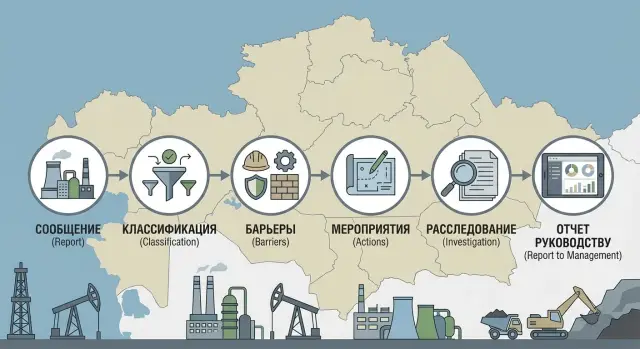
Goal: don’t lose the incident and follow through to actions
An HSE incident is not only an injury. It’s any event that has already caused or could have caused harm to people, property, the environment, or the process. If such cases live in emails, chats and spreadsheets, they are quickly lost: no unified status, unclear ownership, and findings don’t turn into actions.
A single system typically records different case types: injuries and first aid, near misses, environmental incidents (spills, emissions, waste), technical events (equipment failure, fire safety), and violations of HSE requirements without consequences but with risk.
When HSE incident tracking in one system is set up properly, management doesn’t have to chase details manually. It’s visible what happened, how serious it is, which barriers worked or failed, which actions are assigned and what is already closed. The main result is fewer repeats: causes are analyzed and measures are completed on time.
This is not an attempt to build a corporate methodology or argue terms. Below is a minimal incident card model (event, consequences, barriers, investigation, actions, owners and deadlines) and an example of management reporting without personal data so the process is clear and repeatable.
Minimal model: 6 entities that keep the system in order
You don’t need a complex structure for unified tracking. You need a minimal dataset that links the fact, causes, actions and control.
Six entities of an incident card
| Entity | What to record (minimum) | Why it’s needed |
|---|---|---|
| Event | what happened, location, date and time, site/area/process, conditions | to avoid disputes about facts and quickly find similar cases |
| Consequences | actual and potential: people, equipment, environment, downtime | to understand scale and investigation priority |
| Barriers | what protections should have worked, what did/didn’t work, why | to see weaknesses in protection rather than reduce everything to “human error” |
| Investigation | brief causes (direct and systemic), conclusions, confirmations | so decisions are based on causes, not impressions |
| Actions | what we change: engineering/process/training/control, expected effect | to turn findings into a work plan |
| Owners and deadlines | task owner, completion date, acceptance criterion | so the incident doesn’t stall and you can follow up effectively |
Statuses that make control possible
Four statuses are usually sufficient: Registered, In progress, Verification, Closed.
Transitions should be formal. A card may not be closed until actions are completed and verification is confirmed (for example: photo, certificate, training record or audit result).
What an incident report should look like (simple form)
The report should be fillable in 2–3 minutes. If the form is long, people postpone it and the unified register becomes “we’ll sort it later”. At the start you need a single card without duplicates in chats and emails. The simple goal: record the fact, assess urgency and start a response.
Minimum fields that usually suffice:
- Short description: what happened and what was being done at the time.
- Urgency: is there an immediate threat to people, equipment or the environment.
- Where and when: site, area, shift, date and time.
- Type: injury, near miss, spill, fire situation, barrier breach, etc.
- Hazard source: transport, electrical, chemical, work at height, tool.
Attach photos or documents to the card if useful, but without personal data: no full names, ID numbers, large close‑ups of faces, medical records. If details are needed, document them separately in an internal memo outside the card.
Escalation should be automatic. For high severity, notify the duty manager, HSE and security. For low severity, notifying the supervisor and HSE is usually sufficient.
Do not collect extra information at the first step: “who’s to blame”, detailed causes, long explanations, damage estimates before confirmation, or a list of all witnesses. These data appear during classification and investigation.
Classification and severity without arguments
Disputes about severity often start from vague phrases like “almost nothing” or “could have been worse”. In a unified register it’s better to separate two dimensions right away: actual harm and the potential scenario if protections had failed.
A practical option is a 3x3 matrix. On one axis actual consequences (no harm, minor harm, serious harm), on the other axis potential (low, medium, high). The final level is the higher of the two. This way a near miss isn’t zeroed out, and a minor injury isn’t inflated to a catastrophe.
To speak the same language, fix short definitions:
- First aid: on‑site help without medical facility and without loss of shift time.
- Medical treatment: clinic visit/treatment without loss of working capacity.
- Lost time injury: missing at least one shift for medical reasons.
- Property damage: repair/replace cost above an agreed threshold.
- Environment/fire/equipment failure/non‑compliance: separate categories even if no injury occurred.
Rule for statistics: one “primary” classification per card. If there is both an injury and a fire, choose the primary by the most severe consequences and record others as related events.
Who approves: the reporter sets a preliminary rating; HSE (or a commission) finalizes it after an initial check and before investigation starts. Change classification only when new facts appear (medical report, clarified damage, inspection results) and record the reason and date in the card.
Barriers: record not only the fact but the protection
A barrier is something that should stop the hazard before it becomes an incident. It can be a physical protection (guardrail), a rule (permit to work) or a worker habit (check lockout before starting). Without barriers the card becomes a case description, not an improvement tool.
For recording, separate barriers by simple types: technical (equipment, sensors, guards), organizational (procedures, permits, training) and human factors (attention, fatigue, following instructions). They work together in reality. It’s important to note the exact element that should have intercepted the risk at the critical moment.
When linking barriers to the incident, focus on two questions: which barrier was missing and which barrier existed but was weak.
Example: in a finished goods warehouse a forklift nearly hit a pedestrian. The “lane separation by marking” barrier existed but was worn and unreadable. The “physical guard at the turn” barrier did not exist.
Barrier checks should be based on facts: site inspection, patrol logs, equipment settings, currency of procedures, PPE issuance records, training records. This quickly removes “it was probably there” disputes.
In the system, mark each barrier with the same options:
- Worked
- Partially worked
- Did not work
- Not applicable
That way you see not only consequences but the quality of protection and can more easily convert findings into concrete actions.
Investigation: a short and clear cause analysis
Investigation is not about finding who’s to blame but about understanding what failed in the protection and which decisions will prevent a repeat. When the incident is managed in one system, the analysis is simpler: facts, causes and actions live on the same card and don’t get lost in chat.
A minimal set of causes is convenient to record in three layers:
- Immediate cause: what directly led to the event here and now (e.g., slippery surface and no warning).
- Systemic cause: why the protection failed (no floor inspection procedure, no cleaning schedule).
- Management cause: what in management prevented the system from working (no resources assigned, execution not controlled, safety not in KPIs).
To avoid accusations, ask questions about actions and conditions:
- What happened step by step and in what order?
- Which barriers should have worked and which actually did?
- What changed before the event (people, equipment, weather, schedule)?
- If you ask “why” five times (5 Whys), where is the root?
- What needs to change so the risk is lower, not just “have a talk”?
Store evidence so it can be verified without personal data: site photos, zone plans, equipment parameters (speed, pressure, temperature), timestamps, extracts from logs, witness statements without names (role and shift).
A good conclusion reads as a verifiable statement and leads to action. For example: “The unloading zone had no visible lane separation, so a pedestrian entered the vehicle path.” That produces concrete actions: paint markings, install a barrier, update routing and assign checks.
Actions: turn conclusions into a work plan
After investigation it’s easy to get the right words and change nothing. Therefore actions on the card must be a short work plan, not generic promises.
A good action answers five questions: what to do, where, who will do it, by when, and how to verify the result. If you can’t verify the result, you can’t honestly close it later.
Two layers usually help:
- Immediate measures: reduce risk now (cordon the area, stop work, replace a damaged tool).
- Corrective measures: remove the root cause (redesign the process, change the procedure, add training, replace equipment).
To keep the plan focused, link each task to a specific cause and a gap in a barrier. Simple test: “Which barrier will be stronger after this?” If there’s no answer, the task is probably unnecessary.
Prioritize by risk and repeat probability: first address things that can lead again to injury or major damage.
Describe verification methods in advance, for example:
- site inspection and photo evidence after installation
- spot checks of compliance with the new step
- area audit after 30 days
- metric: zero repeats of similar events in the period
Example: a near miss in the warehouse due to faded markings. Immediate — restrict traffic and place temporary cones today. Corrective — apply permanent markings and change traffic routing. Effectiveness — check by walkthrough and short shift survey after two weeks.
Owners and deadlines: so the incident doesn’t stall
An incident must have a clear owner. Otherwise it becomes chat: “handed to the service”, “waiting for a reply”, “we’ll check later.”
Roles that keep the process moving
Four roles are enough:
- Initiator: reports the fact and attaches minimum data (where, when, what happened).
- Incident Owner: takes the card through to closure (assigns investigation, agrees conclusions, launches actions).
- Investigator: performs the cause analysis and drafts conclusions.
- Approver: confirms the investigation quality and closure criteria (usually area manager or HSE coordinator).
An action owner is not required to be “the guilty person”. They are the owner of results: someone with authority and resources to implement the change (install a guard, update training, revise the forklift route).
Deadlines and statuses: no ambiguity
For each action record three dates: planned (agreed), forecast (if moved) and actual (when completed). If overdue, select a reason from a short list (awaiting delivery, contractor dependency, production stop, budget approval), not just “didn’t make it”.
“Closed” means not just “work done” but “result verified”. For example: photo of the installed barrier, recorded training, test report, updated procedure. Closure is confirmed by the incident owner or the approver, not the executor.
Keep a change log: who and when changed key fields (severity, causes, deadlines, status) and what they changed. This protects both the team and leadership: you can see where decisions were made and where delays occurred.
Step by step: from report to closed investigation
The process should move the incident through clear statuses so the system doesn’t become an archive of notes. The most important things happen in the first minutes: record the event and remove the risk, then fill in details.
A common workflow:
- Registration: briefly describe the event, place and time, note immediate safety actions (stopped work, cordoned area, called the responsible person).
- Fact collection: conditions, participants by role (no names), photos/evidence, initial classification and preliminary severity.
- Barrier check: which protections should have worked (training, guard, lockout, PPE) and what failed.
- Investigation: confirm causes based on facts, agree conclusions with area leader and HSE.
- Action plan: create actions, assign owners and deadlines, state expected effect (which barrier we strengthen).
A card should not close automatically. Require verification of completion (evidence: act, photo, training record) and an effectiveness check later: did the risk actually decrease or does the problem repeat?
Example: a pallet shifted during handling in the warehouse. Immediate: stop the area and replace the damaged pallet. Investigation found no lane marking and no pallet checks. Actions: mark lanes, add a pre‑shift pallet check, train forklift drivers, deadline — 10 days, control — review near miss stats in one month.
Common mistakes that break the system
A frequent cause of failure is turning the register into bureaucracy. People avoid reporting, and investigations become formalities.
-
Collecting personal data where it’s not needed. For analysis use role or unit (“contractor driver”, “shift A operator”), not names or IDs. The less sensitive data, the higher the trust.
-
Vague descriptions. “Slipped” or “almost crushed” don’t help prevent a repeat. Need facts: place, time, conditions (weather, lighting, load), what exactly happened and how it could have ended.
-
Mixing causes and actions. Cause explains why it happened (e.g., “unmarked unloading zone”, “speed limiter not working”). Action is what changes the system. Punishing a person is almost never a corrective action.
-
Not recording barriers. If you don’t record which protections should have worked and which did, similar incidents will repeat.
-
Setting deadlines without an owner and resources.
-
Closing the card “by date” without verifying the result.
A useful checklist before closing:
- every action has an owner and confirmed resources
- there is a described way to measure effectiveness (audit, observation, barrier test)
- there is a date for effectiveness check, not only a completion date
- conclusions are separate from disciplinary measures
- barriers updated: what was added or strengthened
Quick quality checklist for an incident card
The card should help action, not just store text. A quick self‑check before sending to investigation and before closing saves time and reduces disputes.
Check basic logic: event as fact (what happened, where, when), consequences in two dimensions (what happened and what could have happened), barriers noted separately. A barrier is not an action. It’s an existing protection that either worked or didn’t (guard, training, lockout, PPE).
Keep two classification versions: initial (right after reporting) and final (after investigation). If level or type changed, the reason must be clear: new facts, clarified effects, or confirmed barrier failure.
The quality of the action plan is visible in details. Each action should have one owner, a concrete deadline and a verifiable acceptance criterion (for example: “zonal marking implemented and repeat briefing done, confirmed by act/training list”).
The card must be data‑safe: no names, phone numbers, ID numbers, photos with readable badges or faces. Overdues must be explained and agreed. Before closing there must be a note on effectiveness: what was checked and how you verified that the measure reduces risk.
Short self‑check before status “Closed”:
- Mandatory fields are filled and consistent (event, consequences, barriers).
- There is initial and final classification; reason for change is clear.
- Actions have owner, deadline and acceptance criterion.
- No personal data in text or attachments.
- Overdues are explained and agreed.
- Effectiveness check done and noted in the card.
Example scenario: near miss in logistics
In a warehouse, while moving equipment on a trolley, a forklift driver began a turn in a narrow aisle. The trolley tilted and nearly struck a rack. There was no impact, no injuries, but the situation could have resulted in a load fall.
Record such a near miss without names so the report does not become a blame exercise. The card needs facts and conditions only.
- Event: “Near collision of forklift with a trolley during a turn in the aisle between racks; load on trolley shifted.”
- Potential consequences: “Load fall, foot/hand injuries when trying to steady load, rack damage, stoppage of work in the area.”
- Barriers (expected): “route markings and one‑way lanes, speed limits, driver training, pre‑shift equipment check, mirror/alarm in blind spot.”
- Actual barriers: “marking partially worn, speed not enforced, mirror missing, equipment check not recorded.”
Analysis often reveals organization issues: crossing routes, weak speed control, cluttered aisles, worn trolley wheels, rush due to shipping schedule.
Make the action plan short and measurable:
- Update traffic scheme and repaint aisle markings, deadline: 7 days, owner: warehouse manager.
- Introduce speed control (observation points/spot checks), deadline: 14 days, owner: HSE coordinator.
- Inspect trolleys and forklifts with entries in the log, deadline: 3 days, owner: mechanic.
- Run an unscheduled briefing on maneuvering in narrow zones, deadline: 5 days, owner: shift supervisor.
Close the investigation with evidence (photo of markings, inspection logs, training protocol) and a short on‑site observation after 2–3 weeks to ensure the new rules work.
Example of management reporting without personal data
Below is a one‑page example for regular oversight. It shows how HSE incident tracking can look in a single system without names, shifts or specific executors.
Summary for the period (example: January 2026)
| Metric | Value | Comment |
|---|---|---|
| Total incidents | 18 | +3 vs previous month |
| Near miss | 9 (50%) | share increased — sign of better reporting |
| Injuries (LTI) | 1 | minor injury, no hospitalization |
| High potential cases | 2 | both transport related |
| Repeat cases | 4 | same scenarios repeated in 2 units |
| 3‑month trend | +12% | increase due to near misses, injuries stable |
Top causes and weak barriers (aggregated)
Top‑5 causes: 1) breach of work order, 2) haste and distraction, 3) insufficient zone checks, 4) wear/failure, 5) unclear roles at shift handover.
Top‑5 weak barriers: 1) pre‑shift checks done formally, 2) incomplete markings and guards, 3) permit checklists don’t cover real risks, 4) training exists but skills aren’t tested, 5) contractor control irregular.
Action status (all investigations): completed 11 (52%), on time 6 (29%), overdue 4 (19%), critical overdue 2 (over 30 days).
Critical overdues: install physical separation of pedestrian and vehicle flows in area 3; replace worn lifting slings after inspection.
Decisions needed from leadership:
- confirm funding for barriers/marking and allow one shift stop for installation;
- enforce the rule: high‑potential incidents are closed only after on‑site barrier verification;
- approve a unified pre‑shift check standard with spot quality checks.
Use depersonalized terms in text: “area employee”, “contractor”, “warehouse terminal”, “time of day”, “equipment type”. No names, badge numbers or specific shifts.
Next steps: how to launch one system and lock the process
Start with the minimum so a unified register works in 2–4 weeks. First agree on the goal: every incident should go from report to closed actions.
Implementation start: the absolute minimum
Define simple roles (reporter, area manager, HSE, investigator, approver) and a short procedure: response times, who assigns investigations, how actions are closed. Then configure the card with minimal fields and run a short 30–40 minute training.
A good starter set:
- mandatory card fields (event, consequences, barriers, actions, owners, deadlines)
- unified statuses (new, in progress, investigation, actions, closed)
- rules for deadlines (e.g., initial assessment within 24 hours)
- report template without personal data
- a channel for reports (form, email or service desk)
Platform and integrations
Choose a platform on practical criteria: single database, role‑based access, change log, search and reports by status and overdue items. Integrate only where it saves time: email notifications, task creation in a service desk, unified site reference data.
Run a pilot on 1–2 sites (for example, a warehouse and a production area), collect feedback and fix a standard: same statuses, same deadlines, same reports. Then scale without special rules for each unit.
If you need a reliable IT base for such a system (servers, workstations, support and integrations), consider engaging a system integrator. For example, GSE.kz (gse.kz) as a vendor and integrator in Kazakhstan can help with infrastructure and support so incident tracking does not depend on scattered files and manual setups.
Frequently asked questions
What counts as an HSE incident besides injuries?
HSE incident — any event that has already caused or could have caused harm to people, property, the environment, or the process. This includes injuries, first‑aid cases, near misses, spills, fire situations, equipment failures and HSE rule violations even if there were no consequences but the risk was real.
When should an incident be registered — immediately or after clarifying details?
Report the incident as soon as you have secured safety: stopped work, cordoned the area, called the person in charge. Log the fact in the system within a few minutes; add details later during collection and investigation.
Which fields in the incident card are mandatory so the form doesn’t become a "wall of text"?
Keep it short: a brief description, place and time, type of event and urgency. Add conditions and source of hazard so the case can be found and compared. Other fields like causes and damages are better filled in after the initial check.
Which statuses are needed and why shouldn’t a card be closed just by the date?
Four statuses are usually enough: Registered, In progress, Verification, Closed. A card must not be moved to “Closed” until actions are completed and their results are evidenced. This prevents incidents being "closed by date" while the risk remains.
How to quickly and uncontroversially determine incident severity?
Separate actual harm and the potential scenario if protections had failed. A simple 3x3 matrix works well: actual consequences (none, minor, serious) versus potential (low, medium, high). Take the higher of the two as the final level — so near misses aren’t treated as zero and minor injuries aren’t inflated to a catastrophe.
How to keep records without personal data and still not lose investigation meaning?
Record only what’s needed to understand the situation and take action, without names, ID numbers or medical documents. Photos and attachments should avoid readable badges and close‑ups of faces. If personal details are necessary, store them in a separate official document outside the incident card.
What are "barriers" and how to record them correctly in the card?
A barrier is a protection that should stop a hazard before it becomes an incident: a guardrail, procedure, permit, training, lockout, PPE or a control. In the card, specify which barrier should have worked and what actually happened: worked, partly worked, or did not work. This focuses work on strengthening protections instead of blaming people.
Who should be responsible for investigation and actions so nothing stalls?
Four roles are enough: Initiator reports the fact, Incident Owner drives the card to closure, Investigator analyzes causes and draws conclusions, Approver confirms investigation quality and closure criteria. The action owner should be someone with authority and resources to deliver the change, not the person at fault.
What evidence is needed to confirm actions and close an incident?
Each action should state the task, location, owner, deadline and an acceptance criterion. Closure must be supported by verifiable evidence: photo of installed barrier, act, training record, or test/audit result. If the criterion can’t be checked, the card shouldn’t be closed honestly.
What does a management incident report without personal data look like and what to include?
One‑page summary: number of incidents, share of near misses, high‑potential cases, repeat occurrences, status of actions and overdue items. Show top causes and weak barriers in aggregate, without names or shifts. Finish with 2–3 decisions needed from leadership, for example budget for barriers or requirement to verify high‑potential incidents on site.
