7 min read
Confirming Equipment Origin in Procurement: How to Write Technical Specifications
How to state proof of equipment origin in procurement neutrally: examples of technical-spec wording, list of checks and a non-discriminatory checklist.
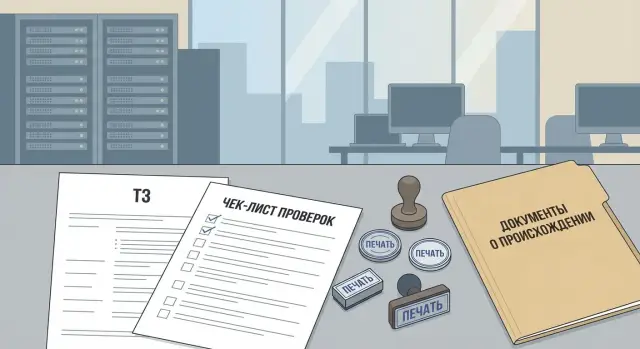
What the problem is and why wording matters
The contracting authority requests proof of equipment origin not out of curiosity. The usual, practical goals are: to receive goods with a required level of local content, reduce supply and service risks, comply with internal rules or procurement regulations, and sometimes obtain entitlement to preferences.
The problem starts when the desire to buy local turns into conditions that close the market to most participants. This happens when the specification says 'only manufacturer X', 'only factory in this city', 'only with a contract with a specific distributor', 'only a specific model', or requires documents that in practice only one supplier can provide.
A good outcome is not measured formally. It happens when you actually receive a local product while competition remains fair: several participants can prove compliance with clear and comparable documents, and the commission's decision is easy to explain and defend.
Neutrality most often 'breaks' in four places: the description of the procurement subject (when origin is mixed with brand or design), document requirements (when 'unique' certificates are demanded instead of verifiable facts), evaluation criteria (when points are awarded for features unavailable to most), and acceptance (when new checks are suddenly introduced that were not in the specification).
A practical example: the buyer wants locally produced computers for an office network. If you immediately require 'a certificate of only this specific type' or 'a letter from the sole factory', many honest suppliers will be excluded, even if their product is genuinely local. If you instead describe what will count as proof of origin and how it will be checked, the market stays open and the risk of a 'relabelled' product decreases.
In Kazakhstan some manufacturers have official statuses and production certifications. Even then, wording should allow other participants to confirm origin with comparable evidence.
What exactly are we confirming: origin, assembly or localization
Confusion usually occurs when one requirement tries to 'catch' everything at once: country of origin, assembly fact and share of local work. For a non-discriminatory approach, decide in advance what exactly you need to confirm.
Three concepts you must not mix
Country of origin — a legal concept: where the product is considered produced under rules of origin (often depends on sufficient processing or a change of HS code).
Place of assembly — narrower: where a device was physically assembled. This can be simple assembly without the legal status of 'produced'.
Localization (local content) — the share of local materials, labor and services confirmed by a specific national methodology.
In practice, when contracting authorities say 'domestic manufacturer', they often mean a producer with a confirmed national status and the right to supply the item as domestic for procurement purposes, not merely the place of assembly.
What to require: documents or the product
It is safer to separate requirements into two groups:
- For the product: characteristics, configuration, warranty, service, delivery times.
- For confirming the status: documents that show origin or localization according to the chosen criterion.
A common mistake is to 'sew' origin into product characteristics. Requirements like 'CPU only from country X' or 'motherboard produced locally' often turn origin checks into hidden competition limits. If local content matters, make it a separate criterion with a clear verification method, not a list of required components.
Simple scenario: you procure PCs for a school and want to support local manufacturers. In the specification it's better to state separately that the participant confirms the product's domestic status under applicable rules, while keeping the technical part neutral (performance, ports, warranty and regional service). That way you can compare offers fairly without replacing origin with a list of 'approved' brands.
Types of evidence found on the market
Suppliers usually provide a set of documents rather than a single paper, and that's normal. Different documents prove different things: country of origin, manufacturer, supply channel, or a specific batch.
Common items include:
- certificate or declaration of origin (if applicable)
- conformity certificates and declarations (these do not always concern origin but link the product to manufacturer and model)
- a manufacturer or authorized distributor letter about origin and supplier status
- invoice, packing list, waybill, contract specification (model, part number, manufacturer)
- product passport, warranty card, manual with manufacturer data and markings
A manufacturer letter or supplier declaration is appropriate where formal origin documents do not exist or are not required. Prefer to accept such letters together with verifiable identifiers: manufacturer details, exact model, country of manufacture, batch numbers, and a contact for verification.
Serial numbers and markings provide additional support. They connect the claims in the application with what is actually delivered: serial on the case, label, matching model and part numbers in documents, batch numbers in shipping papers. If delivery is in multiple batches, record that up front to avoid mixed shipments.
If you use registries and local-producer statuses, treat them as one source among several. Do not make a registry the only filter: allow equivalent documents and specify which fields must match (manufacturer, model, place of manufacture, date of registration, validity period).
Neutral wording examples for technical specifications
A strong specification does not 'guess' the supplier. It states the fact to be proved and how the buyer will verify it. Then origin checks act as a compliance and quality filter, not a market limiter.
Below are neutral phrasing examples:
- 'The participant shall provide one or more documents confirming the country of origin of the goods and the manufacturer (name, model/part number), as well as a link to the supplied batch (serial numbers or other identifiers).'
- 'Equivalent documents issued by the manufacturer, an authorized representative or a competent body are allowed, provided the document contains information sufficient to verify origin and identify the goods.'
- 'When supplying under a private label, the participant additionally confirms the actual manufacturer and the production/assembly site.'
- 'If local content/localization is claimed, the participant provides documents confirming the status of a local manufacturer and the address of the production site on the territory of the Republic of Kazakhstan (or another criterion specified by the buyer).'
- 'The buyer may request clarifications on provided documents and/or additional evidence if the data are contradictory or do not allow unambiguous identification.'
To define 'equivalence' correctly, specify verifiable fields rather than the certificate name. For example, a document should contain: (1) manufacturer, (2) country of origin, (3) model, (4) document details and signature/seal or electronic verification, (5) link to the batch (serial numbers, shipping documents, specification).
On validity periods, write simply: 'Documents must be valid on the date of bid submission' or 'issued no earlier than N calendar days before submission, if the document has no expiry'. For certificates and statuses you can add: 'valid on the date of supply and acceptance.'
Phrases to replace because they often look discriminatory:
- 'Only from registry X' -> 'from registry X or an equivalent source confirming the same information.'
- 'Only certificate Y' -> 'certificate Y or another document containing the same mandatory fields.'
- 'Only a specific country/factory/brand' -> 'requirements to confirm country of origin and product identification, without specifying a brand.'
Step-by-step approach: how to embed origin checks into procurement
Origin checks work better when integrated into the process rather than added at the end. This reduces disputes, supply risk and helps comply with local-content reporting.
Five steps that usually suffice
-
Record the purpose of the check in documentation: preferences, internal control, reduced dependency on supplies from certain countries.
-
Define the subject of the check: country of origin, specific manufacturer, place of manufacture/assembly, or localization (for example, local manufacturer status). Do not mix concepts in one requirement if they are verified by different documents.
-
Describe acceptable evidence as a set of options rather than a single document. Add acceptance criteria up front: validity, model match, serial numbers (if applicable), manufacturer and unambiguous link to the batch.
-
Spread checks across stages: submission (minimum set), contract (clarifications), delivery (batch labeling and documents), acceptance (match claim to fact).
-
Specify consequences for non-conformities: request clarifications and a deadline for correction, replacement with an equivalent item, or rejection under procurement rules if not fixable.
Short example
For PCs and servers you can require confirmation for each line item separately. For workstations, manufacturer documents and place-of-manufacture data may be enough; for servers it is reasonable to additionally check serial numbers and batch conformity.
Checks when evaluating bids: without unnecessary formalism
At the bid evaluation stage the task is simple: ensure documents relate to the offered equipment and are verifiable. Evaluate usability of evidence, not the volume of paperwork.
Practical minimum:
- Name and model match: the bid, specification and the confirming document should match series, part number and configuration (or it should be clear the document covers the product line).
- Manufacturer identification: full legal name, country, address or site, and document details (number, date, validity).
- Signer and authority: who signed, presence of a seal where applicable, and whether the issuer can be verified via open sources.
- Logic of origin: if 'assembly in the country' is stated, the document should explain what work is done locally and by whom.
- Universal letters check: generic letters 'suitable for tenders' without model, date or contacts are a notable risk.
If you require equipment with local status, describe typical documents from local manufacturers but keep the requirement neutral: accept equivalent documents.
When in doubt, request clarifications without changing conditions or granting advantage:
- ask for explanations to already submitted documents rather than demanding a new package;
- ask concrete questions ('specify which model document No. ... refers to');
- give the same deadline and format to all who have the same omission;
- do not require disclosure of trade secrets unless it was a condition;
- record clarifications in writing and attach them to review materials.
Checks at delivery and acceptance of equipment
At delivery confirm that the goods delivered match what was offered and that batch documents correspond to the fact. Acceptance checks should be practical: verify what can be seen and recorded.
What to check on delivery day
Compare the shipment with the application and its supporting documents. Usually a short set is enough:
- labeling on boxes and devices: model, part number, country of manufacture (if listed), manufacturer data;
- serial numbers: match against waybill and the list in the bid (if numbers were disclosed) or record all numbers at acceptance;
- completeness: power supplies, cables, mounts, documentation, accessories, licenses (if applicable);
- batch documents: waybill, invoice, warranty card, product passports, declarations/certificates if needed;
- visual inspection and basic power-on: no physical damage, device model correctly shown in the system.
If origin is required, acceptance should check the link 'bid — document — actual serial number', not just general statements.
How to record acceptance and handle discrepancies
In the acceptance act and, if needed, the commission protocol, record: name, model, quantity, serial numbers, delivery date, list of documents, outcome of completeness checks and remarks. Note which origin confirmations were presented and which batch they apply to.
Actions for discrepancies should be defined in advance:
- record the non-conformity with photos and an entry in the act;
- notify the supplier within the stipulated time;
- agree on replacement/additional delivery and a final deadline;
- suspend payment for the disputed part until resolved;
- apply contractual remedies for repeat violations.
Warranty and service are important but should not replace origin checks. Verify them separately: term, conditions, service addresses and contact procedures.
Typical mistakes and how to avoid them
Complaints and procurement failures usually happen not because the buyer wants local products, but because wording leaves the market to 1–2 participants.
Common mistake: requiring origin to be proved by 'only one document' with no alternatives. Different manufacturers and importers have different evidence sets. Better to list several options (certificate of origin, registry extract, manufacturer letter with production details, declaration with verifiable fields) and state that any of them is sufficient if verifiable.
Second mistake: rigid reliance on one registry or form that not everyone can access or that doesn't list new models. Instead require confirmation 'from one of official sources' and reserve the buyer's right to request additional information if a model is absent from the registry on the submission date.
Third mistake: substituting origin with 'desired' vendor features. A local office, years on the market or exclusive distributor status do not prove origin and look limiting. Specify service requirements (response time, engineers availability, spare-part stock) separately; confirm origin by product documents.
Another risk: unrealistic deadlines. Asking for updated confirmations within 1–2 days or original documents before final results is impractical. A workable scheme: copies at submission stage, originals and clarifications at delivery.
To avoid wording that 'cuts' the market, check yourself:
- are there at least 2–3 alternative ways to confirm origin?;
- can new models meet the requirement without disqualification?;
- are product and supplier requirements separated?;
- is it clear what is being checked: country of origin, place of assembly or localization level?;
- is there a reasonable deadline for clarifications?
Example scenario: procuring IT equipment without discrimination
An institution buys a batch of PCs and a few servers for a small server room. Internal preference is to take local products where possible, but procurement conditions must not exclude system integrators or vendors with different supply chains.
State the goal in the specification as a need for transparency of origin and the ability to verify delivery by documents and labeling. This sounds neutral: the buyer does not 'appoint a winner' but reduces reporting, service and supply risks.
Example clause to embed a non-discriminatory check (adapt to your procurement rules):
'The participant provides proof of origin of the goods by one or more documents of the participant's choice: (a) a document/certificate confirming production on the territory of the Republic of Kazakhstan (if applicable), (b) a manufacturer letter stating country of manufacture and assembly site with model and part numbers, (c) information about the production site and warranty support in the Republic of Kazakhstan, (d) a document confirming the right to supply from the manufacturer or brand rights holder.
The buyer evaluates documents by criteria: match of model and configuration to the request, unambiguous identification of the goods (part number, model, serial series), availability of manufacturer/contact for warranty claims. Equivalent documents confirming the same information are allowed.'
Keep the procedure simple by splitting checks into two levels.
At the bid stage it is enough to confirm that:
- model and configuration match the request (CPU, RAM, storage, form factor);
- documents indicate country of manufacture or assembly site;
- proof of the right to supply is provided (for integrators or distributors);
- who is responsible for warranty and where service will be provided is clear.
At acceptance usually 2–3 actions suffice: reconcile serial numbers and labeling with documents, check completeness and basic power-on (POST/BIOS, inventory). If local status is important, request copies of promised documents at delivery rather than after the fact.
Short checklist for the buyer
A checklist makes requirements clear to participants and reduces disputes at the commission.
-
Why you need proof of origin: local content, import substitution, financing conditions, supply risk control.
-
What exactly you check: country of origin, place of assembly, local manufacturer status or localization level.
-
How the participant can prove this without a 'single correct' document: at least 2–3 equivalent options.
-
Acceptance criteria tied to facts: the document refers to the declared model, configuration and batch (serial number, batch/shipment number, date).
-
How checks are distributed across stages: submission, contract, delivery, acceptance.
-
What to do in case of non-conformity: deadline for clarification, allowed corrections, grounds for rejection or replacement, who decides.
Separate 'document non-conformity' and 'product non-conformity'. Documents can be correct while a different revision or configuration arrives.
If you procure computers, servers or workstations, ask participants to link confirmations to the specification and, where relevant, to serial numbers. This simplifies acceptance without conflicts or extra requests.
Next steps: preparing the specification and reducing risks
Start with a draft clause about origin confirmation and test it with a simple rule: requirements should verify facts and documents, not lock procurement to one supplier. Participants must understand in advance which papers are needed and at what stage.
Then:
- agree the verification logic with legal and the procurement committee;
- before publishing the procurement, request example document packages from potential suppliers (without discussing price or making promises);
- remove requirements that are hard to meet within realistic timelines;
- describe acceptance clearly: serial number reconciliation, labeling, batch documents, and act preparation;
- set a clear procedure for clarifications: request for explanation within procurement rules.
If nationwide local product and service are important, describe these as support-level requirements (response time, service geography, warranty procedure), not as 'must have an office in a specific city.'
If you want an example of what a local manufacturer's document package in Kazakhstan looks like, you may request samples from GSE.kz and compare them with equivalent confirmations from other participants. This helps tune checks so they remain verifiable without discriminating against the market.
Frequently asked questions
Why can't I just write 'equipment of local production' in the technical specification?
First decide which fact you need: **country of origin**, **place of assembly**, or **localization/local content**. In the specification describe the exact fact to be confirmed and how you will verify it, not the 'desired supplier' by brand, city or a single document.
What is the difference between country of origin, place of assembly and localization?
Country of origin is a legal status defined by rules of origin. Place of assembly is where the device was physically assembled and may not equal legal production. Localization refers to the share of local materials, work and services according to a specific methodology and is documented separately.
Which documents actually prove the origin of equipment?
Usually one or several documents are sufficient if they show the manufacturer, model/part number and claimed origin, plus a link to the shipment (batch/serial numbers). If no formal origin document exists, allow a manufacturer or supplier letter, but require verifiable details and identifiers of the product.
Why does the requirement 'only one type of certificate' often lead to complaints?
Because different models and supply channels are validated by different document sets; a single mandatory certificate often exists only for one participant. Better to list required fields (manufacturer, model, origin, document details, link to batch) and accept equivalent proofs.
How to use registries and local-producer statuses without closing the market?
Write 'registry or an equivalent source that confirms the same information'. Also include a clear scenario for when a new model is not yet in the registry at the time of submission: the buyer may request documents that allow identification of the product and the production site.
How to separate product requirements from origin confirmation requirements?
Requirements for the product are performance, ports, warranty, delivery times and service. Origin confirmation should be a separate block listing document options and verification rules. If you hide origin among component specs, you risk creating hidden competition limits and complicating acceptance.
What to check at the application stage to avoid drowning in paperwork?
On the submission stage check that documents refer to the offered model and are verifiable: matching name/part number, manufacturer indicated, document number and date, and clear logic of origin. If needed, request clarifications to the already submitted documents without changing conditions or demanding a new package.
How to check origin and conformity at delivery and acceptance?
At acceptance, match 'application — documents — actual goods': labeling on box and device, model/part number, serial numbers and batch documents. This helps catch cases where the offer promised one thing but another was delivered, even if general letters look convincing.
What to do if documents contradict each other or the goods do not match the application?
Specify the procedure in advance: record the mismatch with photos and an act, request an explanation within a set time and allow correction (replacement, additional delivery, clarifying documents) if procurement rules permit. If correction is impossible, act according to contract rules (rejection, penalties).
How to accept equipment under a private label and not be mistaken about the manufacturer?
Allow any confirmations that provide the same verifiable facts and require disclosure of the actual manufacturer and production/assembly site. If you refer to common practice among Kazakh manufacturers, you may request example document packages from GSE.kz to compare with equivalent proofs from other participants, but do not make this a mandatory condition for participation.
