8 min read
Commercial ETL vs Open Source Stack: Choosing for Your Needs
Compare commercial ETL and an open source stack for batch, streaming and orchestration, and learn how to estimate TCO and the cost of team support.
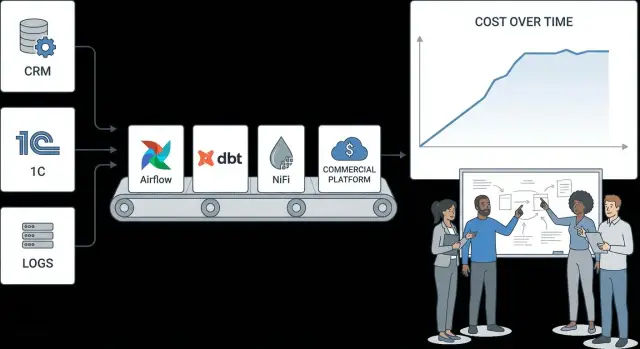
Start by clarifying the problem, not by picking a tool
The debate between commercial ETL and an open source stack often starts with product names: “let’s use Airflow”, “we’ll install a ready-made platform”, “dbt will solve everything.” If you don’t first agree on the problem you are solving, the tool quickly becomes a new source of failures.
Usually the warning signs are simple: reports come late, numbers “don’t match” between marts and Excel, and the team lives with dozens of manual exports and fixes. This is rarely about one bad connector. More often the issue is the process: where data breaks, who notices it, how fast it gets fixed and what counts as the “correct” result.
A sensible goal is stated without jargon: loads must be stable, errors understandable, timelines predictable. Even more important: it should be clear who is responsible for each part of the chain, from source to report.
Before choosing an approach, record constraints. Regulation and audits may require detailed logs and access control. Budget may allow licenses but not headcount. Or the opposite: there’s no budget for licenses, but you have strong engineers. Often the deciding factors are launch timelines and the shortage of people willing to support the system 24/7.
There is a trap almost everyone falls into: “just install the tool” won’t fix data quality. If there is no single reference directory in the source, validation rules are undefined, and schema changes happen without notice, any platform will either silently corrupt data or keep failing.
A practical mini-test: imagine tomorrow a field type changes in a table or a duplicate key appears. What should happen? Where will you see the error, who will get notified, what is the recovery plan, and how fast will the business see correct numbers again? The answers to these questions are the beginning of the right choice.
Key concepts: batch, streaming, orchestration, quality
Before comparing approaches, agree on terminology. Teams often argue about tools while actually discussing different problem types.
ETL and ELT sound similar but differ in step order. In ETL data is extracted, cleaned and transformed before loading into the warehouse. In ELT data is loaded as-is and transformations happen inside the warehouse (usually with SQL). This affects where transformation rules live, who manages them and how easy they are to test.
Batch means scheduled loads: nightly, hourly, or every 15 minutes. Here windows of downtime, recomputation speed and a clear re-run strategy matter. If a step fails overnight, you need to quickly decide: restart only that step or recompute the whole day.
Streaming is processing events almost immediately after they appear. This brings late-arriving events, duplicates, message ordering and latency requirements. Even a simple metric “last 5 minutes” becomes harder than in batch.
Orchestration answers “who and when runs steps, and in what order.” A good orchestrator manages dependencies, retries and pipeline versions, not just script execution.
Quality and observability save production. You need clear logs, timing and volume metrics, alerts on failures and delays, a history of runs and changes, and quality checks (empty fields, duplicates, “yesterday less than the day before”). If you don’t plan this in advance, operations become expensive regardless of the stack.
Two approaches: commercial ETL and open source stack
The difference is usually framed as “convenient” versus “flexible.” In practice the main question is who bears responsibility for the integrity of the solution: the vendor or your team.
Commercial ETL
A commercial platform typically provides a unified interface, ready connectors, built-in data-quality mechanisms, access controls and support with a clear SLA. You pay for licenses, but you buy predictability: less time on assembly and more time on the data itself.
The strength of commercial solutions is covering common cases out of the box: loads from popular sources, scheduling, retries, logging, audit and roles. This is especially important where control and reporting requirements are strict, such as finance or government.
Open source stack (Airflow, dbt, NiFi)
Open source is a constructor kit. Airflow is often used for orchestration, dbt for in-warehouse transforms, NiFi for ingestion and streaming. You choose components that best fit your tech and people.
In such a build you still need components for ingestion, transforms and quality tests, orchestration and scheduling, monitoring and alerts, and a data catalog and documentation.
Complexity often arises not from “writing a pipeline” but from the seams: unified access models, secrets, version upgrades, connector compatibility, observability, on-call duty and meeting promised freshness windows.
Example: a team of 2–3 engineers can start quickly with Airflow + dbt. But if the business requires 24/7 coverage and strict audit, the cost of supporting the stack (on-call, runbooks, upgrades) can approach the price of a commercial product license.
How to choose for batch loads
Batch is most needed where data can be updated on a schedule: loading a DWH, building BI marts, month-end closes, regulated morning reports. Here predictability and control matter more than milliseconds of latency.
Batch typically requires solving four things: incremental loads (to avoid reprocessing everything), retries (so failures don’t break the process), task dependencies (so a mart isn’t built before facts arrive) and backfill (recomputing past days after fixing data or logic).
Commercial ETL usually wins when you need to launch quickly: ready connectors, visual pipeline building, schedules, clear logs, built-in notifications and basic monitoring. This is handy if you have many sources and little time to set up a platform.
Open source is often chosen when flexibility and code control are important. The price of freedom in batch is agreements and standards: how to structure pipelines, where to store parameters, how to test quality, how to monitor and who is on-call for failures.
To decide, look at operations, not popularity:
- how many different sources must be connected in the first quarter;
- how many teams will write and maintain pipelines in parallel;
- how often backfills and historical recomputations are needed;
- observability requirements: alerts, clear failure reasons, SLA;
- who owns the platform and how much time they can spend on support.
If you have 5–7 sources, one DWH and 1–2 engineers, open source may be more cost-effective. If you have dozens of sources, multiple departments and strict reporting deadlines, commercial ETL often reduces the risk of missing schedules thanks to ready components.
How to choose for streaming and near-real-time
Streaming is needed not because it’s trendier, but when the cost of delay is high. Typical cases: risk alerts, anti-fraud, system monitoring, equipment telemetry—situations where reacting in seconds or minutes matters rather than “by morning.”
Streaming is often confused with frequent batch. If updates every 5–15 minutes are sufficient, that is often simpler, cheaper and more reliable than true event-by-event processing. For many business dashboards, near-real-time is effectively “frequent batch plus good orchestration.”
Before choosing, fix requirements that break projects most often: acceptable latency from event to result, whether strict event ordering is required (and in what scope), how you detect duplicates and distinguish retries from new events, whether replay is needed, and what counts as success (an alert, a store write, or a metric recompute).
NiFi is useful as an entry gate in these tasks: it can accept data from many sources, route and buffer it, enrich with simple rules and quickly add integrations without heavy coding. This works well for monitoring event streams or logs where sources are many and changing.
But one tool is rarely enough. You almost always need an event broker (queues and backpressure), raw-event storage and retention rules (how long to keep events, how to delete, how to restore). The stricter latency and audit needs are, the more important it is to count support costs for these components and on-call, not just pipeline development costs.
Orchestration and pipeline management: what matters in practice
Orchestration is not about a pretty diagram but about reliably delivering data every day. If a nightly load fails, you need to quickly understand: what broke, why, who to wake up and how to safely restart.
Airflow is often chosen for orchestration because it handles dependency graphs, schedules and retries well. In production, predictable retries (to avoid duplicates) and backfill (to catch up without manual work) are valued.
dbt usually complements orchestration as the transformation layer: models live in a repo, changes go through code review, tests catch issues before reports show wrong numbers. Documentation and a consistent style make handing work from one analyst to another easier.
Commercial platforms often win on time-to-value: visual pipelines, a single console, roles and permissions, run reports. But the UI isn’t the deciding factor—discipline is: a single way to view statuses, reasons for failures and pipeline owners.
In operations the most important things usually are:
- naming standards for tasks, tables and datasets so you don’t hunt for “load_final_v3_new”;
- clear templates (a typical DAG in Airflow, a standard dbt project) so new pipelines look familiar;
- CI/CD: dbt tests, checks and environment deployments;
- a unified observability surface: alerts, logs, owner, SLA;
- clear rollback procedures and incident decision rules.
If a team runs dozens of integrations in a closed environment (common in government or finance), it’s often more convenient when orchestration, monitoring and access control are gathered in one place, whether running in the cloud or on-prem.
Security, audit and compliance
The choice between commercial ETL and open source often comes down to control: who can do what and can you prove it to auditors.
Start with users. Analysts typically need access only to results and marts, data engineers to code and task runs, admins to infrastructure, and InfoSec to policies, logs and investigations. If the same person can change a pipeline, run it and modify access, auditors will almost always raise questions.
Next: roles and access. Check whether you can restrict access to data (tables, schemas, sensitive fields) separately from task management (run, stop, change schedules), secrets (passwords, tokens, keys) and logs/metadata, and whether you can separate environments (dev, test, prod).
Audit and change tracing matter as much as error logs. It should be clear who changed a pipeline, what changed, when it reached prod and what effect it had: did columns or cleaning rules change?
Updates and patches are a separate area. In commercial platforms the vendor takes on part of the responsibility, but you still need testing, an update window and a rollback plan. Open source gives more freedom but requires stricter discipline: pinned versions, update procedures, a test environment and clear rollbacks.
For government and finance, on-prem deployment and supply-chain transparency are often critical. In Kazakhstan this is especially visible: predictable supply chains and infrastructure control are required. Decide early who is responsible for on-prem deployment, support and hardware—not just the “pipeline tool.”
How to estimate support and ownership costs
Comparing cost by license price alone is almost always a mistake. For an honest TCO you must estimate who will maintain the platform, how much time they spend, and the cost of data downtime.
It’s helpful to split ownership into items and estimate ranges: licenses and support, infrastructure (servers, storage, network, backups), people (salaries, on-call, incident time), training and onboarding, and data outages (fines, lost revenue, missed reports).
Open source is often cheaper up front but more expensive in engineering effort. You need to deploy and update Airflow/schedulers, set up observability, secrets, access controls, CI/CD, test environments, backups and recovery. With 1–2 people, the risk of burnout and a single knowledge holder sharply increases real costs.
Commercial ETL typically reduces assembly and routine support: more ready connectors, UIs and vendor support. But it creates dependency on license terms, scaling limits and migration complexity if the approach stops fitting later.
Hidden costs are easy to forget: InfoSec approvals (audit, logs, segmentation), documentation, test environments, integration with corporate catalogs, and on-call runbooks. In organizations with 24/7 services the cost of a night incident can outweigh a year’s license savings if monitoring and recovery procedures are missing.
Step-by-step plan to pick a stack for your situation
Decide by real data flows and the people who will support them, not by brands.
-
List 10–20 real pipelines and classify them as batch, streaming or mixed. Use actual business flows: 1С loads, CRM syncs, BI marts, app events—not idealized diagrams.
-
Record expectations for time and stability. For each pipeline note SLA, acceptable latency, how often backfills are allowed (e.g., 7 days) and approximate volumes. The same tool may be fine for nightly batch but expensive to operate for near-real-time.
-
Describe data sources and sinks. Where do you get data (APIs, files, databases, queues) and where do you put it (warehouse, marts, BI, ML). Limits often surface here: API quotas, unstable files, access rights, encryption needs.
-
Agree on a base architecture and observability. Minimum: logging, metrics, alerts, retries, run status storage, and a clear audit of changes. Without this, support costs grow faster than expected.
-
Run a short pilot on 2–3 critical cases and compare effort. Count not only “it works” but hours for development, debugging, deployment, adding a new source and handling an incident.
If you are in a bank or government body and must perform daily loads inside your perimeter, run the pilot on your infrastructure from the start, including on-prem servers. In such projects decide who owns hardware, monitoring and 24/7 support—your team or an integrator.
Common mistakes when choosing commercial or open source
The main trap is picking the “most popular” tool and hoping it will fix processes. Commercial ETL won’t help if the team lacks release rules and environment access control. An open source stack won’t fly if no one is ready to run it as a product.
Teams often start with streaming because it seems modern. That adds components, failure points and debugging complexity. If reports are daily and business is fine with that, batch gives simpler support and fewer incidents.
Another common mistake is skipping data quality checks. Initially everything looks fine, then manual report fixes appear and endless “why don’t the numbers match?” questions follow. A basic test set (nulls, ranges, uniqueness, checksum reconciliations) usually pays off quickly.
Lack of ownership hurts too. When pipeline owners aren’t assigned, incidents turn into chat-based detective work: who changed what, where it broke and who will fix it. Agree in advance who owns each mart and who is on-call for failed loads.
Finally, skimping on monitoring yields silent failures for weeks: a pipeline ran but produced zero rows or stale data. To avoid this, define core signals up front: alerts for latency and volume, schedule-miss notifications, error metrics by source, simple freshness dashboards and a run/change log.
These mistakes happen with both commercial ETL and Airflow-dbt-NiFi combos. The difference is where you pay first: license fees or engineering time for support and discipline.
Example scenario: how context changes the choice
Imagine a bank or government body: data from 1С, CRM and user action logs must be consolidated. Some reports are scheduled (daily, weekly, monthly), others are needed nearly immediately for operation control and investigations. The team is small, audit requirements are high and calculations change regularly.
Option A: commercial ETL when speed of launch matters
If the main goal is to quickly set up controls and get a single management center, commercial ETL often wins. It’s easier to configure connectors for typical sources, schedules, alerts and role-based access without long platform assembly.
This choice suits cases where predictability matters: less home-grown infra, easier to hand over to shift teams, simpler to show auditors who ran what. The price is licenses and vendor lock-in. Pilots usually take weeks rather than months.
Option B: Airflow + dbt + NiFi when transparency and collaborative development matter
Open source fits when transforms change often and should be discussed as code. Airflow offers managed orchestration, dbt expresses calculations as readable models with tests, and NiFi helps ingest and route events.
This works well when the team has DevOps experience and code-review discipline. You must invest in monitoring, upgrades, backups, access control and training.
In practice hybrid solutions often win. For example, use a commercial ingestion product for reliable loads from 1С and CRM while doing transformations and marts in dbt. Or NiFi may handle streams while a commercial tool enforces downstream quality.
To compare fairly, agree up front on four metrics: pilot time, weekly support hours, transparency of calculation changes and how the system handles failures (restarts, deduplication, replays).
Short checklist before the final decision
Before finalizing, go through this checklist to verify readiness for real operations.
- Tasks are described as services: what we load, from where to where, frequency, volume and required SLA for batch and near-real-time.
- Process owners are clear: who is responsible for data, who changes transforms, who is on-call for night failures, and what counts as a failure vs acceptable delay.
- Security requirements are documented: roles and access, action audit, secret storage, dev/test/prod separation, encryption and logging rules.
- Ownership costs for 1–3 years are estimated: people, infra, licenses (if any), training, and time for support and upgrades.
- A pilot is agreed: which 1–2 typical flows to test, success metrics (development speed, stability, support effort, clarity of errors) and who approves the result.
If uptime is critical and audits are expected, clarify how this will work in your environment: who stores secrets, how logs are collected, how fast systems can be restored after failure and what happens when a key engineer leaves. These answers matter more than feature lists in presentations.
Next steps: pilot, infrastructure and support
After comparing approaches on paper, quickly validate conclusions in practice. A pragmatic format is a 3–6 month pilot with one or two key marts and a clear business effect—for example, daily sales and inventory reporting.
At the start define a minimal target architecture and rollout plan: 2–3 data sources, one DWH/lake and 5–10 critical transforms; SLO for refresh (e.g., by 08:30 daily or every 5 minutes); quality criteria (reconciliations, deduplication, completeness); pipeline owner and support contact; final decision date.
Then focus on platform reliability fundamentals. Verify that infrastructure and processes are ready for daily operation: compute and storage resources, backups and recovery; monitoring and incident review; release and rollback procedures and update windows; role-based access, audit, secrets management; and development standards (naming, tests, docs, code review).
If your team lacks on-prem experience and 24/7 ops, you can engage an integrator. For example, GSE.kz as a vendor and integrator in Kazakhstan helps deploy servers and run perimeter infrastructure and can organize 24/7 support—useful for projects with strict audit and reporting deadlines.
Frequently asked questions
Where should we start when choosing between commercial ETL and an open source stack?
Start by defining the problem without product names: what are the sources, which marts/reports, how often to refresh, what SLA is required and what counts as an error. After that it becomes clear whether you need fast launch and a single control plane or flexibility and code-level control.
When is commercial ETL truly more beneficial than open source?
Choose commercial ETL when you have many sources, strict reporting deadlines, audit/role requirements and a limited support team. In that case ‘out-of-the-box’ capabilities are more valuable than maximum flexibility because they reduce operational risk.
When is it better to choose Airflow + dbt + NiFi (or a similar combo)?
An open source stack makes sense when you have strong engineers, want transformation logic as code, change calculations often and are ready to invest in operations. It’s especially convenient if you already use CI/CD and need transparent change management.
Do we need streaming or is frequent batch enough?
If the business accepts updates every 5–15 minutes, a frequent batch with good orchestration and alerts is often simpler and more reliable. True streaming is needed when the cost of delay is high and events must be processed almost immediately; otherwise you add components and failure points without much benefit.
What should be considered for reliable batch loads?
For batch loads plan incremental loading, retries that avoid duplicates, task dependencies (so a mart isn’t built before facts arrive) and backfill for recomputing history. If these scenarios aren’t defined, any tool will either silently corrupt data or regularly break scheduled reports.
How do you know data quality and observability are sufficient?
Imagine a field type changed or a duplicate key appeared in a source: where will this be detected, who will be notified and how will you restore correct data? In a good system an error is immediately visible, the cause is clear and there is a safe restart or rollback plan.
What security and audit requirements should we verify first?
Focus on four areas: separation of duties and roles, access control to data and task management, secure storage of secrets, and an audit trail of changes. It must be provable who changed what and when it reached production, and dev/test/prod environments should be separated.
How to compare TCO of commercial ETL and open source correctly?
Count not only licenses but also hours people spend on support, on-call duty, incident handling, upgrades, test environments, backups and recovery, and the business cost of data downtime. Open source is often cheaper up front but costs more in engineering effort, especially for small teams.
How to run a pilot so it fairly shows what suits us?
Run a pilot on 2–3 critical cases and record metrics: development time, stability, time spent investigating failures, and how transparent calculation changes are. Test on your infrastructure with your access and logging requirements; otherwise the pilot will be overly optimistic.
What if we need on-prem infrastructure and 24/7 support but lack internal teams?
Lack of on-prem infrastructure, monitoring, release procedures and 24/7 support is more common than missing a connector. A systems integrator can provide server-side deployment and round-the-clock support; in Kazakhstan such tasks are often handled by GSE.kz together with hardware delivery and support inside the organisation perimeter.
